Shinkansen E-Ticket and Luggage at Tokyo Station: Reserved Seats Explained
Shinkansen e-ticket and luggage at Tokyo Station: how IC card boarding works, which trains are reserved-only, and which line needs a bag reservation.
The short version of the shinkansen e-ticket and luggage at Tokyo Station system: book on Smart EX (Tokaido/Sanyo/Kyushu) or eki-net (Tohoku-group lines), link a registered IC card, then tap that same card at the shinkansen gates — no paper ticket to collect. The one exception: an eki-net booking for the Tokaido Shinkansen is not ticketless, and you still have to collect a paper ticket from a machine. If your train is a Hayabusa, Komachi or Kagayaki, every seat on board is reserved, so turning up without a booking means standing in the vestibule if the train is full. And if you're hauling a suitcase that totals more than 160cm (height plus width plus depth), only the Tokaido/Sanyo/Kyushu group forces you to book a specific seat for it — the Tohoku-group trains that leave from Tokyo Station's northern platforms have first-come, first-served luggage racks you can just use.
Some links in this guide are affiliate links. If you book through them, we may earn a commission at no extra cost to you.
This guide covers the practical side of catching a shinkansen from Tokyo Station, not the exits and concourses — for that, see our companion Tokyo Station Marunouchi vs Yaesu guide. What follows is what we checked in person at the gates and on the platforms: how the e-ticket machines behave, what "Reserved Seats Only" means, and the one rule that trips up people carrying an oversized bag.
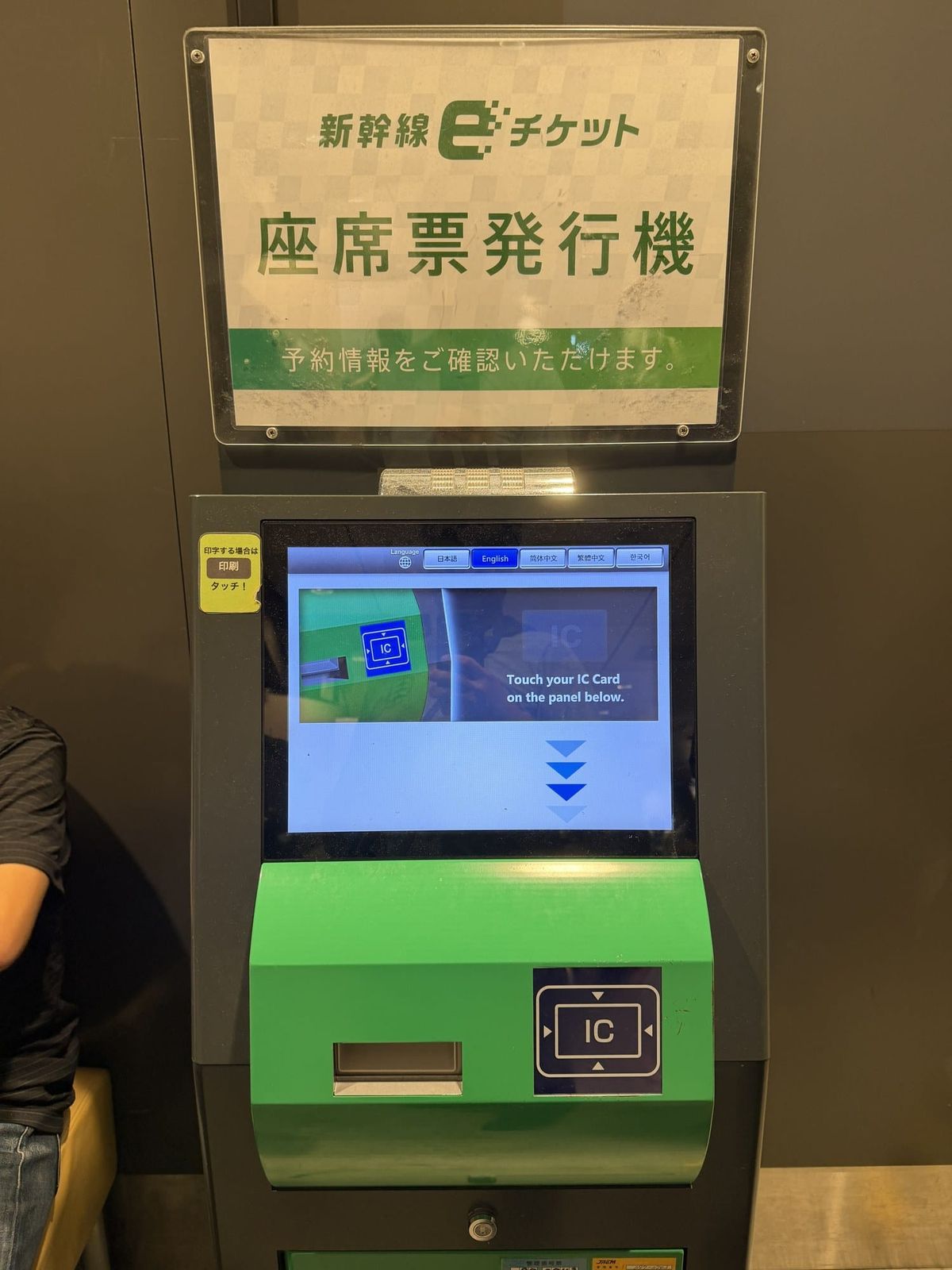
The machine by the gates does not sell tickets — it prints your seat slip
Get this straight before you arrive: the machine looks like a ticket vending machine but cannot sell you a seat. It reads the IC card you already linked to a booking made online and prints a slip with your car and seat. If you have no booking yet, this machine cannot help you: you need the ticket office or a separate ticket vending machine. Its Japanese label says exactly that: zaseki-hyo hakkoki, "seat-slip issuing machine". You do the actual booking beforehand, at home or from your phone: eki-net (JR East's own portal; it can sell Tokaido Shinkansen tickets too, but those cannot be used ticketlessly — you collect a paper ticket at a machine) for the Tohoku, Yamagata, Akita, Joetsu and Hokuriku lines, or Smart EX (run jointly by JR Central, JR West and JR Kyushu) for the Tokaido, Sanyo and Kyushu lines. Both let you register a physical Suica or Pasmo, or a mobile IC card on your phone, against the reservation during checkout.
At the gate itself, you don't need a machine at all if your IC card is already linked — just tap the card on the reader and walk through. That is the whole purpose of the standalone machines by the gates: tap the linked IC card on the panel to confirm the booking and, if you want it on paper, print the slip with your car and seat number. Booking, changing and paying happen in the app beforehand — never here. The machine we used offered five languages — Japanese, English, Simplified Chinese, Traditional Chinese and Korean — with English selected (checked August 2026).
Tohoku-group trains are Reserved Seats Only — what that means if you just turn up
Hayabusa and Komachi carry no non-reserved cars at all, which is a real trap for anyone used to the Tokaido Shinkansen, where Nozomi keeps cars 1–2 unreserved (reduced from cars 1–3 in a March 2025 revision), Hikari cars 1–5, and Kodama cars 1–6 and 13–16 — though JR Central runs Nozomi as all-reserved during peak periods, so even that side is not always walk-up-friendly. The scrolling departure board over Platform 21 lists Hayabusa, Komachi and Yamabiko services in rotation; the Shin-Hakodate-Hokuto-bound Hayabusa showing when we photographed it was tagged "Reserved Seats Only," which is accurate for every Hayabusa working the Tokyo–Shin-Aomori–Shin-Hakodate-Hokuto route.
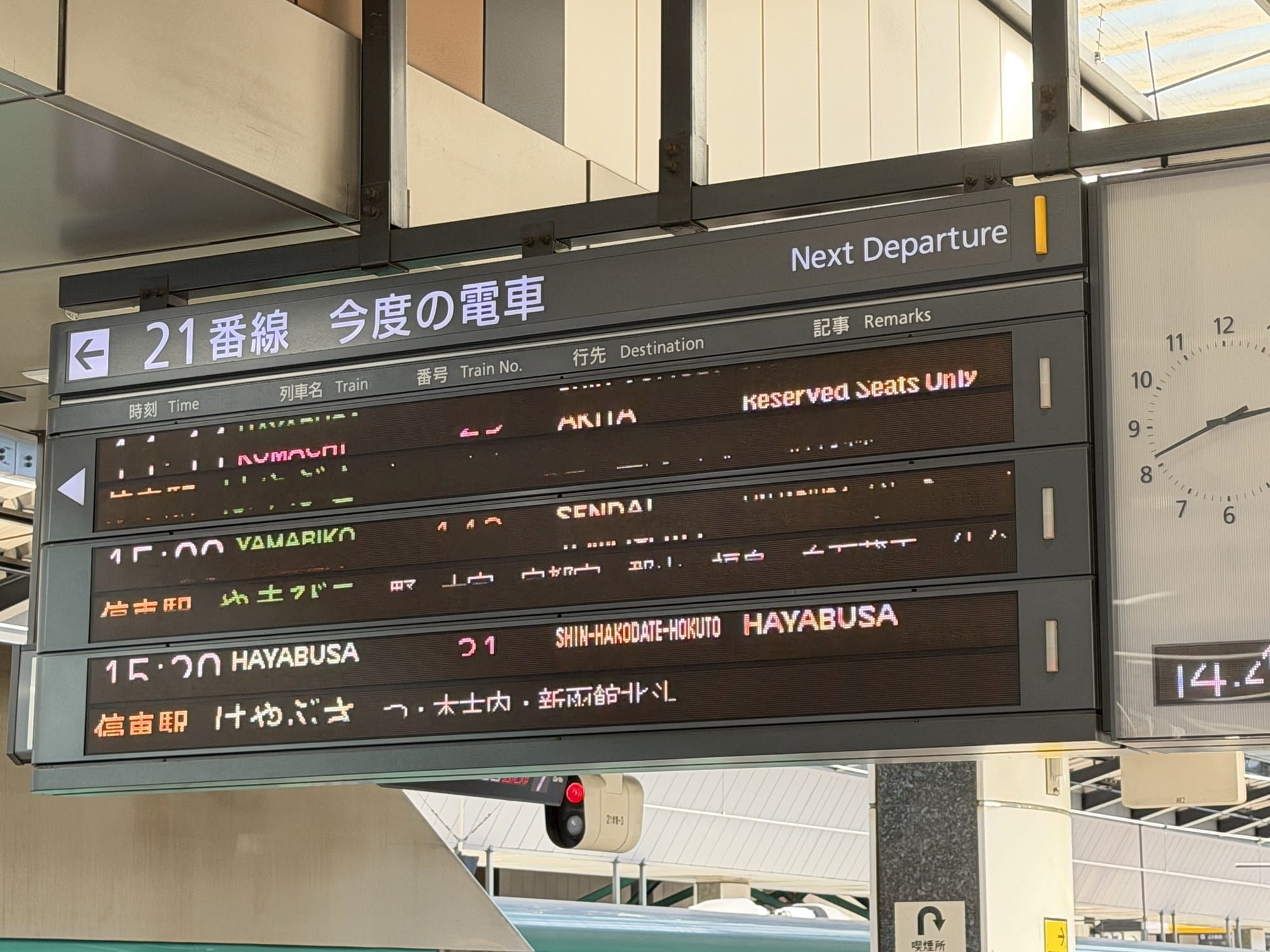
Komachi is the same story: every seat is reserved, and it runs coupled to a Hayabusa between Tokyo and Morioka before splitting off toward Akita. Kagayaki, the fastest Hokuriku Shinkansen service to Kanazawa and Tsuruga, is also fully reserved. Yamabiko is the exception on the Tohoku-group platforms — it does carry non-reserved cars — so check which specific train you're booked on rather than assuming the whole northbound side works one way.
If you show up without a reservation for a Hayabusa, Komachi or Kagayaki, station staff can sell you a standing ticket once seats sell out, but you won't get a seat. Reserving ahead through eki-net or Smart EX is the way to avoid that.
Big suitcases: Tokaido needs a reservation, Tohoku has racks you can just use
Of the two shinkansen networks this guide covers, only one — Tokaido, Sanyo and Kyushu — requires you to book a specific seat for an oversized bag (checked August 2026). The rule applies once a bag's three dimensions (height plus width plus depth) add up to more than 160cm; anything totalling 160cm or less needs nothing, and bags over 250cm cannot be brought on board at all. Most standard airline check-in suitcases fall under the 160cm line, so this mainly affects golf bags, extra-large cases and stroller-plus-car-seat combinations. If your bag totals more than 160cm, you book a "seat with an oversized-baggage area" on Smart EX or eki-net — it costs nothing extra — and your case goes into the space built behind that row. Board with an oversized bag and no reservation on the Tokaido, Sanyo or Kyushu Shinkansen and staff can charge a ¥1,000 fee at the gate.
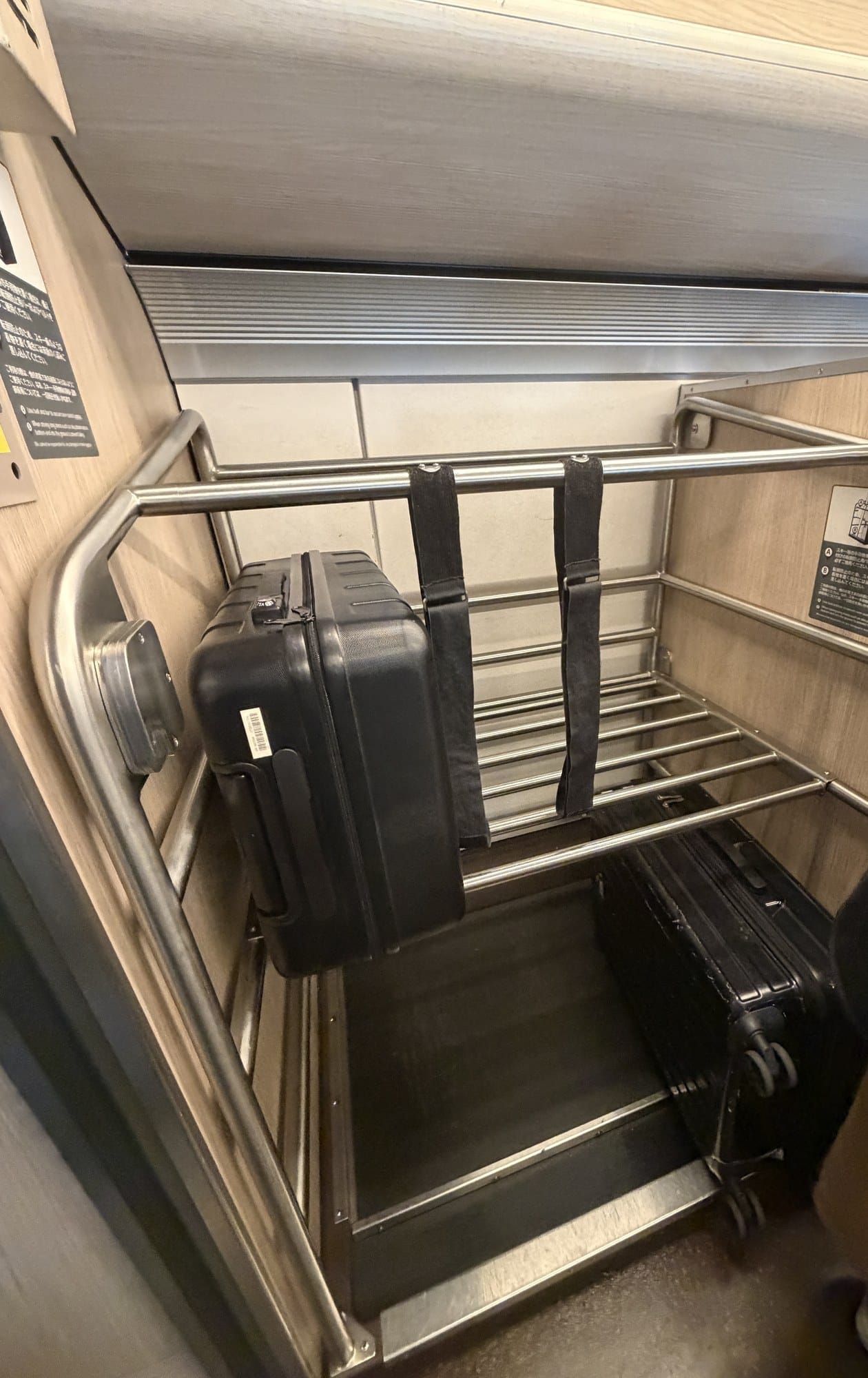
The Tohoku-group trains skip this system entirely. The E5 and E6 series that work the Hayabusa and Komachi carry a belt-strap luggage space in every ordinary car, at the Tokyo end of the cabin (in the Green Car it sits in the deck area). Other rolling stock on these platforms varies, so check your car when you board. There's no reservation to make and nothing to book — it's first-come, first-served, so during peak ski season or Golden Week the racks can fill up, but for most departures there's room.
| Shinkansen group | Named trains | Bag over 160cm (up to 250cm) | Bag 160cm or under |
|---|---|---|---|
| Tokaido / Sanyo / Kyushu | Nozomi, Hikari, Kodama (Tokyo–Nagoya–Osaka–Fukuoka) | Reservation required for a seat with an oversized-baggage area (free to book; ¥1,000 fee if you skip it) | Overhead rack or beside your seat, no reservation needed |
| Tohoku / Yamagata / Akita / Joetsu / Hokkaido / Hokuriku | Hayabusa, Komachi, Yamabiko, Kagayaki and others | Belt-strap luggage space at the Tokyo end of each ordinary car on the E5/E6 series; no reservation, first-come first-served | Same racks, same rule |
For a wider comparison of how Japan's hotel chains handle luggage before check-in and after checkout, see our guide to Japan's major hotel chains.
Which train is which: Hayabusa, Komachi, Kagayaki
The nose shape and paint job tell you which shinkansen family you're looking at before you can even read the sign. Hayabusa runs on the E5 series, green-and-white with a long aerodynamic nose, and is the flagship of the Tohoku and Hokkaido Shinkansen — Tokyo to Shin-Aomori or Shin-Hakodate-Hokuto, fully reserved.
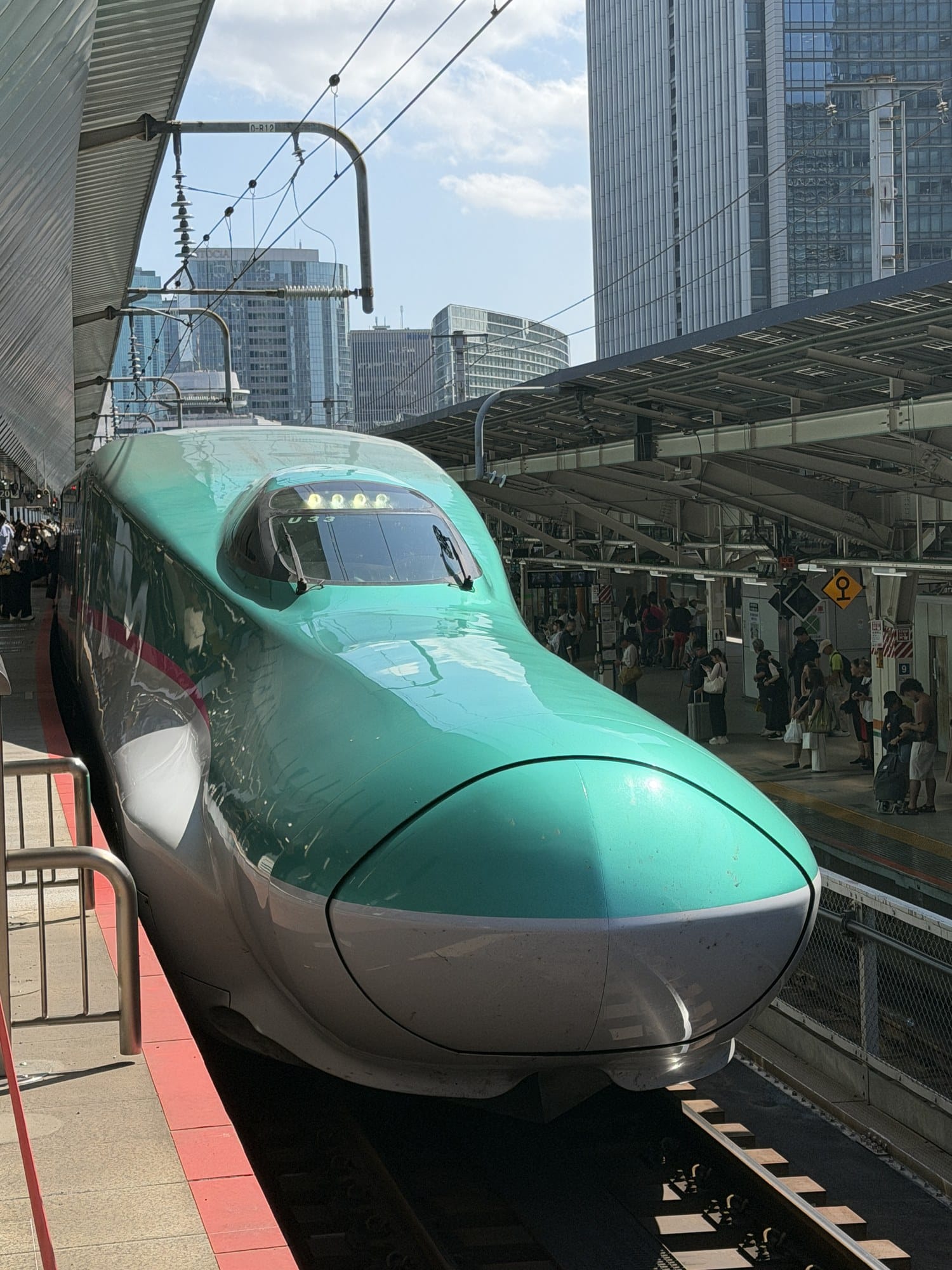
Komachi shares the Tokyo–Morioka stretch coupled to a Hayabusa, then splits off to continue alone to Akita on narrower track. Kagayaki runs the Hokuriku Shinkansen's fastest, most limited-stop service between Tokyo and Kanazawa, extended to Tsuruga since March 2024; it uses the E7/W7 series, identifiable by the blue body with a copper-bronze accent stripe running along the nose.
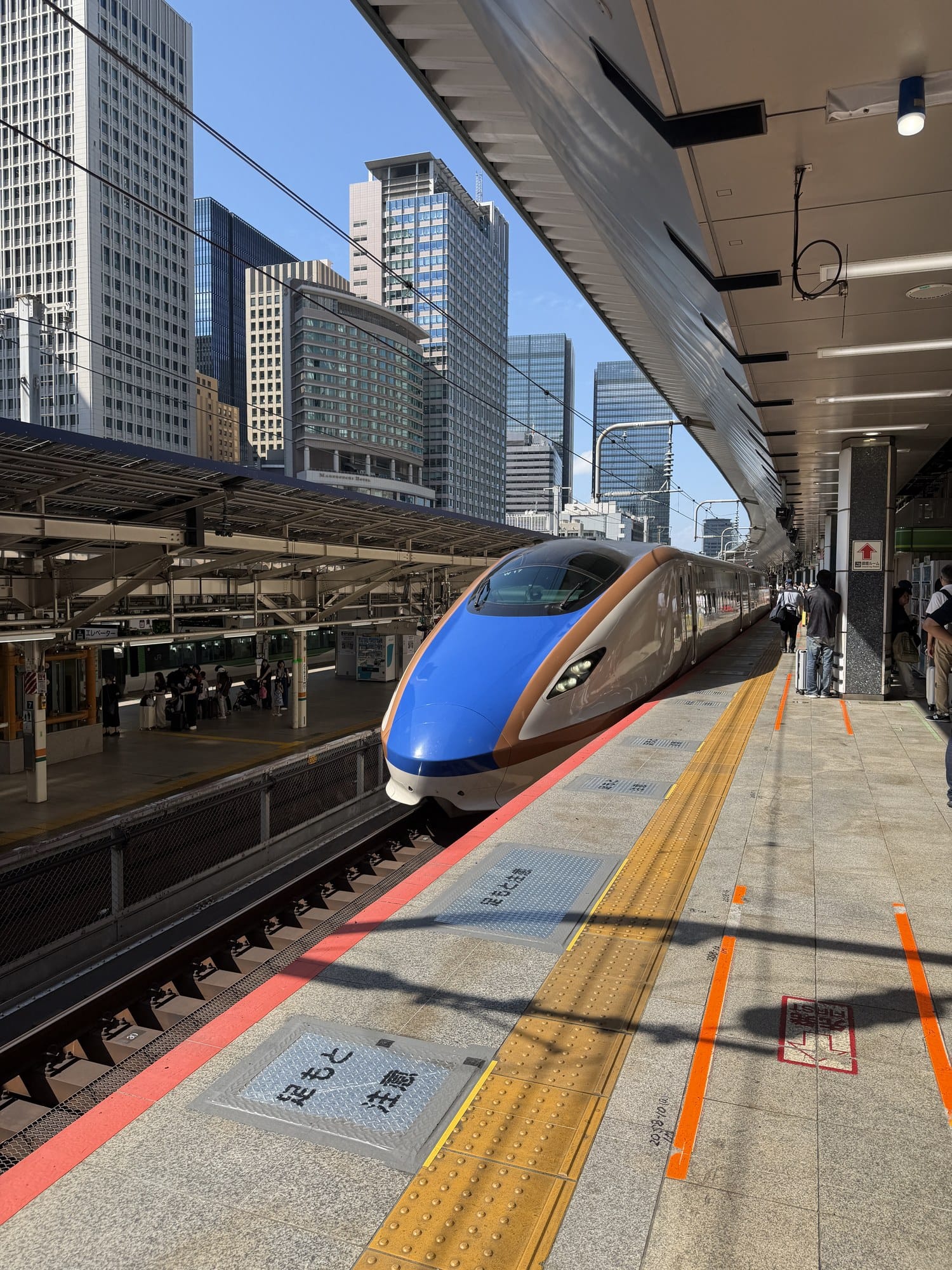
All three — Hayabusa, Komachi and Kagayaki — depart from the same cluster of platforms as the slower Yamabiko services, so match the train name on your ticket to the name on the departure board rather than just the platform number; several different named trains can share a platform across the day. Station guide series: this practical guide sits alongside our Tokyo Station exits guide and the same by-exit approach for Shibuya, Nagoya, Akihabara and Roppongi.
Ekiben: buying lunch on the platform
Tokyo Station's main ekiben counters sit inside the ticket gates on the Marunouchi side, so you don't need to leave the paid area to pick one up before boarding.
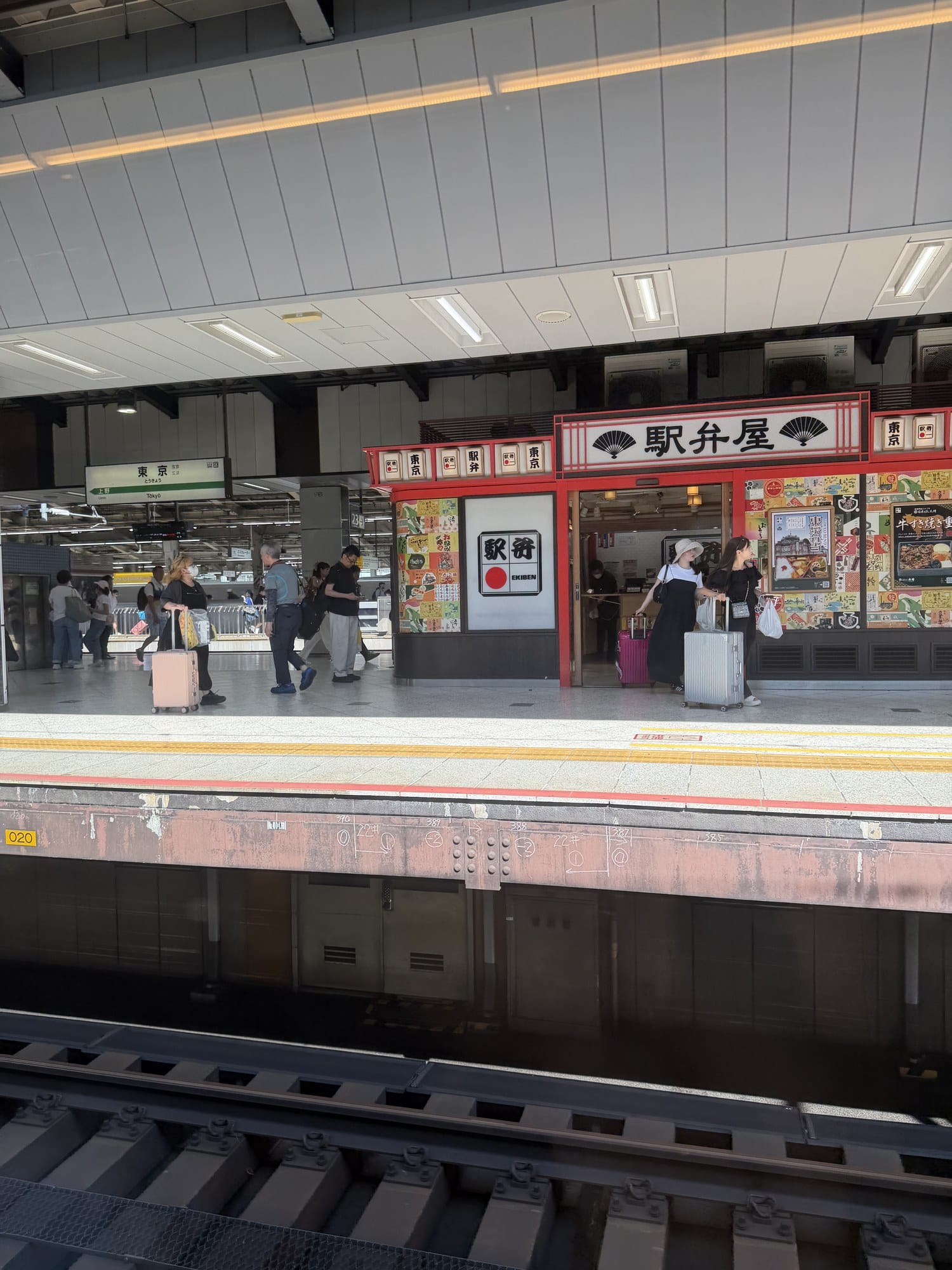
The largest single shop, carrying regional bento from across the country, sits inside the gates on the Marunouchi side; expect it to be busy at lunchtime, so budget extra time if you want to browse rather than grab-and-go. GRANSTA Tokyo, the in-gate shopping concourse on the Marunouchi side, is the second option, with a smaller but higher-end bento selection alongside sweets and souvenirs. Either way, buy on the concourse rather than on the platform — options thin out fast once you are trackside, and none of these services runs a dining car.
If you need a room near Tokyo Station before or after your train
Most travelers passing through Tokyo Station are heading somewhere else, so we're keeping this short: two options actually sit within a reasonable walk if you need a night in the area before an early departure or after a late arrival.
| Name | Area | Price range | Best for |
|---|---|---|---|
| Ascott Marunouchi Tokyo | Marunouchi/Otemachi — 10-min walk to Tokyo Station, direct underground link to Otemachi Sta. Exit C6a | from ¥48,000, varies by season | Serviced apartment with a kitchen, good for a pre-shinkansen night with luggage to repack |
| Mimaru Tokyo Station East | Hatchobori — 14-min walk to Tokyo Station, 2-min walk to Hatchobori Sta. | from ¥38,000, varies by season | Apartment-style rooms with a kitchenette, useful for families or groups despite the longer walk |
Skis are the one big bag the oversized-baggage seat does not catch: packed in a bag they count as sports equipment and are exempt from the reservation on the Tokaido, Sanyo and Kyushu lines, while the Tohoku, Yamagata and Joetsu Shinkansen do not run that system at all. The one rule that applies everywhere is the 250cm ceiling on any single piece. Taking skis on the Shinkansen has the rules by line and what to measure before boarding.
FAQ: Shinkansen E-Tickets and Luggage at Tokyo Station
How does the shinkansen e-ticket system work at Tokyo Station?
You book online through eki-net or Smart EX and link a registered IC card — physical Suica or Pasmo, or a mobile IC card on your phone — to that reservation during checkout. On an iPhone, Welcome Suica Mobile issues one without a Japanese card. At the gate, tap the same IC card on the ticket gate reader and walk through; there's no paper ticket or QR code to keep track of, except an eki-net booking for the Tokaido Shinkansen, which still requires a paper ticket from a machine. If you want a printed reference slip with your car and seat number, the standalone touchscreen machines near the gates can print one after you tap your IC card on the panel.
Do I need a reserved seat for the Tohoku Shinkansen from Tokyo Station?
For Hayabusa and Komachi, yes — both run fully reserved with no non-reserved cars at all, so a booking is the only way to guarantee a seat. Yamabiko is the exception on the same platforms, since it carries non-reserved cars similar to the Tokaido Shinkansen's Nozomi and Hikari. Check the train name on your ticket, not just the platform, before assuming either way.
Can I bring a large suitcase on the Tohoku Shinkansen without booking anything?
Yes. The Tohoku, Yamagata, Akita, Joetsu, Hokkaido and Hokuriku Shinkansen have no oversized-baggage reservation system — on the E5/E6 series that work the Hayabusa and Komachi you use the belt-strap luggage space at the Tokyo end of the car on a first-come, first-served basis, free of charge. This is the opposite of the Tokaido, Sanyo and Kyushu Shinkansen, where a bag totalling more than 160cm requires booking a specific seat in advance or risking a ¥1,000 fee.
Where can I buy ekiben at Tokyo Station before boarding?
The main ekiben shops sit inside the ticket gates on the Marunouchi side, so you can buy lunch after you have already passed the ticket gates and are walking toward your platform. GRANSTA Tokyo, the in-gate, basement-level shopping concourse on the Marunouchi side, is a second option if the counters near the gates are busy. Buy before you reach the platform — selection thins out fast once you're past the main concourse, and none of the Hayabusa, Komachi or Kagayaki services run a dining car.