Taking Skis on the Shinkansen: Rules, Sizes and Which Trains
Skis and boards count as exempt sports equipment on JR trains, but the 160cm oversized-baggage reservation still applies to other bags on some Shinkansen lines.
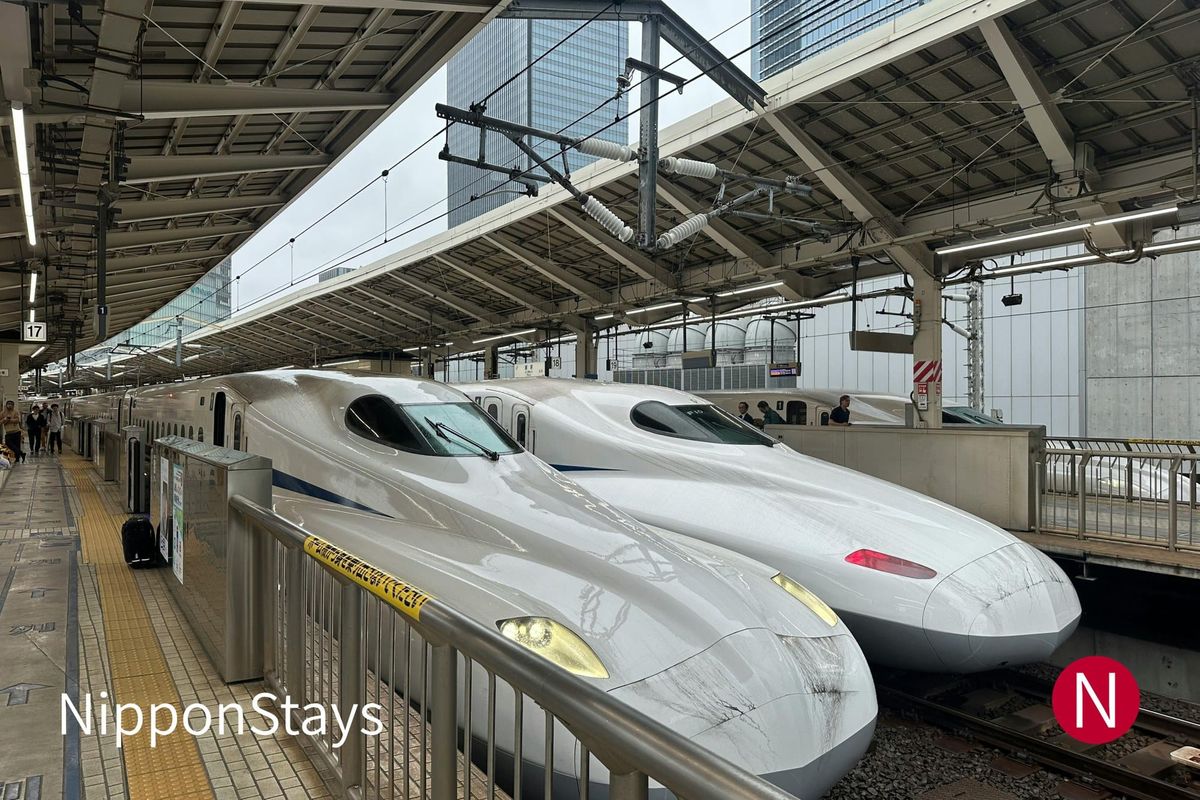
Taking skis on the Shinkansen comes down to one distinction most travelers miss: skis and snowboards packed in a bag count as sports equipment, so they are exempt from the reserved oversized-baggage seat that catches other big bags, no matter how long the bag is. That reservation system — a bag summing over 160cm in length, width and height, with a ¥1,000 fee for boarding without booking it — runs only on the Tokaido, Sanyo, Kyushu and Nishi-Kyushu Shinkansen; the Tohoku, Yamagata and Joetsu Shinkansen that reach Honshu's snow country do not operate it at all (checked August 2026). The one rule that does apply everywhere: no single piece of luggage, ski bag included, may exceed 250cm in total, and oversized pieces beyond that are refused at the gate. Anyone traveling with two pairs in one case, or a hard-shell bag with boots and poles strapped to the outside, should measure the finished bundle before assuming either rule is settled. Skiers headed to Zao Onsen off the Yamagata Shinkansen have a slope-side base at Zao Kokusai Hotel, reached by bus from Yamagata Station.
The Rules in One Place
Two separate systems govern big luggage on JR trains, and skis interact with only one of them.
| Rule | Value | Source | Checked |
|---|---|---|---|
| Standard carry-on allowance (all JR lines) | Up to 2 pieces per passenger, each 30kg or less, longest side 200cm or less | JR East / JR Central baggage rules | Aug 2026 |
| Oversized-baggage threshold | Sum of length + width + height over 160cm and up to 250cm | JR Central oversized-baggage page | Aug 2026 |
| Lines that run the reserved-seat system | Tokaido, Sanyo, Kyushu and Nishi-Kyushu Shinkansen only | JR Central / Smart EX reservation service | Aug 2026 |
| Lines with no reservation system | Tohoku, Yamagata and Joetsu Shinkansen (also Akita and Hokuriku Shinkansen) – the JR East network | JR East oversized-luggage guide | Aug 2026 |
| Fee for boarding unreserved (Tokaido/Sanyo/Kyushu/Nishi-Kyushu only) | ¥1,000, tax included; conductor may relocate the bag | JR Central oversized-baggage page | Aug 2026 |
| Sports-equipment exemption | Skis, snowboards, surfboards, bagged bicycles and musical instruments do not need the reservation on any line, at any length, up to the 250cm cap | JR Central oversized-baggage page | Aug 2026 |
| Absolute size cap | 250cm total, no exceptions, on every JR line | JR East / JR Central baggage rules | Aug 2026 |
Of the three JR East Shinkansen lines that reach Honshu's snow country – Tohoku, Yamagata and Joetsu – zero run the reserved oversized-baggage system that JR Central's own oversized-baggage rules page sets out for the Tokaido, Sanyo, Kyushu and Nishi-Kyushu lines (checked August 2026); JR East's luggage-area guide confirms the Tohoku, Yamagata and Joetsu Shinkansen fall outside that system. A ski bag that would need a reservation on a Tokyo-to-Osaka train needs nothing at all on a Tokyo-to-Yamagata one — not because of the sports-equipment exemption, which would still apply on either line, but because the JR East network the second train runs on does not operate the reserved-space system in the first place.
How to Measure a Ski Bag Against the Rule
The measurement is the sum of three dimensions, not any single one, so a bag can look compact and still add up to an oversized figure. Lay the packed bag flat and add its longest side to its width and its thickness. A single-pair ski bag at roughly 175cm by 22cm by 18cm sums to about 215cm – past the 160cm oversized line and inside the 250cm cap. A padded double-board bag at 165cm by 35cm by 25cm sums to about 225cm, the same story. Where travelers get caught out is strapping boots or poles to the outside of a case that was measured empty: a bag that read 225cm empty can clear 245cm loaded, close enough to the 250cm ceiling to re-measure with everything attached. None of this changes whether a reservation is required – skis stay exempt regardless of the sum – but it does decide whether the bag boards at all.
Booking the Oversized Space
For any other bag that crosses 160cm on a Tokaido, Sanyo, Kyushu or Nishi-Kyushu Shinkansen leg – a large suitcase traveling alongside the ski bag, say – the reservation is made the same way as any other reserved seat: through Smart EX, at a ticket machine, or at a counter, by asking for a seat with the oversized-baggage area. There is no extra charge over the normal reserved-seat fare, and a Japan Rail Pass covers it at no additional cost; JR Kyushu Rail Pass holders make this reservation at a counter rather than online. Reservations open when tickets for that date go on sale, one month before departure. If every oversized-baggage seat is already booked, the alternatives are the next departure or boarding unreserved and accepting the ¥1,000 fee and a staff-assigned spot not guaranteed to fit a large case. None of this applies to a ski bag traveling alone, since the sports-equipment exemption removes the requirement regardless of size; it matters only when the same trip also carries non-exempt luggage over the threshold.
The Lines That Matter for Skiing on Honshu
Three JR East Shinkansen lines out of Tokyo carry skiers into Honshu's snow country, each ending the rail leg at a different kind of station. The Tohoku Shinkansen's Hayabusa reaches Sendai in about 90 minutes, the railhead for day trips across Tohoku and a change point onto local and limited-express lines toward the interior. The Yamagata Shinkansen's Tsubasa through-runs from Tokyo to Yamagata Station with no manual change – it splits from a Tohoku Shinkansen Yamabiko at Fukushima and continues on a narrower-gauge conventional line – in roughly 2.5 to 3 hours, and Yamagata Station is the railhead for Zao Onsen. The Joetsu Shinkansen's Toki and Tanigawa services run from Tokyo or Ueno directly to GALA Yuzawa Station in about 75 to 90 minutes; GALA Yuzawa is the only ski resort in Japan built around its own Shinkansen station, its gondola base a short walk from the platform. The resort's season typically runs mid/late December to early May based on past years; the 2026-27 dates were not yet published as of August 2026, so travelers should check the operator's site closer to autumn.
Local Trains, Limited Expresses and the Last Leg
None of Honshu's snow-country resorts sit on a Shinkansen line themselves – GALA Yuzawa is the sole exception – so the rail journey ends at a station and a bus covers the final distance. The reserved oversized-baggage seat is a Shinkansen-only product; it does not exist on limited-express or local trains, which fall back to the same nationwide 2-piece, 30kg, 250cm-sum carry-on allowance with no special reserved space. In practice that means first-come space in an end-of-carriage rack, a vestibule, or the floor by a seat, which is why a ski bag on a crowded local train is a matter of courtesy rather than any published rule. From Yamagata Station, the Yamako bus to Zao Onsen leaves from the East Exit, Bus Stop 1, runs roughly hourly and takes about 40 minutes; the route takes no reservations, so a skier arriving on a busy Saturday should expect to queue, and the current one-way fare is worth confirming at the stop since it was not independently verified for this guide.
The Alternative: Shipping the Bag Ahead
Anyone who would rather not carry a ski bag through a transfer can send it ahead by courier (takkyubin) from a convenience store, hotel desk, or a resort's ski counter, typically for next-day delivery. The trade-off is timing, not cost: the bag needs enough lead time to arrive before check-in, which rules out same-day shipping from Tokyo for an early lift ticket. NipponStays covers the door-to-door version of this service in its guide to sending luggage between hotels instead.
Station-Side Beds on the Snow-Country Lines
Of the three Zao Onsen hotels mapped for this guide, all three sit within a 10-min walk of the ski resort's base area, from ¥20,460 for two guests, room-only (rates checked August 2026, vary by season and rise sharply around New Year). Zao Kokusai Hotel sits against the ropeway's base footbridge; Zao Shiki no Hotel is a 3-min walk from the same slope; and Zao Sunvalley Hotel is an 8-min walk further out, with its current rate best checked directly since it was not independently confirmed at the time of writing.
| Hotel | Station-side approach | Distance to slope | From price (for two guests, room-only) |
|---|---|---|---|
| Zao Kokusai Hotel | Yamagata Station, then the Zao Onsen bus | 1-min walk (adjoins the base footbridge) | ¥30,360 |
| Zao Shiki no Hotel | Yamagata Station, then the Zao Onsen bus | 3-min walk to the base slope | ¥20,460 |
| Zao Sunvalley Hotel | Yamagata Station, then the Zao Onsen bus | 8-min walk from the ski resort | Rate not independently confirmed; check current availability |
All three depend on the same Yamagata Station-to-Zao Onsen bus rather than any rail connection, which is why the transport question above matters more than the last-mile distance once a skier is off the train. Readers weighing this route against the rest of Zao's calendar can compare it with the warmer months in NipponStays' Tohoku end of the line guide, and readers deciding between a slope-side base and a town base more generally can start from NipponStays' where to stay for skiing in Japan hub. Travelers building a wider Tohoku loop around Sendai's Shinkansen access can see the rest of the region in NipponStays' guide to Sendai as a Tohoku railhead. Anyone who arrives at a full coin locker bank while juggling a ski bag and a suitcase at the same station can check NipponStays' guide to what to do when the coin lockers are full.
The Hokkaido side of the same question is answered in taking skis on buses and trains in Hokkaido, and for a trip that starts with a resort on the Tohoku Shinkansen, Zao for the snow monsters is the natural first stop. If carrying the bag is the problem, sending ski bags ahead by takkyubin removes it; when Japan ski hotels sell out covers the hotels at the other end.
FAQ: Skis on Japanese Trains
Do skis need a reservation on the Shinkansen?
Not for the size-based system: skis and snowboards in a bag count as sports equipment, which is exempt from the 160-250cm oversized-baggage reservation on every JR line, checked August 2026. The only hard limit that still applies is the network-wide 250cm cap on any single piece of luggage.
What size counts as oversized on a Japanese train?
A bag whose length, width and height add up to more than 160cm is classed as oversized; anything over 250cm in that sum is refused outright. A single-pair ski bag around 175cm by 22cm by 18cm sums to roughly 215cm – oversized by that definition, but exempt from the reservation because it is sports equipment.
What happens if oversized baggage boards a Tokaido, Sanyo, Kyushu or Nishi-Kyushu Shinkansen without a reservation?
A ¥1,000 fee applies (checked August 2026), and the conductor assigns a spot for the bag, which is not guaranteed to comfortably fit a large case. This fee and reservation apply only on those four lines; it does not exist on the Tohoku, Yamagata or Joetsu Shinkansen serving Honshu's snow country.
Which Shinkansen lines reach Honshu's ski country from Tokyo?
The Tohoku Shinkansen's Hayabusa reaches Sendai in about 90 minutes, the Yamagata Shinkansen's Tsubasa reaches Yamagata Station (for Zao Onsen) in roughly 2.5 to 3 hours with no manual train change, and the Joetsu Shinkansen's Toki and Tanigawa reach GALA Yuzawa Station, the only Japanese ski resort with its own Shinkansen station, in about 75 to 90 minutes.