Crab Kaiseki Ryokan Plan Meaning: Whole, Half or Tagged
Crab kaiseki ryokan plans use different words for very different amounts of crab. What "tagged," "whole" and "half" actually mean before you book.

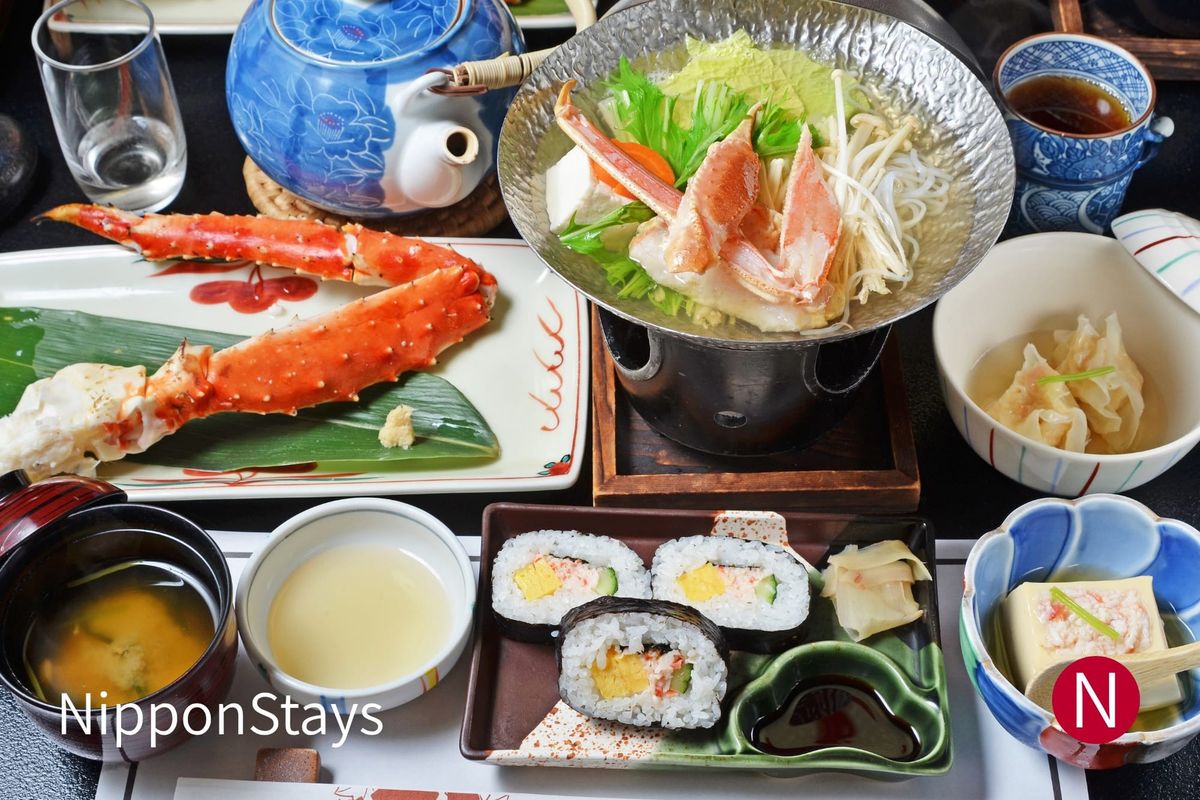
Understanding crab kaiseki ryokan plan meaning before you book saves you from an unpleasant surprise at the table. Four things decide what you're actually getting: whether the plan states a crab count per guest, whether it says "tagged" (a traceable, registered catch), how the crab is prepared, and how strict the cancellation window is — these plans use live crab, so refunds tighten fast as the date nears. Araya Totoan in Kaga Onsen is a plan worth using as a model: its winter plan states roughly one whole tagged crab per guest, served three ways, with cancellation fees that start five days out rather than the night before. If a plan you're looking at skips all four points, ask before you book rather than assume.
Whole crab, half crab, or "crab course"
A ryokan crab plan is not one product — it's a family of plans that differ in how much crab you get and how it's split across the meal. The simplest version states a whole crab per guest (一人一杯, hitori ippai), usually served three or four ways across the course: sashimi, grilled, boiled and sometimes a crab-shell finish with rice or porridge. A step down is a half-crab plan (半身, hanmi), where the crab is split — often grilled as one half and served raw as the other — and priced lower because there's less of it. A third pattern mixes both: one Kinosaki ryokan, Higashiyamaso, lists a plan built around 2.5 crabs per guest, combining one whole boiled crab with a grilled half and a sashimi half across the same dinner. None of these numbers are marketing copy — they're literally what the plan name promises, so read the number before the noun.
| Plan pattern | What it usually means | Per person or shared | What to check before booking |
|---|---|---|---|
| Tagged whole-crab kaiseki | One whole crab per guest, tag disclosed, served sashimi / grilled / boiled | Per person | Cancellation fees usually escalate as the date nears — read the exact schedule, not just "cancellation applies" |
| Whole-crab kaiseki, no tag stated | A crab count is given but the plan doesn't say "tagged" | Per person | Ask directly whether the crab is tagged if that matters to you — an untagged plan isn't automatically frozen or imported |
| Mixed-preparation course (e.g. "2.5-crab") | Crab split across preparations — part boiled whole, part grilled half, part sashimi half | Per person | Read the dish list, not just the headline number — the count can include shell garnishes |
| Kani-suki (crab hot pot) | Crab and vegetables cooked together in a shared pot at the table | Shared | Confirm whether it's the whole meal or one course inside a longer kaiseki |
Does the plan say "tagged"?
"Tagged" (タグ付き, tagu-tsuki) means the crab carries a physical tag attached at landing that identifies its catch — the kind of detail a plan page includes specifically because it costs the ryokan nothing to state and reassures the guest the crab isn't a substitute. Araya Totoan's own crab menu states this directly for its winter plans, describing the crab as sourced through Hashidate fishing port and served tagged (araya-totoan.com, checked September 2026). Not every plan bothers to say it. ゆのくに天祥 (Yunokuni Tensho), also in Kaga Onsen, lists two crab-course plans — one built around roughly two crabs' worth of meat, one centered on a single whole boiled crab (about 530g) — and neither plan page states a tag or a brand name for the crab, even though both clearly quote a count. This article isn't the place to explain what a tag certifies region by region; treat "tagged" here as a single yes/no checklist item, and if the distinction matters to you, ask the ryokan directly rather than assume from the price alone.
Frozen and imported crab: reading the small print
A handful of Japanese terms show up across crab plan pages and are worth knowing before you scan one. 地物 (jimono) means locally landed; 活〆 (ikejime) means processed live, immediately before cooking; 冷凍 (reito) means frozen, and ボイル冷凍 (boiru-reito) specifically means boiled then frozen rather than served fresh; 輸入 (yunyu) means imported. None of these words is inherently bad — a well-run frozen-and-thawed plan can still be a good meal — but a plan that states none of them, the way Yunokuni Tensho's two listings do, simply hasn't told you which one you're getting. The honest reading is that an untagged, unlabeled plan is ambiguous rather than deceptive: it gives you a crab count and a preparation list but leaves origin and handling for you to ask about, which is a five-minute phone call or booking-site message before you commit.
Kids and non-crab eaters
Crab kaiseki plans are built around the crab, so a non-crab-eating guest at the same table is a request, not a default option. Yunokuni Tensho's own allergy policy is a workable model for what to expect elsewhere: the ryokan accommodates allergy requests made at least seven days before the stay, and says it may not be able to fully substitute a meal for guests with three or more listed allergens (yunokunitensyo.jp, checked September 2026). Children's meals follow the same logic across most Kaga Onsen ryokan: a simplified course is available, but it has to be requested when you book, not decided at check-in. If you're traveling with a child or a guest who won't eat crab, message the property directly with the request at the time of booking rather than relying on the plan description to cover it.
Live-crab cancellation rules
Because these plans commit the kitchen to a live crab bought for your specific date, cancellation policies are tighter than a standard room-only booking, and they aren't standardized across properties — read the actual schedule rather than assuming "the night before is fine." Araya Totoan's crab plan is free to cancel up to six days before arrival, then charges 20% at five to three days out, 30% at two days out, 50% the day before, and 100% on the day of arrival or for a no-show. A different Kaga-area crab specialist, Kani Araiso Ryori Shima, uses a simpler two-step schedule: 70% the day before and 100% for a same-day cancellation or no-show. Both are real examples, not a rule you can apply to a third property — the only way to know a given plan's terms is to read that plan's own cancellation table before you pay a deposit.
What crab plans on Kaga Onsen booking pages actually state
Of five crab kaiseki plans sampled across four Kaga Onsen ryokan (Araya Totoan, Kissho Yamanaka, Hoshino Resorts KAI Kaga and Yunokuni Tensho's two listings), four state a specific crab count per guest and two explicitly state a brand tag — Araya Totoan's plan and Kissho Yamanaka's blue-tagged Kano-gani plan (official ryokan pages and Ikyu listings, checked September 2026). None of the five stated whether the crab was fresh-caught or frozen in as many words, which matches the pattern above: count is usually disclosed, tag is disclosed about half the time, and handling is left for the guest to ask about directly.
Where next
| Question | Where to read it |
|---|---|
| What is kobako gani, the crab this region is actually known for? | What Is Kobako Gani? Kanazawa's Crab |
| Kanazawa or Kaga Onsen — which base fits a crab-focused trip? | Kanazawa or Kaga Onsen for Crab Season |
| How does a ryokan dinner course work beyond just the crab? | Ryokan With Meals vs. Room Only |
| How do you pick an onsen ryokan in the first place? | Onsen Ryokan in Japan: Where to Stay |
The same multi-course kaiseki logic — a fixed sequence of small dishes rather than a single entrée — shows up well outside crab season too; our guide to kaiseki dinners at Kyoto ryokan covers how to read a kaiseki menu when crab isn't the headline ingredient.
Trip Essentials for Japan
Things worth booking before you land, all in English:
- eSIM — Airalo's Japan eSIM: install it at home and data works as soon as you switch off airplane mode at Haneda, Narita, Kansai, or wherever you land.
- Tickets and day trips — Klook covers the Japan Rail Pass, teamLab tickets, and shinkansen-linked day trips; booking ahead skips the ticket-window line.
FAQ: Crab Kaiseki Ryokan Plans
What does "tagged" mean on a crab plan, and should I care?
"Tagged" means the crab carries a physical tag attached at the fishing port identifying its catch, and it's stated on the plan page because it costs the ryokan nothing to disclose. Araya Totoan states it directly for its winter crab plan; Yunokuni Tensho's two crab plans don't state it at all despite both quoting a crab count. Whether it matters to you is a personal call — it isn't a guarantee the untagged option is worse, just less documented.
What's the real difference between a whole-crab and a half-crab plan?
A whole-crab plan states roughly one crab per guest, prepared several ways across the meal. A half-crab plan splits that in two, commonly one half grilled and one half raw, at a lower price for less crab. Some plans mix both patterns — Higashiyamaso in Kinosaki lists a 2.5-crab plan combining one whole boiled crab with a grilled half and a sashimi half in the same course.
How strict are cancellation fees on live-crab plans?
Stricter than a standard room booking and not standardized across properties. Araya Totoan is free to cancel up to six days before, then 20% at five to three days out, 30% at two days out, 50% the night before, and 100% on the day. Kani Araiso Ryori Shima uses a simpler 70% the day before and 100% same-day schedule. Read the specific plan's cancellation table — don't assume one property's terms apply to another.
Can I request a non-crab or children's meal on a crab plan?
Yes, but it has to be requested when you book, not at check-in. Yunokuni Tensho asks for allergy requests at least seven days ahead and notes it may not fully accommodate three or more listed allergens. Children's meals work the same way at most Kaga Onsen ryokan — message the property directly with the request at booking time.