Renting a Car in Hokkaido in Winter: When It Pays Off
Renting a car in Hokkaido in winter: when it's worth it, when to take a bus or taxi instead, road-closure traps, studless tyres and NOC insurance explained.
The first question in deciding on renting a car in Hokkaido in winter is not how many days you have or how many people are in your group — it's whether you've driven a snowy mountain road before. January and February in Hokkaido are genuinely hard driving, and if the answer is no, a bus or a taxi is the better call every time. If the answer is yes, a rental car starts making financial sense from around three people in a group, and it's the only way to be on the hill before the first shuttle bus arrives. The one thing that flips this: a single-resort trip with a working shuttle, where a rental car just sits costing money.
The real decision rule: experience first, then party size
After more than 150 days driving to and around Kiroro, my own rule is simple: the deciding factor is not days or headcount, it's whether you've handled a snowy mountain road before. Mid-winter Hokkaido isn't the same task as a European or North American winter drive — the cold is deeper, the snowfall heavier and more frequent, and the roads between resorts climb through passes that see little traffic. My honest read is that January and February raise the difficulty enough that a nervous or first-time winter driver shouldn't be learning here. That's a personal judgment, not a safety authority's ruling, so weigh it against your own driving background.
If you've driven confidently on snow and ice before — anywhere, not necessarily in Japan — a car opens up flexibility no shuttle timetable gives you. If you haven't, the bus network and taxis cover the same ground without the risk.
| Situation | Drive? | Why | What to do instead |
|---|---|---|---|
| First-time winter driver | No | Packed snow, ice and whiteout are a real skill, not a rental add-on | Bus, shuttle, or taxi |
| Group of 3+ with winter driving experience | Yes, usually | Cost per person tends to beat bus fares once shared | — |
| Solo or pair, any experience level | Rarely worth it | Rental + fuel + tolls usually exceeds bus fares for 1–2 people | Bus or taxi |
| Chasing first tracks / powder mornings | Yes, if experienced | Only way to beat scheduled shuttle departure times | Taxi if not confident driving |
| Single resort, working shuttle exists | No | Car sits idle and costs money with no upside | Use the shuttle |
| New Year holiday week (29 Dec–4 Jan) | No | Roads and rental counters are at their busiest and most stressed | Book transfers well ahead — see our booking-window guide |
For a single named route between two specific resorts, the bus-versus-car call comes down to fares and timetables we deliberately don't repeat here — see our Kiroro bus vs rental car guide for that route worked through in full, and our ski resorts near Otaru and Kiroro for what else the Otaru base reaches. For the gear question this decision often turns on, see taking skis and snowboards on Hokkaido buses and trains. And for the network this all sits inside, see our pillar guide, how to get between Hokkaido ski resorts.
The trap nobody warns you about: your map app will route you down a closed road
Seasonal road closures are normal on Hokkaido's mountain routes, and navigation apps route through them anyway — this is the single biggest driving hazard around Kiroro that I've never seen mentioned on an English-language page. Standard map apps calculate the shortest or fastest route without knowing which mountain roads are gated shut for winter, so they'll happily send you toward a pass that's been closed since November. The fix is checking a dedicated road-closure resource before you trust the route, not after you're already on it.
Northern Road Navi, an English-language site covering seasonal road regulations and closures for Hokkaido, is run by CERI (the Civil Engineering Research Institute for Cold Region) under MLIT's Hokkaido Regional Development Bureau (northern-road.ceri.go.jp). We have no commercial relationship with them; it's listed here because it's the resource that actually answers the question a map app can't. Check it the night before and again the morning of any drive that crosses a pass, since closures can shift with weather.
Studless tyres, and what "included" means
Winter rentals in Hokkaido come on studless snow tyres as standard: of the 3 major operators we checked directly (Toyota Rent a Car, Nippon Rent-A-Car, ORIX Rent-A-Car), all 3 list studless tyres as included equipment for winter-season bookings rather than a paid option (checked August 2026). A desk renting you a car on summer tyres in January would be the exception, not the rule. What isn't standard is 4WD — typically a paid upgrade, and it does less for your safety than most renters assume. Traction off the line is only part of winter driving; stopping distance on ice depends far more on tyres and following distance than on how many wheels are driven.
Insurance, CDW and the non-operation charge
Japanese rental agreements layer three things that trip up visitors: the base liability/collision cover, an optional Collision Damage Waiver (CDW) that reduces your out-of-pocket excess in an accident, and a separate Non-Operation Charge (NOC) most first-time renters have never heard of. NOC compensates the rental company for lost business while a damaged car is off the road for repair, billed on top of any repair excess — it's exactly what "full CDW" packages exist to waive. Confirm with your operator whether their standard CDW includes an NOC waiver, since terms vary by company and plan tier.
What driving actually looks like: packed snow, ice, ruts and whiteout
Most of a Hokkaido winter drive is packed snow with visible tyre ruts — manageable at a steady pace with gentle inputs on the wheel, brake and throttle. The condition that actually catches people out isn't deep snow, it's the polished black ice that forms at intersections and on bridges, where compressed traffic snow looks like wet asphalt. Leave more space than feels necessary, brake earlier, and treat every intersection as potentially slicker than the road before it. In heavier snowfall, visibility can drop to whiteout for minutes at a time — slow down, use hazards if you stop, and don't push through at normal speed.
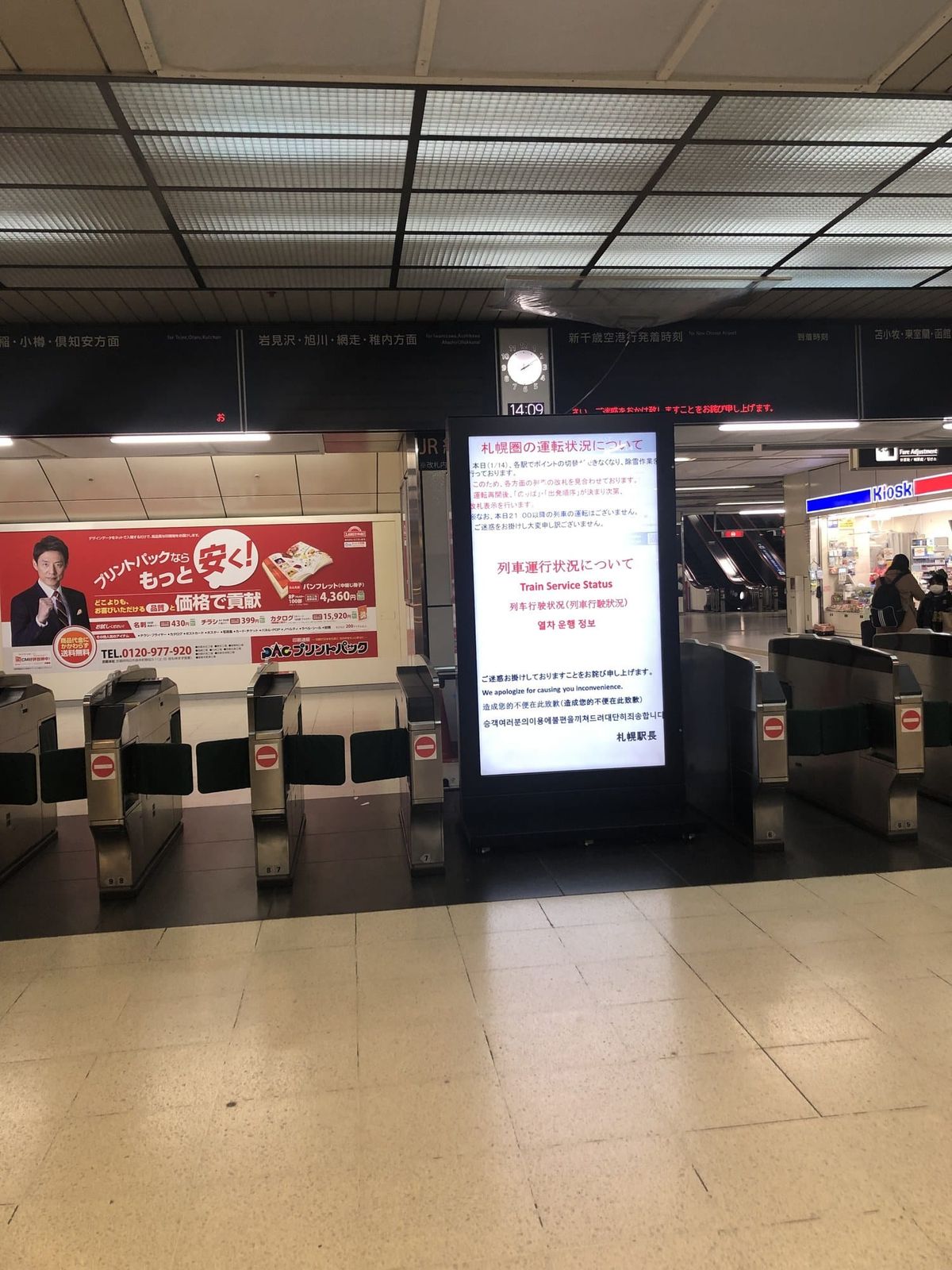
⚠️ There is a fifth condition the guides skip, and it is the one that ends trips: snowfall that outpaces the ploughs. When it comes down hard enough for long enough, a two-lane road becomes one lane of cleared width with walls on either side, and traffic has to take turns. It happens a handful of times a season. There is no technique for it — if you hit one of those days, give up on the car and take public transport. ⚠️ With one caveat: on the worst days the trains stop too. JR Hokkaido suspends services when points freeze or snow clearing cannot keep up, and it announces a cut-off for the day rather than running late — a board at Sapporo Station saying no trains will run after 21:00 is a normal sight in a heavy winter. Buses are usually the last thing still moving, but the real lesson is to keep a day of slack in a February itinerary.
The cost maths, and where three people is the hinge
A rough way to compare: add the daily rental rate, fuel for the distance, any expressway tolls, and parking at your accommodation, then divide by the number of people in the car. Against that, line up the per-person fare for the bus or shuttle covering the same route (see our route guides for actual fares — this article deliberately doesn't price any single trip). In my experience the maths tips toward the car from around three people sharing it; for one or two, a car usually costs more than the equivalent bus or taxi fares once tolls and fuel are counted, before even weighing the driving risk.
The case for a taxi instead
Where budget allows, my own preference is a taxi over a self-drive for a short mountain leg. It removes the driving risk entirely while keeping the schedule freedom a rental car offers — no shuttle departure time to wait for, no unfamiliar pass to navigate yourself. For a single transfer rather than several days of driving, it isn't always the extravagance it looks like once you've added up a rental day, fuel, tolls and parking. This isn't a claim about service quality, only that the cost gap to a rental car is smaller than most visitors assume for a one-way transfer.
Picking the car up early enough to matter
The whole reason a car beats a bus for a powder morning is a first-lift start, so the rental desk's opening hour is the entire plan. The Toyota Rent a Car branch in front of Otaru Station has opened at 08:00 in recent seasons (checked August 2026) — early enough to collect a car and be on the road before most resort shuttles depart. That's one example from a branch I use myself; confirm current hours directly with the operator before building a schedule around it. This is a single worked example, not a route timetable; for the actual Otaru-to-Kiroro drive time, see our Otaru commute plan.
When you should not rent
Skip the rental car if: you're staying at a single resort with a working shuttle, you're travelling during New Year week when every road and rental counter is under pressure, you or your driver haven't handled snow and ice before, or your group is one or two people where the per-person cost rarely beats the bus. In each case, a bus, shuttle or taxi gets you the same result with less risk and often less money.
Where to stay if you are driving, and if you are not
If you're renting, prioritise a base with parking included and enough space to keep skis dry overnight — a garage or covered lot beats an open-air space in a Hokkaido winter. If you're not driving, a base directly on a resort shuttle route removes the question entirely.
| Name | Area | Best for |
|---|---|---|
| Club Med Kiroro Grand | Kiroro | Slope-side, no driving needed (all-inclusive package, from ¥160,000/night for up to two, varies by season) |
| Authent Hotel Otaru | Otaru | Rental pickup a 5-min walk from JR Otaru Station (from ¥11,000/room, varies by season) |
| Grand Park Otaru | Otaru | Parking on-site, easy town base for a drive to Kiroro |
| The Westin Rusutsu Resort | Rusutsu | On-mountain base if you're not driving (from ¥50,000/room/night ski season, verified July 2026) |
Check current rates and availability: Club Med Kiroro Grand, Authent Hotel Otaru, Grand Park Otaru, The Westin Rusutsu Resort.
For a fuller comparison of every Kiroro-area base, see our Kiroro accommodation guide, and for the specific Otaru-base commute pattern, our Otaru commute plan.
Trip Essentials for New Chitose
Things worth booking before you land, all in English:
- eSIM — Airalo's Japan eSIM: install it at home and data works as soon as you switch off airplane mode at New Chitose Airport.
- Airport transfer — Klook covers bus, train, and private transfers from New Chitose Airport.
- Tickets and day trips — Klook covers Sapporo day trips, ski passes, and airport transfers; booking ahead skips the ticket-window line.
Honshu changes the calculation. For Takayama and Shirakawa-go the highway bus usually wins, because the village restricts light-up parking to a pre-booked permit and the drive adds tolls and an expressway crossing that can close to chainless traffic — the comparison is in renting a car for Takayama and Shirakawa-go in winter.
FAQ: driving in Hokkaido in winter
Do I need international driving experience to rent a car in Hokkaido?
No specific certification beyond a valid International Driving Permit or recognised licence is required, but the practical question is whether you've personally handled snow and ice driving before. Rental desks in Hokkaido will hand you the keys regardless of your winter driving background, so the judgment call is yours to make, not theirs.
Are winter tyres included in the rental price?
Studless snow tyres are standard equipment on winter rentals at all 3 major Hokkaido operators we checked directly (checked August 2026), included in the base rate rather than charged as an add-on. Confirm this explicitly when booking if you're using a smaller local operator, since practices can vary outside the major chains.
Is it cheaper to drive or take the bus between Hokkaido ski resorts?
It depends mainly on group size: for one or two people, bus or shuttle fares usually come out cheaper once you add rental cost, fuel, tolls and parking to a car. From around three people sharing a car, the maths tends to tip toward driving. See our route guides for the actual per-person fares on specific journeys.
What is the biggest hazard driving in Hokkaido that visitors don't expect?
Two things surprise most first-time winter drivers here: seasonal road closures that navigation apps route through anyway, and black ice at intersections and on bridges, which looks like wet asphalt rather than obviously frozen ground. Checking a dedicated road-closure resource before a mountain-pass drive, and slowing down at every intersection regardless of how the road looks, address both.