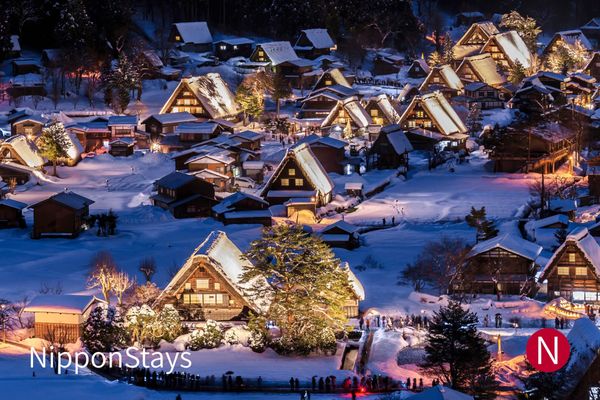
Renting a Car Takayama Shirakawa-go Winter: Car vs Bus
Renting a car for Takayama and Shirakawa-go in winter, compared against the Nohi Bus on cost, chain regulation, and light-up parking rules (checked Aug 2026).
On the renting a car Takayama Shirakawa-go winter question, the highway bus usually wins for most trips: the village restricts parking to a pre-booked permit on light-up evenings, and a rental car adds tolls, an expressway crossing that can close to chainless traffic, and a return drop-off fee if the trip continues past Takayama. A Takayama base that advertised free on-site parking under its previous name is the reopening Hilton Takayama Resort (reopens September 14, 2026); the one hot-spring option actually inside the village is Shirakawago no Yu. The car earns its cost back for a group of three or four splitting one rental, or for anyone adding an onsen town off the bus route — everyone else should book the bus.
Car against bus on this corridor
Six factors decide the comparison, and none of them favor the car by default once winter conditions are added to the normal cost math.
| Factor | Rental car | Highway bus |
|---|---|---|
| Journey time, Takayama to the village | 35-45 min via the Tokai-Hokuriku Expressway in clear conditions; longer under chain regulation | About 50 minutes, direct |
| Cost for one traveler | A day's compact rental plus expressway tolls and fuel typically runs well above a bus round trip | ¥2,800 one way; Nohi Bus also sells a discounted round-trip ticket that comes in below two one-way fares combined |
| Cost for four travelers | The same day-rental, tolls and fuel split four ways can undercut four bus fares | Four one-way fares run ¥11,200; the discounted round-trip ticket brings a group of four in lower still |
| Parking on arrival | Reservation-only permit on light-up evenings; first-come daytime lot before 15:00 | None needed — the bus stops at the village terminal |
| Winter equipment | Studless tires standard at Takayama's snow-region rental counters; chains must still be carried for regulated sections | Handled entirely by the operator |
| Light-up evening access | Requires a pre-booked parking permit; no same-day option | Route-bus tour tickets bundle transport with a platform seat, sold separately |
Of the seven hotels and ryokan mapped for this route below, only the reopening Hilton Takayama Resort is on record with free on-site parking; three more — Spa Hotel Alpina Hida Takayama, KOKO Hotel Hida Takayama and Wat Hotel & Spa Hida Takayama — publish an on-site fee of ¥800-1,000 a night, and the remaining three (Takayama Ouan, Shirakawago no Yu and Toyota Shirakawa-go Eco Institute) do not publish a parking rate (checked August 2026).
The winter equipment rules
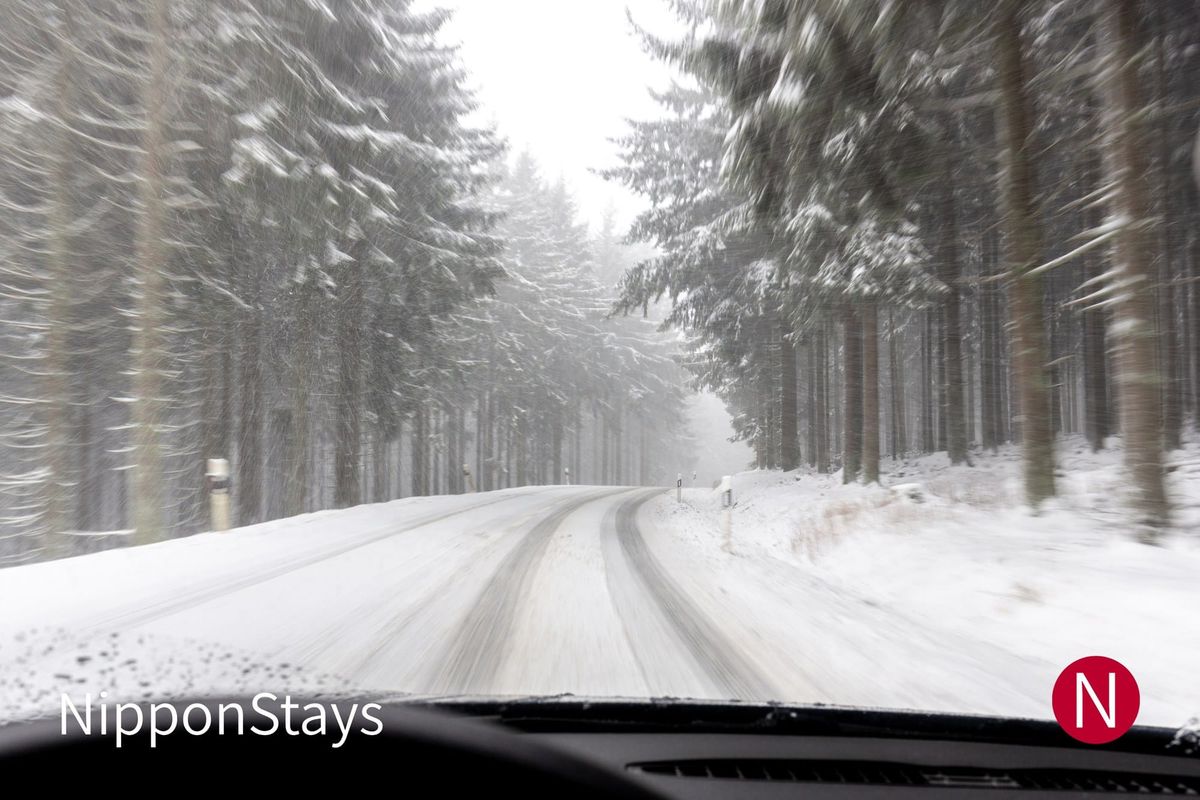
Japan has no single national law mandating studless tires; instead, prefectural regulations require anti-slip equipment — winter tires or tire chains — on roads that are snow-covered or frozen, and Takayama's roads fall under exactly that rule for the winter months. In practice this makes studless tires the default at Takayama's rental counters: they are fitted as standard equipment at no extra charge, so the separate "winter tire plan" some agencies sell in non-snow regions does not apply here. That does not remove the chain requirement. NEXCO Chubu, which operates the Tokai-Hokuriku Expressway, can impose chain regulation on the steep mountain stretch north of Shirotori IC — the section that includes the Shirakawago Interchange — during heavy snowfall warnings, and a car without chains on board can be turned back from a regulated section even on studless tires. NEXCO Chubu's own snow-driving guide states this plainly: carry chains regardless of tire type and check the mounting instructions before a regulated stretch. One piece of the route did improve recently — the Shirakawago IC to Gokayama IC section, previously a narrow two-lane stretch with opposing traffic, was widened to four lanes on October 24, 2025, removing the head-on-collision risk that stretch carried for years.
Where a car genuinely wins
A car earns its cost in two situations. The first is a group of three or four sharing one rental — split four ways, a day's compact car, tolls and fuel can come in under four round-trip bus fares, and the group is not tied to the bus timetable for the return leg. The second is a trip that adds an onsen town or village the Nohi Bus network does not serve directly, since a car turns a single there-and-back errand into a loop that a fixed bus route cannot match. Neither case applies to a solo traveler making a straightforward day trip, which is the majority of light-up visitors.
Where a car loses
The light-up evenings are where a car loses outright: since 2019 every vehicle entering the village on those nights has needed a pre-approved parking reservation through the Tourist Association's own booking system, with no same-day sale and no walk-up option. Daytime self-drive visitors without an evening ticket fare little better — final parking entry is 15:00 and the village must be cleared by 17:00, well before the lights come on. Add the possibility of chain regulation shutting the expressway's mountain section during a storm, plus a return drop-off fee if the itinerary continues to Kanazawa or Toyama rather than looping back to Takayama, and the bus's fixed but guaranteed timetable becomes the safer default.
Hotel parking in Takayama
Parking availability and cost vary more than the from-rates suggest:
- Hilton Takayama Resort — under its previous name the property advertised free on-site parking and a complimentary shuttle from JR Takayama Station; the reopening announcement confirms the shuttle, but parking terms and space count have not yet been republished ahead of the September 14, 2026 reopening.
- Spa Hotel Alpina Hida Takayama — a 90-space lot, ¥900 per night, first-come with no reservation, open from 12:00.
- KOKO Hotel Hida Takayama — ¥1,000 per night by phone reservation, available 12:00 to 11:00 the next day; vehicles are capped at 1.8m wide, 4.5m long and 2.3m tall, and overflow is directed to a nearby paid lot.
- Wat Hotel & Spa Hida Takayama — 46 on-site spaces at ¥800 per night (¥200 per hour after checkout), plus a free lot 4-5 minutes' walk closer to the Old Town.
- Takayama Ouan — parking runs through an automated mechanical tower, a system that typically limits vehicle height to roughly 1.5-1.6m; anyone renting an SUV or minivan should confirm clearance with the ryokan directly.
Picking the car up
Takayama's rental counters cluster within a few minutes of Takayama Station and cover the corridor without a drop fee as long as the car returns to the same prefecture; Toyota Rent-a-Car's own one-way rental page states that crossing into a different prefecture — Kanazawa in Ishikawa or Toyama city in Toyama — adds a fee, with a published example of ¥12,100 for a similar cross-prefecture drop. That makes Takayama-to-Kanazawa or Takayama-to-Toyama one-way rentals workable for a traveler continuing on rather than looping back, and it pairs naturally with a stay in Kanazawa or a comparison of Kanazawa against Toyama as a Hokuriku base. Anyone arriving via Nagoya instead can pick up at Takayama Station on the way through rather than at Nagoya itself, since the expressway run from Takayama is shorter than from Nagoya.
Hotels with parking on this route
Prices below are from-rates at two guests, except Takayama Ouan and Toyota Shirakawa-go Eco Institute, which are quoted per person with two meals included; both figures vary by season.
| Name | Area | Price range | Best for |
|---|---|---|---|
| Hilton Takayama Resort | Takayama, station-side | Reopens Sept 14, 2026; rates not yet published | Free on-site parking, no reservation |
| Spa Hotel Alpina Hida Takayama | Takayama, onsen-side | from ¥9,060 for two, room only | Large first-come lot, no booking needed |
| KOKO Hotel Hida Takayama | Takayama, 5-min walk from Takayama Station | from ¥7,200 for two | Budget base; parking needs a phone booking |
| Wat Hotel & Spa Hida Takayama | Takayama, near the Old Town | from ¥11,000 for two, room only | Cheapest on-site fee, free overflow lot nearby |
| Takayama Ouan | Takayama, hot-spring ryokan | from ¥18,000 per person, two meals | Onsen night; confirm tower clearance for large vehicles |
| Shirakawago no Yu | Village, 2-min walk from the bus terminal | from ¥25,400 for two, room only | The village's own natural hot spring |
| Toyota Shirakawa-go Eco Institute | Village edge | from ¥13,000 per person, two meals | Modern rooms with a village address |
For a wider look at hot-spring stays along the same route, see onsen ryokan compared by region.
The trip this drive usually serves is the Shirakawa-go winter light-up, which has its own page on the lottery and where to sleep. For the same car-versus-bus decision in far heavier snow, see renting a car in Hokkaido in winter; and if the itinerary continues to a ski resort, when Japan ski hotels sell out gives the booking timeline.
FAQ: driving Takayama to Shirakawa-go in winter
Is it worth renting a car for Shirakawa-go in winter?
Usually not for a solo or two-person trip: the Nohi Bus covers the 50-minute run for ¥2,800 one way with no parking to arrange, while a car adds tolls, fuel and the risk of chain regulation closing the expressway's mountain section. A car pays off mainly for three or four people sharing one rental, or a trip adding a stop the bus network does not reach.
Do rental cars in Takayama come with winter tires automatically?
Yes — Takayama sits in Japan's snow-country rental zone, so counters based there fit studless winter tires as standard equipment at no extra charge. Tire chains are a separate matter: NEXCO Chubu can still require them on regulated Tokai-Hokuriku Expressway sections during heavy snowfall, regardless of tire type.
Can you park a rental car in Shirakawa-go during the light-up?
Only with a parking permit pre-booked through the Tourist Association's own site; there is no same-day or walk-up parking on light-up evenings. Daytime visitors without an evening ticket also face a cutoff — final entry is 15:00 and the village must be cleared by 17:00.
How much does the Nohi Bus cost between Takayama and Shirakawa-go?
¥2,800 one way per adult (checked August 2026), with departures roughly a dozen times a day and about half of them requiring an advance seat reservation. Nohi Bus also sells the return leg as a discounted round-trip ticket priced below two one-way fares combined — that discounted total, not a simple doubling, is the figure a shared rental car needs to beat once tolls and fuel are added.