Japan Autumn Leaves Timing by Region: A Booking Table
Japan's autumn leaves move north to south over ~7 weeks. A booking-view table: which region peaks when, book-by windows, and one bookable base per stage.

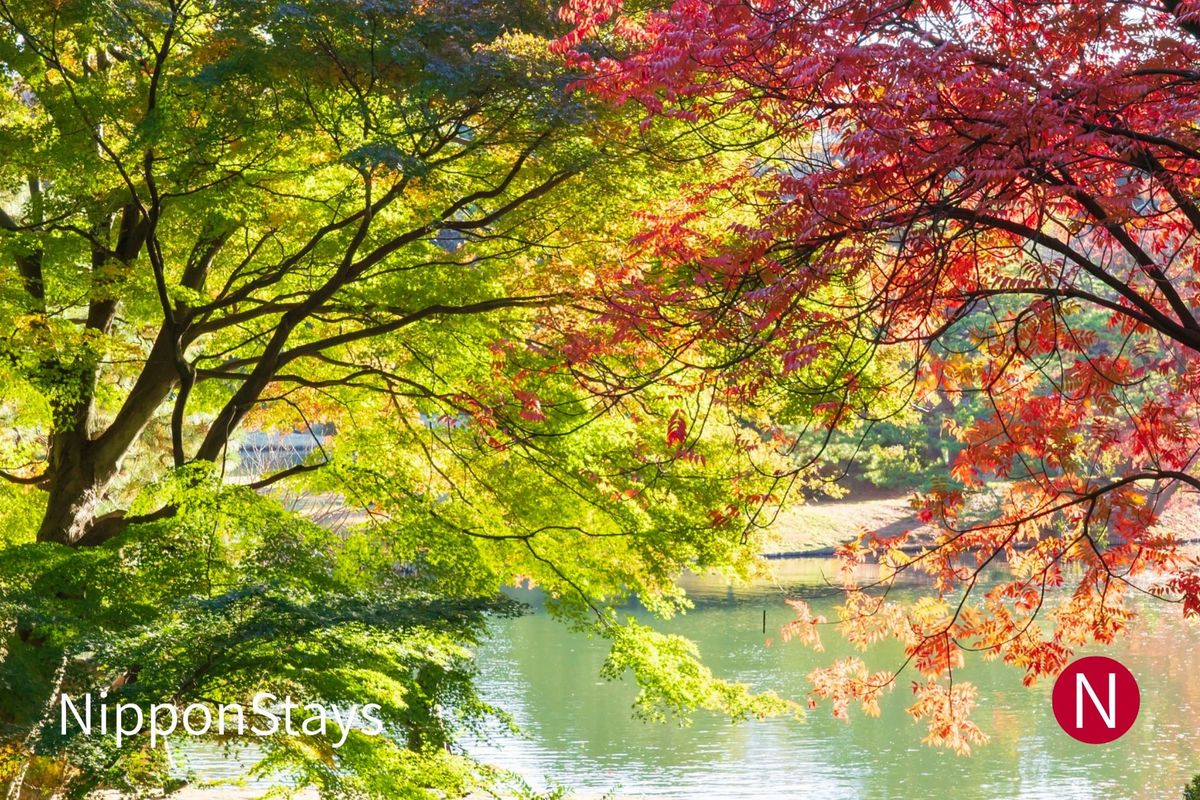
Japan autumn leaves timing by region moves from north to south in stages, and the practical booking question is never "when is peak" but "which region is at its peak on the one week a traveler can actually take." As a rough guide: an early-October trip fits Hokkaido best, at a base such as Jozankei View Hotel outside Sapporo, from ¥19,000 for two; a mid-to-late-November trip fits the coast around Hiroshima instead, at Iwaso, whose grounds sit inside Miyajima's Momijidani park itself, from ¥100,000 for two with two meals. Everything between those two dates — Tohoku, the Nikko highlands, inland Kyushu — falls on a roughly six-week ramp, and the exact week still slides by seven to ten days most years depending on how cold that autumn's nights turn out to be. The prices above and in the tables below are ordinary-week from-rates at two guests, not a forecast of what a specific November week will cost; read them as a ranking of one base against another, not as a quote, and put a traveler's own dates into a search before booking.
This Is the Booking View of the Season, Not the Sightseeing View
Japan's Autumn Leaves: When and Where already covers which gardens, gorges, and shrines to see across the country. This guide answers a narrower question that pillar leaves open: given that a trip has to be booked months ahead of the color itself, which week belongs to which region, and which one hotel in that region is worth naming and holding a room at now. It is deliberately built from just five stops, one per stage of the front's march south, rather than an exhaustive list of viewing spots.
Three regional match-ups elsewhere on this site go deeper on any one of these stages: Oirase vs. Towada and Zao vs. Naruko both split hairs inside Tohoku, and Nikko vs. Kinugawa does the same for the Kanto mountains. Kyoto's own calendar, which runs later than most of Honshu and gets a full guide of its own, is covered separately in Kyoto Autumn Leaves: How Early to Start rather than repeated here.
Five Stages, North to South
| Region | Typical peak window | Book by (rough) | One bookable base | From price (2 guests) |
|---|---|---|---|---|
| Hokkaido (Jozankei, near Sapporo) | Early-to-mid October | Early August | Jozankei View Hotel | From ¥19,000 |
| Tohoku (Naruko Gorge, Miyagi) | Late October to early November | Early September | Naruko Hotel | From ¥30,800 (two meals) |
| Nikko highlands (Lake Chuzenji, Tochigi) | Mid-October to early November | Mid-September | Chuzenji Kanaya Hotel | From ¥28,000 |
| Chugoku coast (Miyajima, Hiroshima) | Mid-to-late November | Late September | Iwaso | From ¥100,000 (two meals) |
| Kyushu inland basin (Yufuin, Oita) | Late November to early December | Late September | Yufuin Sansuikan | From ¥21,000 |
"Book by" here is a general rule of thumb, not a measured cutoff for any one property: the lower-priced, well-reviewed rooms at a hotel's home region tend to be the first inventory to disappear once a specific date range shows fall color, and that thinning starts roughly two to two-and-a-half months ahead of the peak weekend rather than at the last minute. Hokkaido's window opens first in the calendar, so it is also the first region where a traveler runs out of easy choices.
Altitude Beats Latitude
A map that only tracks latitude gets two of these five stops wrong. Lake Chuzenji sits roughly 726m above Nikko's own train-station town, and that elevation gap — not the short distance south on the map — is why Nikko vs. Kinugawa treats them as two separate booking decisions rather than one. The same pattern repeats in Zao vs. Naruko, where Zao's higher onsen villages turn color before Naruko Gorge's lower valley floor despite sitting at a similar latitude.
Jozankei works the same way in miniature: the onsen town itself, strung along the Toyohira River, colors first, while the deeper Toyohira Gorge overlook a short drive upstream can lag by a week or so at the margins of the season. A traveler reading only a country-wide latitude map would book Nikko and Zao on the same week as their lowland neighbors and arrive at one of the two too early.
Two Mistakes This Table Is Built to Prevent
The first mistake is treating Hokkaido as the latest color in the country because it is the coldest place in winter; it is actually the earliest, and a traveler who saves Hokkaido for a late-November trip built around Miyajima or Yufuin arrives to bare branches at Jozankei. The second mistake runs the other way: booking Tohoku for early October on the assumption that "further north than Tokyo" means "further along," when Naruko Gorge in Miyagi is still mostly green three to four weeks after Hokkaido has turned and does not reliably color until late October or early November itself.
How Much of This Table Is Walkable
Of the five bases named above, two sit close enough to the color that no transfer is needed at all: Iwaso's address is inside Momijidani Park itself, and Chuzenji Kanaya Hotel is a 5-min walk from the Lake Chuzenji shoreline. The other three need a short connection — an in-town riverside walk of roughly 10–15 minutes for Jozankei View Hotel toward the Toyohira River, a 13-min taxi from Naruko Hotel to the Ofukazawa Bridge viewpoint at Naruko Gorge, and a walk of around 25 minutes from Yufuin Sansuikan to the Lake Kinrin shoreline in the town center (checked August 2026). None of the five requires a rental car, which is the actual bar this guide is checking each stop against, given how much of rural autumn-leaves travel elsewhere in Japan assumes one.
Compare All Five Bases
| Name | Area | From price (2 guests) | Best for | Walk to the leaves |
|---|---|---|---|---|
| Jozankei View Hotel | Jozankei Onsen, Hokkaido | From ¥19,000 | Families wanting Hokkaido's earliest color plus an indoor water park for a rainy day | 10–15-min riverside walk in town |
| Naruko Hotel | Naruko Onsen, Miyagi | From ¥30,800 (two meals) | A Tohoku base for travelers who want the gorge itself, not just an onsen town view | 13-min taxi to Ofukazawa Bridge |
| Chuzenji Kanaya Hotel | Lake Chuzenji, Nikko | From ¥28,000 | Waking up already above Irohazaka's tourist-bus traffic | 5-min walk to the shoreline |
| Iwaso | Miyajima, Hiroshima | From ¥100,000 (two meals) | Being inside Momijidani Park after the last ferry back to the mainland has gone | Grounds adjoin the park entrance |
| Yufuin Sansuikan | Yufuin, Oita | From ¥21,000 | Kyushu's inland basin, where the elevation buys color closer to a Tokyo-style November than a Kyushu one | ~25-min walk to Lake Kinrin |
Sources for hotel walking distances and access: Chuzenji Kanaya Hotel's own property page for the lakeside walk, plus Naruko Hotel's own site for its station shuttle. The definition of when a maple counts as "turned," used loosely throughout this guide, follows the Japan Meteorological Agency's own biological-season observation standard, which is built around a specimen tree rather than a single calendar date — see the JMA's phenological observation page.
FAQ: Japan's Autumn Leaves Timing
How many weeks does the color front take to cross Japan?
Across the five stops in this guide, roughly seven to eight weeks separate Hokkaido's early-October peak from Yufuin's late-November-to-early-December peak, with Miyajima's mid-to-late-November window falling a week or two ahead of Yufuin's. The full country runs longer than that if lowland Kyushu and Kyushu's far south are included, since those areas can push into December in a mild year, but the span above covers every base named in this article.
How much does altitude shift the peak?
At Nikko, roughly 726m of elevation gap between the town and Lake Chuzenji is enough to separate the two into different booking weeks entirely, and the same relationship shows up between Zao's higher onsen villages and Naruko Gorge's lower valley floor. As a rule of thumb, expect the color to arrive one to two weeks earlier for every few hundred meters of extra elevation at a similar latitude.
How far ahead should each region be booked?
Two to two-and-a-half months ahead of the target week is the general pattern for when the cheaper, better-reviewed rooms start disappearing at these five bases, which puts Hokkaido bookings starting in early August and the Kyushu and Chugoku bases starting in late September. This is a rough pattern drawn from how quickly comparable listings vanish in past seasons, not a guaranteed sell-out date for any one property.
What happens if the year runs late?
A warm autumn can push every window in this table back by one to two weeks without changing their order relative to each other — Hokkaido still turns before Tohoku, and Tohoku still turns before Miyajima or Yufuin, even in a delayed year. The safer adjustment is to treat the "typical peak window" column as a starting guess and re-check each region's own current-season reports a few weeks out, rather than to assume the whole calendar has shifted evenly.