Inoue Masaru, the Man Whose Statue Stands at Tokyo Station
Who is the statue on Tokyo Station's Marunouchi plaza? Inoue Masaru, father of Japanese railways: melted down in 1944, back on the plaza since December 2017.
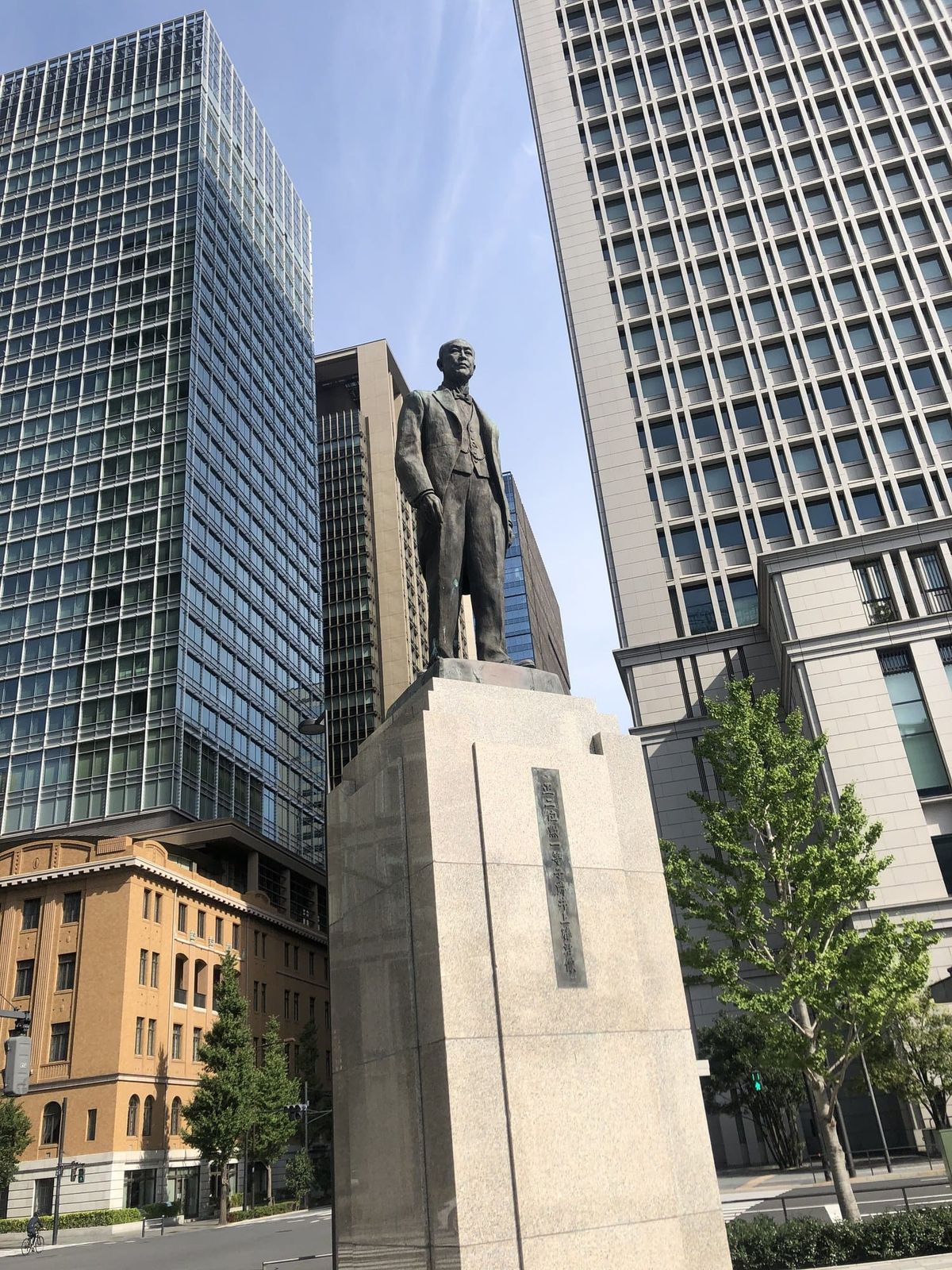
The bronze figure standing on the Marunouchi plaza at Tokyo Station is Inoue Masaru (1843–1910), the man Japan calls the father of Japanese railways. He was one of five Chōshū samurai smuggled out of the country in 1863 to study at University College London, and he came home to run the construction of Japan's first railway — the Shimbashi–Yokohama line, opened on 14 October 1872. The statue you are looking at is the second casting: the first was taken away for its metal in March 1944, and the present one has stood at the north-west corner of the plaza since 7 December 2017. If you have ten minutes between trains, it is the one monument outside the red-brick building worth crossing the plaza for.
The statue most travellers walk past
The Inoue Masaru statue stands at the north-west corner of the Marunouchi station plaza: a bronze figure of about 3 m on a pedestal of about 5 m, roughly 8 m in all (Tokyo Shimbun, 7 December 2017). Leave by the Marunouchi North Exit and it is diagonally ahead of you, nearest Marunouchi Oazo and the Shin-Marunouchi Building.
The inscription on the pedestal is vertical Japanese with no English, one reason most visitors photograph the red-brick station and keep walking. The north-west corner is close to where the first statue stood in 1914, and the figure looks back towards the station building.
| Year | Event | Where |
|---|---|---|
| 1843 | Born, 25 August | Hagi, Chōshū domain (Yamaguchi) |
| 1863–1868 | Stows away to Britain with four other Chōshū men; studies civil engineering and mining | University College London |
| 1871 | Appointed head of railways in the new government | Tokyo |
| 1872 | Japan's first railway opens, 14 October | Shimbashi–Yokohama |
| 1880 | Osakayama tunnel completed, 28 June | Kyoto–Otsu |
| 1891 | Koiwai Farm founded with two partners | Shizukuishi, Iwate |
| 1910 | Dies on official business, 2 August | London |
The man who smuggled himself to London
In 1863 leaving Japan was a capital offence, and five young men from the Chōshū domain did it anyway: Itō Hirobumi, Inoue Kaoru, Endō Kinsuke, Yamao Yōzō and Inoue Masaru. Alexander Williamson, professor of chemistry at UCL, and his wife housed them at Haverstock Hill and taught them English. UCL was then the only university in England admitting students regardless of race or religion.
Of the five, four studied analytical chemistry under Williamson; Inoue Masaru took civil engineering and mining instead, and was the only one whose whole career was railways (checked August 2026). Itō became Japan's first prime minister in 1885, Inoue Kaoru its foreign minister, Endō founded the Japanese mint, and Yamao the country's first engineering college.
British readers can see the group commemorated at UCL: a monument in the Japanese Garden between the Student Centre and the Wilkins Building, unveiled by the Japanese ambassador in September 1993, carrying the names of the Chōshū Five and of the 14 Satsuma students who followed in 1865 (checked August 2026).
What he actually built
Japan's first railway ran 29 km from Shimbashi to Yokohama and covered it in 53 minutes, opening on 14 October 1872 with Emperor Meiji aboard the first train. Inoue, appointed head of railways in 1871, ran the system for over two decades: director of the Railway Bureau from 1877 and, after that office was reorganised as the Railway Agency in 1890, its director-general until he stepped down on 17 March 1893.
His most pointed decision came in the hills between Kyoto and Otsu, where British engineers still directed the work: Inoue insisted the Osakayama tunnel be driven by Japanese engineers alone, under chief engineer Kunisawa Yoshinaga. It was finished on 28 June 1880 at 664.8 m — the first railway tunnel in Japan built without foreign supervision, completed in about one year and eight months, and cheaper by roughly 17% because no foreign salaries were paid.
He died in London on 2 August 1910 and is buried at the Tōkai-ji Ōyama cemetery in Kita-Shinagawa. He chose the plot himself, flanked by the lines he had built — the Tōkaidō Main Line in front of it, the Yamanote Line and the Tōkaidō Shinkansen behind. The grave was designated a Railway Monument on 14 October 1964. Japan is still laying new track, too — see our guide to the Utsunomiya LRT.
The statue that was melted down
The first Inoue statue was put up in 1914 for the opening of Tokyo Station, sculpted by Motoyama Hakuun, and it was removed in March 1944 in the wartime collection of metal. A second was cast by Asakura Fumio and unveiled on 14 October 1959, the anniversary of the 1872 opening and the date Japan now marks as Railway Day.
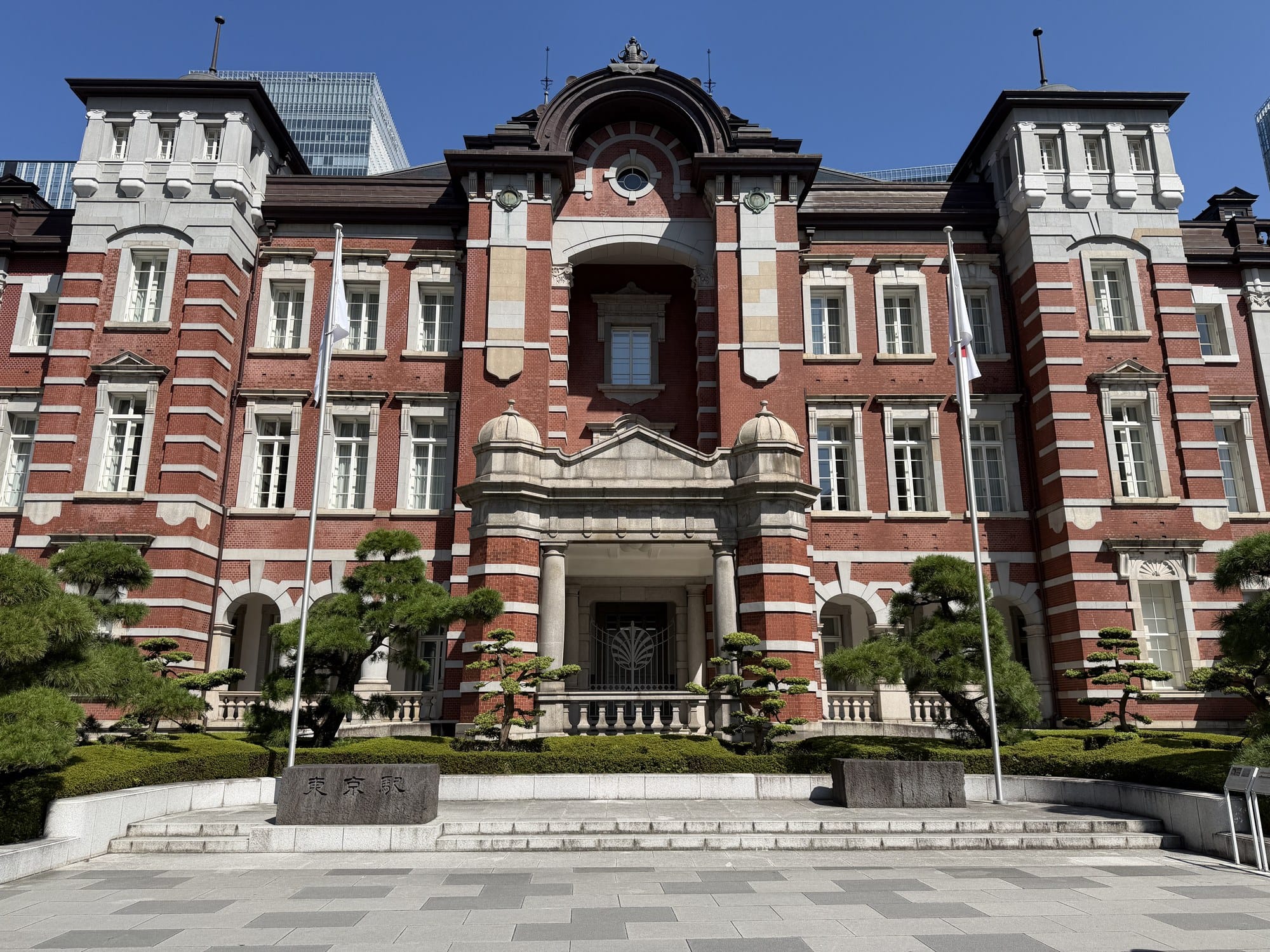
The second statue then disappeared again, this time for the rebuilding of the plaza itself. When the restoration of the red-brick station building was completed in 2012 the statue did not come back with it; Hagi, his birthplace, pressed JR to return it. It went back up on 7 December 2017, when the new plaza opened (Tokyo Shimbun, 7 December 2017). Across the 112 years since the first casting went up in 1914, the plaza has stood empty of him for at least the 15 years between March 1944 and October 1959, and again for the years of the rebuild that ended in December 2017 (checked August 2026).
Three places carry his name
Inoue Masaru is commemorated in three places a traveller can reach, each tied to a different part of his life.
| Place | Area | What is there | Connection |
|---|---|---|---|
| Tokyo Station, Marunouchi plaza | Tokyo | Bronze statue, about 8 m with pedestal, reinstalled 7 December 2017 | The system he ran; the first statue here dates from the station's opening in 1914 |
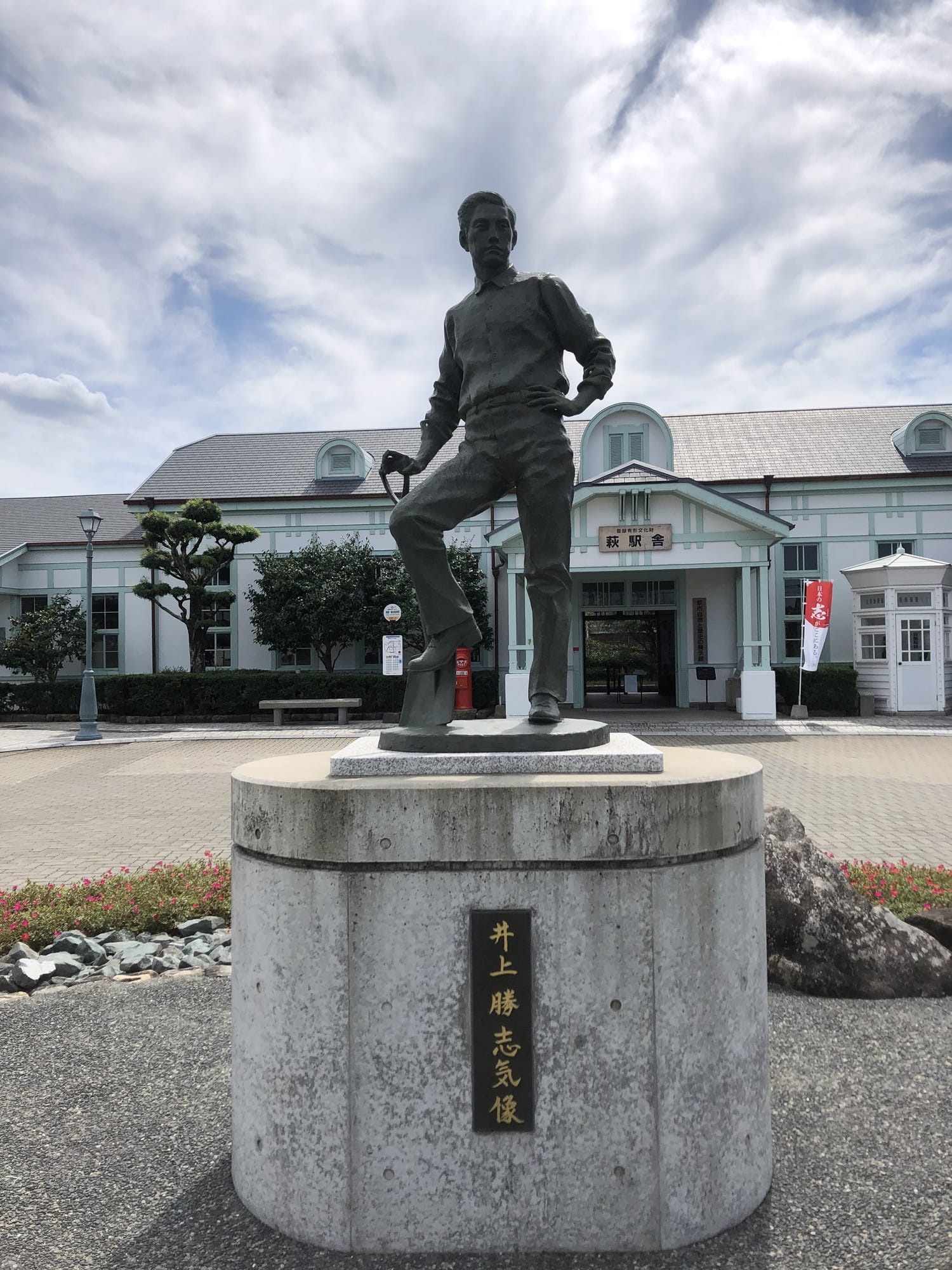
| Hagi Station | Hagi, Yamaguchi | The Shiki-zō statue by Eri Toshiaki, a 1.8 m bronze on a pedestal, about 3 m in all, unveiled 14 October 2016 in front of the 1925 station building | His birthplace; the station building has been a Registered Tangible Cultural Property since 20 December 1996 and its west half is now a nature and history exhibition hall |
| Koiwai Farm | Shizukuishi, Iwate | A working farm founded in 1891, still operating under the same name | The i in Ko-iwa-i is his surname — see how Koiwai Farm got its name |
For getting to any of them from the Marunouchi side, our Tokyo Station guide covers the layout, and the Shinkansen platforms guide covers the transfer gates.
A story his family tells
One of the people who taught our editor at school was a descendant of Inoue Masaru, and this is what he told the class. Japan's weather service sat under the railway ministry, he said, because railway surveyors worked at night to lay out dead-straight alignments, sighting along the glow of incense sticks — so the weather mattered enormously to the railways, and that is how the two came to share a ministry. It is a family account, heard first-hand in a classroom. It is not an archival claim, and it should not be read as one.
The record confirms the shape of it and changes the mechanism. Weather and railways really did sit in the same ministry: on 1 November 1943 the Central Meteorological Observatory was moved out of the Ministry of Education and into the newly created Ministry of Transport and Communications, whose remit explicitly listed meteorology alongside shipping, ports, warehousing and aviation. That ministry was formed by merging the Ministry of Communications with the Ministry of Railways — so the weather service was not placed under the Railway Ministry; the Railway Ministry was folded into the same new body. The pairing then lasted: the Ministry of Transport from 1945, the Japan Meteorological Agency from 1956 as an external bureau of that ministry, and finally the Ministry of Land, Infrastructure and Transport in 2001 — about 58 years in the transport line of ministries.
Night surveying by incense and lantern is also real, and it has a name in Japanese: senkō-chōchin sokuryō. Lights are carried to the points being sighted — incense for the near marks, paper lanterns for the far ones — and the line is read off the row of glows in the dark. The works it is attached to in surviving accounts are Edo-period civil engineering, above all the Tamagawa Aqueduct of the 1650s. I could not find it documented for Meiji-era railway surveying (checked August 2026); the survey for the Shimbashi–Yokohama line began in 1870 under the British engineer Edmund Morel, with imported instruments.
The standard explanation for the 1943 transfer is administrative rather than technical: wartime consolidation of transport administration into a single ministry, with meteorology written into that ministry's remit alongside shipping, ports and aviation. The causal link in the family story — railway night-surveying as the reason weather sat with the railways — is not supported by the sources I could find.
Both are worth keeping, which is the interesting part. A family holds on to the reason a thing was done; the archive holds on to the date an office moved. The two are answering different questions, and a descendant standing in front of a classroom was passing on something no ministry gazette records.
FAQ: Inoue Masaru and the Tokyo Station statue
Who is the statue outside Tokyo Station?
The statue on the Marunouchi plaza at Tokyo Station is Inoue Masaru (1843–1910), known in Japan as the father of Japanese railways. It stands at the north-west corner of the plaza, is about 8 m tall including its pedestal, and was reinstalled there on 7 December 2017 after the plaza was rebuilt.
Why is Inoue Masaru called the father of Japanese railways?
Inoue Masaru ran Japan's railway administration for over two decades from 1871, oversaw the country's first line from Shimbashi to Yokohama in 1872, and pushed for Japanese engineers to take over the work from their British teachers — the Osakayama tunnel of 1880 was the first railway tunnel in Japan built without foreign supervision. He shaped both the network and the profession that built it.
What were the Chōshū Five, and what did Inoue study in London?
The Chōshū Five were five young samurai who were smuggled out of Japan in 1863, when leaving the country was punishable by death, to study at University College London under the chemist Alexander Williamson. Inoue Masaru studied civil engineering and mining there and returned to Japan in 1868; a monument to the group stands in UCL's Japanese Garden, unveiled in September 1993.
Where else can I see a statue of Inoue Masaru?
The second statue of Inoue Masaru stands outside Hagi Station in Yamaguchi Prefecture, his birthplace, unveiled on 14 October 2016 and modelled on a photograph taken while he was studying in Britain. It sits in front of the 1925 Hagi Station building, a Registered Tangible Cultural Property since 20 December 1996, and is 1.8 m tall.