Twin vs Hollywood Twin vs Double in Japanese Hotels: Read the Widths
A Japanese double is 140cm — narrower than a US queen. A Hollywood twin is about 200cm, wider than a US king, and priced as a twin. The labels do not map.

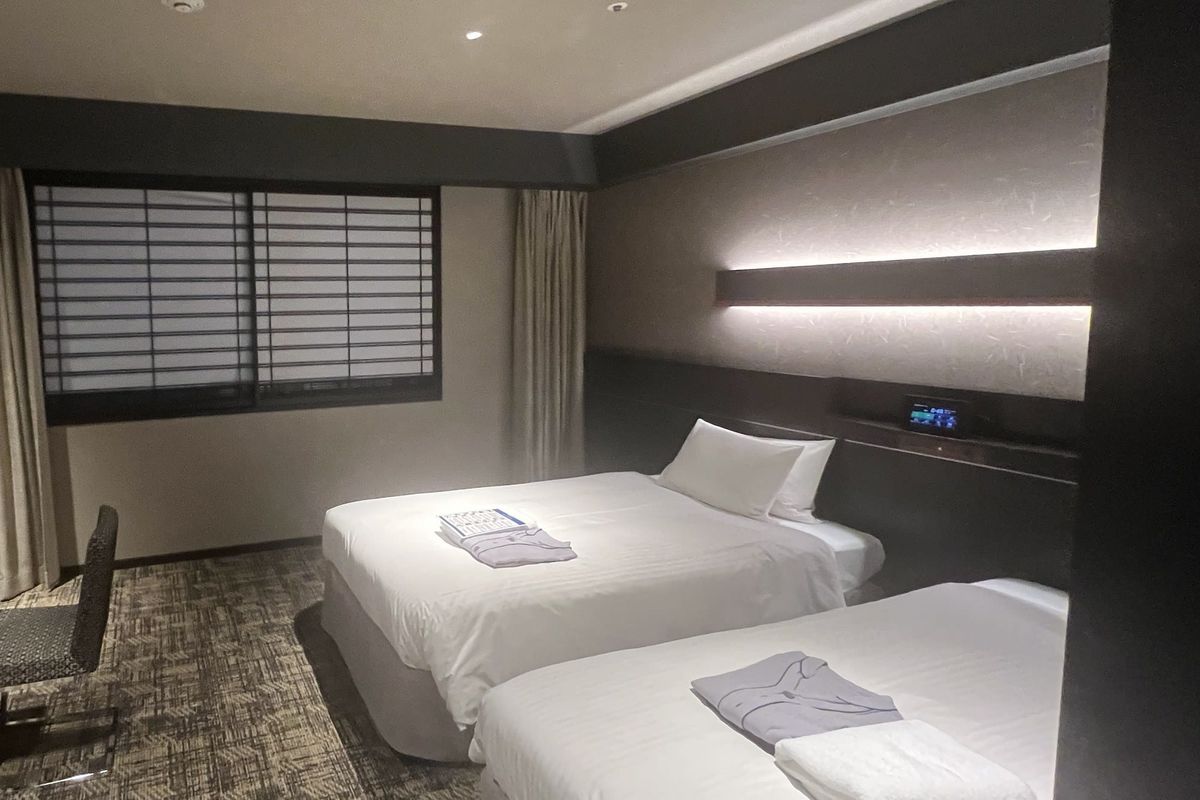
Twin vs Hollywood twin vs double in Japanese hotels is a decision Western travellers usually get wrong, because the labels do not mean what they mean at home. A Japanese double is a single bed about 140cm wide — narrower than a US queen. A Hollywood twin is two beds pushed together, giving roughly 200cm of width, which is wider than a US king, and it is normally priced as a twin. For two adults who want space, the Hollywood twin is the best value in Japanese hotels. Avoid a semi-double for two people unless you are very comfortable with each other.
The widths, which is the whole problem
Japanese hotel bed categories are standardised enough to plan around, and the numbers are the fastest way to see why the English labels mislead.
| Japanese room type | Bed width | Closest US equivalent | Realistic occupancy |
|---|---|---|---|
| Single (シングル) | about 90–100cm | Narrower than a US twin | One adult |
| Semi-double (セミダブル) | about 120cm | Narrower than a US full | One adult comfortably, two at a squeeze |
| Double (ダブル) | about 140cm | Between a US full and a queen | Two adults |
| Queen (クイーン) | about 160cm | About a US queen | Two adults comfortably |
| Twin (ツイン) | two beds, about 100cm each | Two US twins | Two adults, separate beds |
| Hollywood twin (ハリウッドツイン) | two beds joined, about 200cm total | Wider than a US king | Two adults, or two adults and a small child |
Widths checked in August 2026 against Japanese hotel industry sources; individual properties vary by roughly 10cm either way, and older business hotels tend to sit at the lower end of each band.
Why "double" disappoints people
The word carries a promise it does not keep. In the US a double often gets used loosely for anything two people sleep in, and travellers mentally picture a queen at minimum.
A Japanese double is about 140cm. A US queen is about 152cm and a US king about 193cm. So booking a double in Tokyo and expecting the bed you have at home means arriving to something meaningfully narrower — and Japanese hotel rooms are compact enough that there is nowhere else to go.
This is not a quality problem. Japanese hotel bedding is generally excellent and the rooms are immaculate. It is purely a dimensional expectation that the English label sets wrongly.
The semi-double is the trap
Semi-double rooms are frequently sold as suitable for two people, and at roughly 120cm they are narrower than the bed most couples have at home for one purpose and share for another.
They exist because they are efficient: a hotel can price a room above a single without needing the floor area of a double. For a solo traveller who wants more room than a single, a semi-double is excellent value and worth seeking out.
For two adults across several nights it is a decision you will re-evaluate at 03:00 on the second night. If the rate difference to a double or twin is small, take it.
The Hollywood twin is the value pick
Two single beds pushed flush together, made up as one surface. It sounds like a compromise and it is the opposite.
The total width lands around 200cm, which exceeds a US king. You are getting more bed width than almost any Western hotel category, and because the room is classified and priced as a twin, you are paying twin rates for it.
The catch is the seam. There is a join down the middle where the two mattresses meet, and how noticeable it is depends on the property — some use a bridging pad, some do not. If one of you is a light sleeper who ends up in the middle, it registers.
The other catch is availability. Hollywood twin is a configuration rather than a universal room category, so it is often not selectable at booking. The practical move is to book a twin and ask at check-in whether the beds can be joined; at many hotels this is a routine request.
How Japanese hotels count people, which changes the maths
Two conventions catch Western travellers out, and both interact with the room type.
First, occupancy limits are enforced literally. A room sold for two people means two people, and adding a third — even a child sleeping on the floor — is normally not permitted without booking it. Fire regulations and per-person breakfast counts both sit behind this.
Second, some properties price per person rather than per room, which is standard at ryokan and appears at some hotels too. A twin at "¥9,000" may mean ¥9,000 each. Check whether a rate is per room or per person before comparing anything.
Together these mean the room-type decision is also a headcount decision. If you are three adults, a twin plus an extra bed is often unavailable and two rooms is the real answer.
What to book
| If this is you | Book | Why | Watch for |
|---|---|---|---|
| Couple, want maximum space | Hollywood twin | About 200cm, priced as a twin | The seam down the middle |
| Couple, want one bed with no join | Double or queen | A single continuous surface | 140cm is narrower than you expect |
| Two friends or colleagues | Twin | Separate beds, standard everywhere | Nothing — this is the safe default |
| Solo, want more room than a single | Semi-double | 120cm for one person is generous | Do not book it for two |
| Two adults and a small child | Twin or Hollywood twin, booked for three | Occupancy is enforced literally | Book the child in; do not add on arrival |
| Three adults | Two rooms | Extra beds are rarely available | Check whether the rate is per person |
The solo row is the one people misread most often, because a semi-double sounds like a compromise and is not. Booking for one in Osaka shows what those 120cm actually buy when there is nobody to share the width with.
For the room-size problem at the family end, our guide to Tokyo hotels for a family of five covers what to do when standard rooms cap out, and connecting rooms in Tokyo covers the two-room answer. If the format question is broader than beds, ryokan vs hotel covers the step above this one, and capsule vs business hotel covers the budget end where the bed is the entire room.
Bed type is the first field on the booking form; the child's age is the one that decides whether the room can be booked at all. How to book a Welcome Baby room in Japan explains why the certification is a signal rather than a guarantee, and which exact room or plan carries the fullest assessed setup.
FAQ: twin vs Hollywood twin vs double
What is a Hollywood twin in a Japanese hotel?
Two single beds pushed flush together and made up as one sleeping surface, giving roughly 200cm of total width. That is wider than a US king, and because the room is classified as a twin it is normally priced as one. The trade-off is a seam where the two mattresses meet.
How wide is a double bed in a Japanese hotel?
About 140cm, which sits between a US full and a US queen and is narrower than most Western travellers expect. If bed width matters to you, a Hollywood twin at around 200cm or a queen at around 160cm are the better bookings.
Can two people share a semi-double room?
Technically yes, and hotels sell them that way, but at about 120cm it is narrower than most couples are used to. It is excellent value for one person who wants more space than a single. For two adults across several nights, pay the difference for a double or twin.
Can I add a person to a room after booking?
Usually not. Japanese hotels enforce occupancy limits literally, and an unbooked extra guest — including a child sleeping on the floor — is normally not permitted. Book the correct headcount in advance, and check whether the rate quoted is per room or per person, since some properties price per person.