Capsule Hotel vs Business Hotel Japan: Which to Book
Capsule hotel vs business hotel Japan: solo + carry-on = capsule from ¥4,400. Couple or 3+ nights = business hotel from ¥7,000. Full breakdown inside.

The capsule hotel vs business hotel Japan debate comes down to one question: do you need a door that locks? Solo traveler watching every yen? Book a capsule — pods start from ¥4,400 per night and put you in a prime city location. Traveling with a partner, carrying a large suitcase, or staying three or more nights? A business hotel is the better call — private rooms with a locking door start from ¥7,000 and give you space to unpack, store luggage, and work at a desk. The answer flips if you're a solo minimalist open to the shared-bath experience and want maximum budget for food and day trips.
Quick Comparison: Capsule Hotels vs Business Hotels
The two types occupy completely different niches in Japan's accommodation market. Capsule hotels trade floor space for price and location; business hotels trade price for privacy and practicality. Here is a sample of verified properties across both types to anchor the comparison.
| Name | Area | Price range | Best for |
|---|---|---|---|
| First Cabin Midosuji Namba | Namba, Osaka | from ¥5,800/night | Solo traveler wanting semi-private "business class" pod |
| Capsule Inn Osaka (male only) | Umeda, Osaka | from ¥4,400/night | Male solo travelers, lowest nightly price |
| APA Hotel Osaka Namba Ekimae Tower | Namba, Osaka | from ¥7,500/night | Solo or couple, private room, desk work |
| Toyoko Inn Tokyo Shinjuku Kabuki-cho | Shinjuku, Tokyo | from ¥7,300/night | Budget private room, free breakfast, Tokyo transit hub |
| Dormy Inn Premium Namba | Namba, Osaka | from ¥7,700/night | Solo or couple wanting onsen access in a business hotel |
Rates vary by season and day of week. All properties above were confirmed operating as of July 2026.
Capsule Hotels: What You Get and What You Give Up
A capsule hotel gives you a sleeping pod — roughly 1.2 m wide by 2 m long — a locker for day bags and valuables, and shared bathrooms, showers, and often a communal lounge or sauna.
What you get:
- The lowest nightly price in any city center — typically ¥4,400–6,500 per person
- Prime transit locations: First Cabin Midosuji Namba sits directly on the Midosuji Line
- Often a communal bath or sauna included in the price (Capsule Inn Osaka has a sauna)
- No single supplement — solo travelers pay the same per-pod rate regardless
- Quiet-enforced floors, blackout curtains, and individual reading lights
What you give up:
- A door that locks. Pods have a curtain or a roll-down shade — not a door with a key
- Private bathroom. All toilets, showers, and wash basins are shared
- Luggage space. Most lockers do not fit a 26-inch suitcase; larger bags go in a separate luggage room or coin lockers, not in your pod area
- Couples sharing a pod — virtually all capsule hotels are single-occupancy per pod. Some newer properties have mixed-gender floors or private suite pods, but standard capsules are one person only
Gender policy matters: most traditional capsule hotels in Japan separate floors by gender. Women-only floors with keycard-only access are now standard at modern chains. Capsule Inn Osaka is male-only entirely — worth checking the individual property before booking if you're traveling as a woman.
Business Hotels: Private Room, Small but Yours
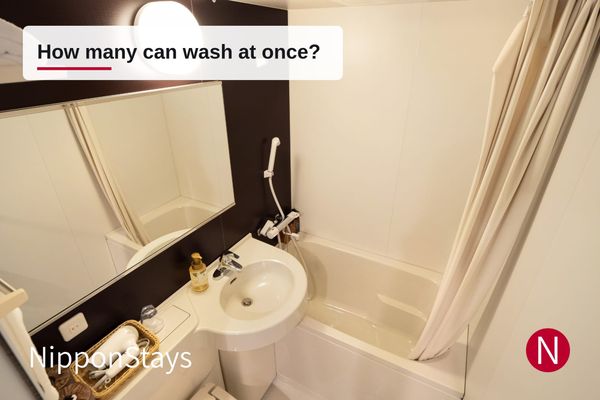
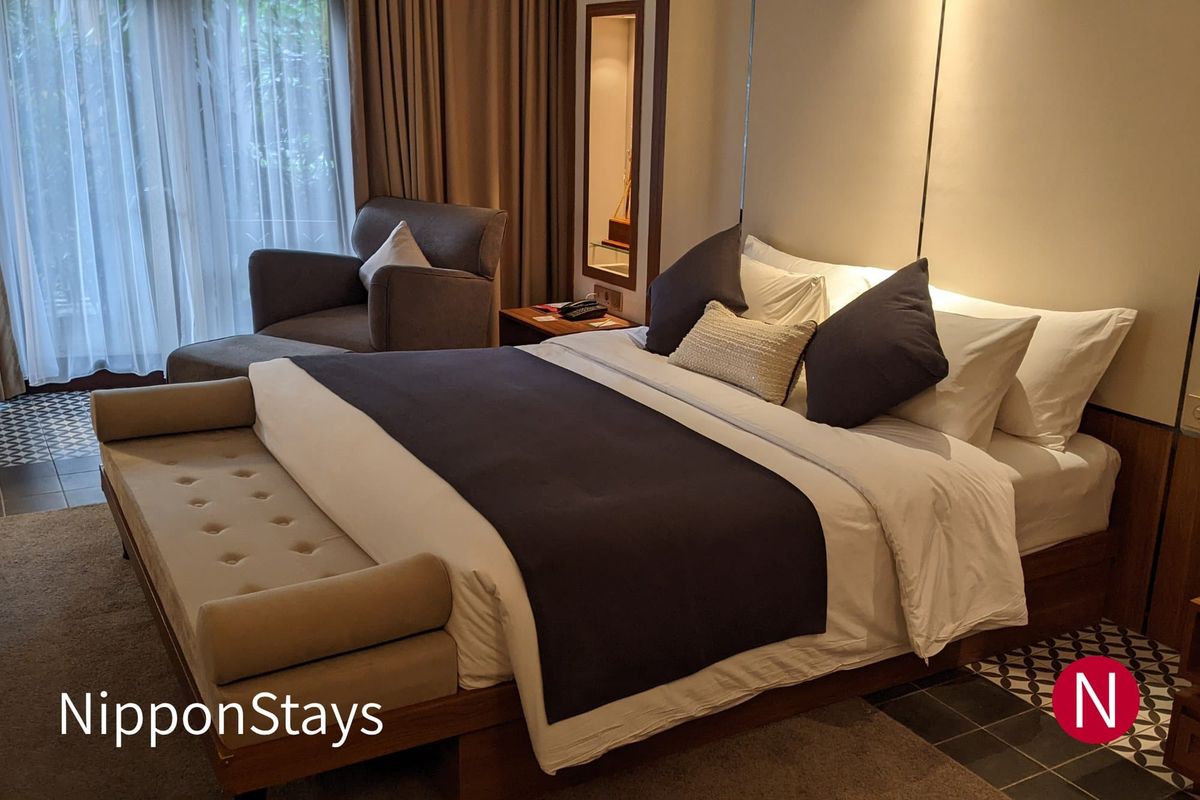
Japan's business hotel category — dominated by chains like APA Hotel, Toyoko Inn, Dormy Inn, and Super Hotel — offers private rooms with a locking door, a private bathroom (shower-over-bath or separate shower unit), a work desk, and free Wi-Fi. Rooms are compact, typically 11–16 m², but they are entirely yours.
Standard features across the major chains (verified July 2026):
- Private room with a locking door and keycard entry
- In-room desk, chair, and TV
- Private bathroom with toilet, shower, and amenities provided
- Air conditioning and blackout curtains
- Luggage fits under the bed or in a closet — no separate luggage room needed
- Check-in from 15:00, check-out by 10:00 at most chains
Toyoko Inn adds a free breakfast at most properties. Dormy Inn charges a slight premium but includes access to communal onsen-style baths — a genuine comfort upgrade after a long travel day. APA Hotel's rooms run 11–13 m², among the smallest in the category, but are clean, well-lit, and include a bidet toilet and electric kettle. Super Hotel Osaka Natural Hot Spring (Yumoto Hananoi) reopened after renovation in February 2024 with a natural hot spring bath drawn from 1,000 m underground, and its official site was still taking bookings at our last check (October 2026).
Price Gap: How Much Cheaper Is a Capsule?
Of the six properties sampled above, capsule options average ¥5,200 per night and business hotel options average ¥7,500 per night — a gap of roughly ¥2,300 per night (checked July 2026). Over a five-night stay, that difference is ¥11,500 — enough for two or three full meals at a sit-down restaurant, or a day trip by Shinkansen between cities.
The gap widens significantly during peak travel periods (Golden Week, late March cherry blossom, Christmas–New Year). Business hotel rates can spike to ¥15,000–20,000 per night in prime locations; capsule hotel rates are more stable, rarely exceeding ¥8,000 even in high season.
One important note: capsule hotel pricing is per person, always. Business hotels in Japan typically quote per room, so two people sharing a business hotel twin halves the per-person cost to ¥4,000–7,500 — competitive with or cheaper than two capsule pods.
Which to Pick by Trip Type
| Factor | Capsule Hotel | Business Hotel |
|---|---|---|
| Privacy | Pod with curtain or shade; no locking door | Private room, keycard door lock |
| Price per person | from ¥4,400 (solo) | from ¥7,000 solo; ~¥4,000/person if sharing twin |
| Luggage | Small locker + separate luggage room; large bags awkward | Fits under bed or in closet in your room |
| Couples / pairs | Not suitable — single-occupancy pods; couples need two pods on different floors | Twin/double rooms available; share one room |
| Bathroom | Shared (often communal baths/sauna included) | Private bathroom in room |
| Nights suitable for | 1–2 nights; transit stops; budget stretching | Any length; especially 3+ nights |
| Desk / work space | Usually none in the pod; communal lounge only | Desk and chair in every room |
| Late check-in | 24-hour front desk at most modern chains | 24-hour front desk standard |
For a practical decision: if you are a solo traveler on a one- or two-night stop in Osaka or Tokyo, carrying a carry-on bag only, a capsule hotel saves meaningful money and puts you in a prime transit location. If you are traveling with another person, carrying a checked-bag-sized suitcase, or staying three or more nights in one city, a business hotel is the cleaner choice. See our full Japan accommodation decision guide for city-by-city breakdowns.
For capsule hotel picks in Osaka specifically, see our Osaka capsule hotel guide. For capsule options in Fukuoka, our Fukuoka capsule guide covers the Hakata area. Business hotel choices near Shinjuku are covered in our Shinjuku business hotel guide.
Trip Essentials for Japan
Things worth booking before you land, all in English:
- eSIM — Airalo's Japan eSIM: install it at home and data works as soon as you switch off airplane mode at Haneda, Narita, Kansai, or wherever you land. Comparing providers? See our Japan eSIM guide.
- Tickets and day trips — Klook covers the Japan Rail Pass, teamLab tickets, and shinkansen-linked day trips; booking ahead skips the ticket-window line.
FAQ: Capsule Hotel vs Business Hotel Japan
Are capsule hotels good for couples?
Most capsule hotels in Japan are not suitable for couples sharing a sleeping space. Standard pods are single-occupancy only, and male and female guests are typically assigned to separate floors, meaning partners cannot share adjacent pods. A small number of newer or boutique capsule properties offer private double-pod suites, but these are the exception. Couples are generally better served by a business hotel twin or double room, which runs from around ¥8,000 per room — roughly ¥4,000 per person, competitive with two separate capsule pods.
How much cheaper is a capsule hotel compared to a business hotel?
Based on a sample of six properties in Osaka and Tokyo checked in July 2026, capsule hotel nightly rates averaged around ¥5,200 versus ¥7,500 for business hotels — a difference of approximately ¥2,300 per night per person when traveling solo. Over a five-night trip, that is around ¥11,500 saved. The gap tends to be larger during peak periods, when business hotel rates spike but capsule rates stay relatively stable.
Where do I store my luggage in a capsule hotel?
Capsule hotels provide a locker for day bags, wallets, and electronics — but standard lockers typically do not fit a large suitcase or 26-inch rolling bag. Most properties have a separate luggage room or coin-operated lockers for oversized bags. If you are arriving with a large checked bag, check the specific hotel's policy before booking. Traveling with a carry-on bag makes the capsule hotel experience considerably simpler.
Are business hotel rooms really that small in Japan?
Yes, single rooms at Japanese business hotels are compact — APA Hotel singles are 11–13 m², Toyoko Inn rooms are in a similar range. For comparison, a standard US hotel room runs 25–30 m². That said, Japanese business hotel rooms are efficiently designed: the bed, desk, and bathroom are all functional, and the small footprint rarely feels oppressive for one or two nights. For stays of a week or more, consider whether the limited floor space will affect comfort — particularly if you need to spread out work materials or have large luggage.