Onsen Ryokan Private Bath vs Shared Grand Bath: What You Are Really Buying
The in-room bath buys timing, not a better soak. The grand bath is usually the better bath. And kashikiri solves the same problem for a fraction of the premium.

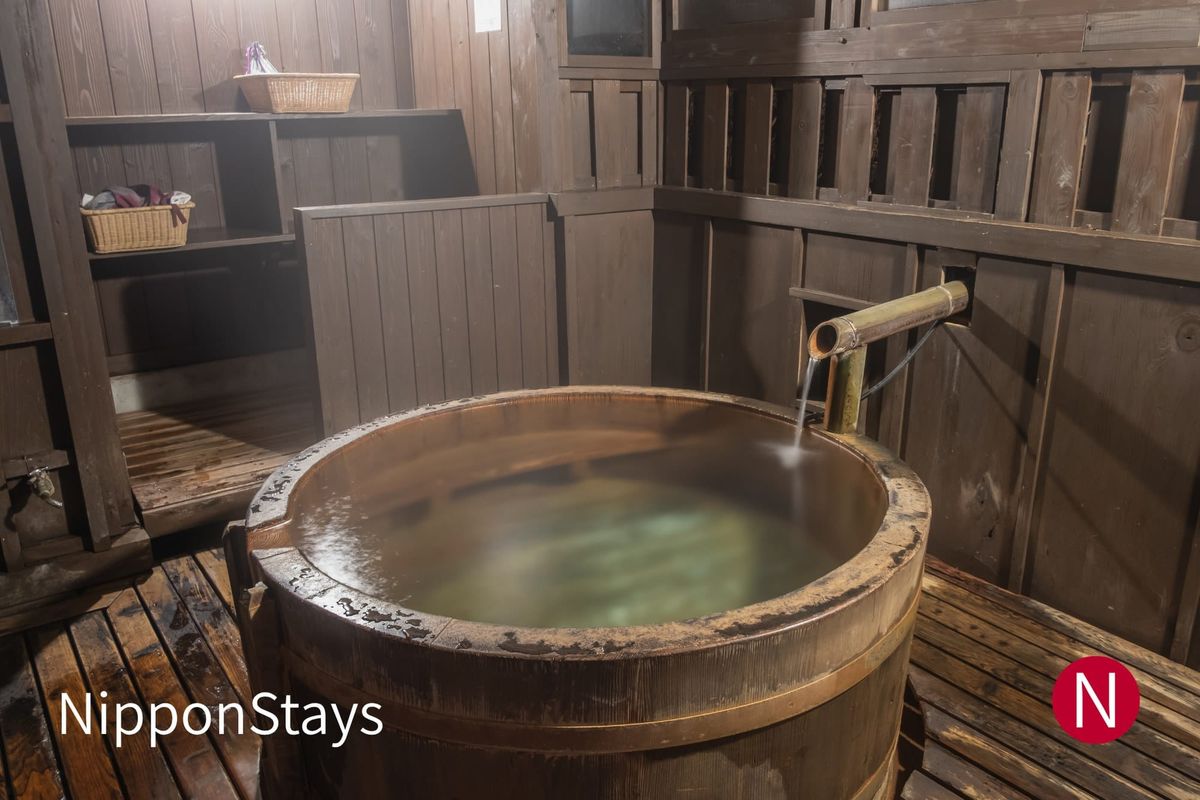
Onsen ryokan private bath vs shared grand bath is usually framed as a privacy question, and that framing gets it wrong. What the in-room bath actually buys you is timing — the ability to get in at 02:00, or straight off the train, without checking a schedule. The grand bath is normally the better bath: larger, properly temperature-managed, and the one with the view. Pay for the private bath if you have tattoos, small children, mobility limits, or genuine discomfort about bathing communally. Otherwise book the shared bath and reserve a kashikiri private slot, which most ryokan offer for a fraction of the room upgrade.
What you are actually paying for
A room with its own bath — rotenburo-tsuki kyakushitsu — typically carries a substantial premium over the same ryokan's standard room. Understanding what that premium buys is the whole decision.
It buys hours. The grand bath usually closes for cleaning in the small hours and switches between men's and women's sides on a schedule, so the exact bath you liked at 21:00 may not be the one available at 06:00. An in-room bath has no schedule at all.
It buys the arrival. You can be in the water twenty minutes after check-in, before dinner, without working out where anything is.
What it does not buy is a better soak, and the marketing rarely says so.
Why the shared bath is usually the better bath
This is the part English-language guides skip.
The grand bath is larger, which matters more than it sounds — you can stretch out, and the water volume holds temperature. An in-room outdoor bath is small, and in winter a small volume of water sitting in cold air loses heat quickly. Some are heated and circulated; some fill on request and then simply cool.
The grand bath is also where the ryokan puts its money. The view, the rock work, the covered and uncovered sections, the cold plunge if there is one — that is the showpiece. The in-room bath is a fixture on a balcony.
And at some ryokan the room bath is not spring water at all but heated tap water, because piping genuine onsen water to every room is expensive. This is a fair question to ask before booking and the answer is usually given plainly.
The option almost nobody mentions
Kashikiri is a private bath you reserve for a block of time, commonly around 45 minutes, and it exists at a large share of ryokan. Sometimes it is free with the room and booked at check-in; sometimes it carries a modest charge.
It solves nearly everything the in-room bath solves — tattoos, modesty, bathing as a couple or a family together — at a small fraction of the room premium. The one thing it does not solve is spontaneity, since you are booking a slot.
If you take one thing from this comparison: ask whether the ryokan has kashikiri before you upgrade the room. Many people pay the premium for a problem the reservation sheet at reception already solves.
| Name | Area | Price range | Best for |
|---|---|---|---|
| Yufuin Sansuikan | Yufuin, Kyushu | from ¥14,080 for two | Trying the shared-bath format before paying for a private one |
| Hyoe Koyokaku | Arima Onsen, near Kobe | from ¥39,886 for two | The large-scale bathing side, at a long-established Arima house |
| Gora Kadan | Hakone | Check current rates | The tier where in-room baths are properly built rather than added |
Rates are the lowest advertised for two with no dates specified, checked in August 2026, and normally include dinner and breakfast. Note that these are entry rates: at every ryokan we checked, the room categories with their own bath sit above the figure shown here, so treat the premium as additional to the number in this table.
The four cases where the private bath is the right call
Tattoos. This is the strongest case and the one most worth stating plainly. Many onsen still refuse entry to tattooed guests, and policies vary by property rather than by region, so the answer is unpredictable in advance. A room with its own bath removes the question completely — you are not asking anyone's permission. If you have visible tattoos and want to onsen without negotiating, this is what the premium is for.
Small children. A shared bath with a toddler is manageable but tense, and some ryokan set age or supervision rules. In the room, the stakes drop to zero.
Mobility. The grand bath means walking to another part of the building, changing in a shared area and negotiating wet stone. The room bath is a few steps.
Real discomfort with communal bathing. Not mild self-consciousness, which passes within about ninety seconds of getting in the water. Actual discomfort, which does not.
How to decide in one question
Ask yourself whether the reason you want privacy is a constraint or a preference.
Constraints — tattoos, children, mobility, genuine discomfort — do not go away, and they justify the room premium because you will use the bath repeatedly across the stay.
Preferences — wanting one quiet soak together, or wanting to avoid a busy hour — are solved by kashikiri for a fraction of the money. Book the standard room and the private slot, and spend the difference on the ryokan tier instead.
| If this is you | Choose | Price range | Best for |
|---|---|---|---|
| Visible tattoos | Private in-room bath | Above the entry rate | No permission needed at any property |
| Travelling with a toddler | Private in-room bath | Above the entry rate | No age rules, no tension |
| Want one soak as a couple | Kashikiri slot | from ¥14,080 room rate | The premium solved at reception instead |
| Want the best water and view | Shared grand bath | from ¥39,886 | Larger volume, holds heat, the showpiece |
| Winter, outdoor bathing | Shared grand bath | from ¥39,886 | Small in-room baths lose heat fast in cold air |
For finding the rooms themselves, our guides to Arima ryokan with private baths and Kyoto ryokan with private onsen list properties in each area. The onsen ryokan guide covers the country-wide picture, and Takegawara in Beppu covers the opposite end — municipal bathing at a few hundred yen, where the communal question is the whole point.
FAQ: private bath vs shared grand bath
Is a room with a private onsen bath worth the extra cost?
It depends on whether your reason is a constraint or a preference. Tattoos, small children, mobility limits and genuine discomfort with communal bathing are constraints, and the premium pays for itself across a stay. Wanting one quiet soak is a preference, and a reservable kashikiri slot solves it far more cheaply.
What is a kashikiri bath?
A private bath you reserve for a block of time, commonly around 45 minutes. It is available at a large share of ryokan, sometimes free with the room and booked at check-in, sometimes for a modest charge. It gives you privacy without the room upgrade, and it is worth asking about before paying the premium.
Can I use an onsen if I have tattoos?
Policies vary by individual property rather than by region, so the answer is genuinely unpredictable before you arrive. A room with its own bath removes the question entirely, which is why tattoos are the strongest single case for paying the premium. Some ryokan also allow kashikiri bathing for tattooed guests.
Is the water in a room bath real onsen water?
Not always. Piping genuine spring water to every room is expensive, so some ryokan use heated tap water in room baths while the grand bath runs on the spring. Ask directly before booking — the answer is normally given plainly, and it changes what the premium is buying.