Japan Rental Car 4WD in Winter: What You Actually Get
Studless tires come standard on Japan rental cars in Hokkaido winters, but 4WD costs ¥1,650/24h extra at 3 of 4 companies (checked Nov 2026).

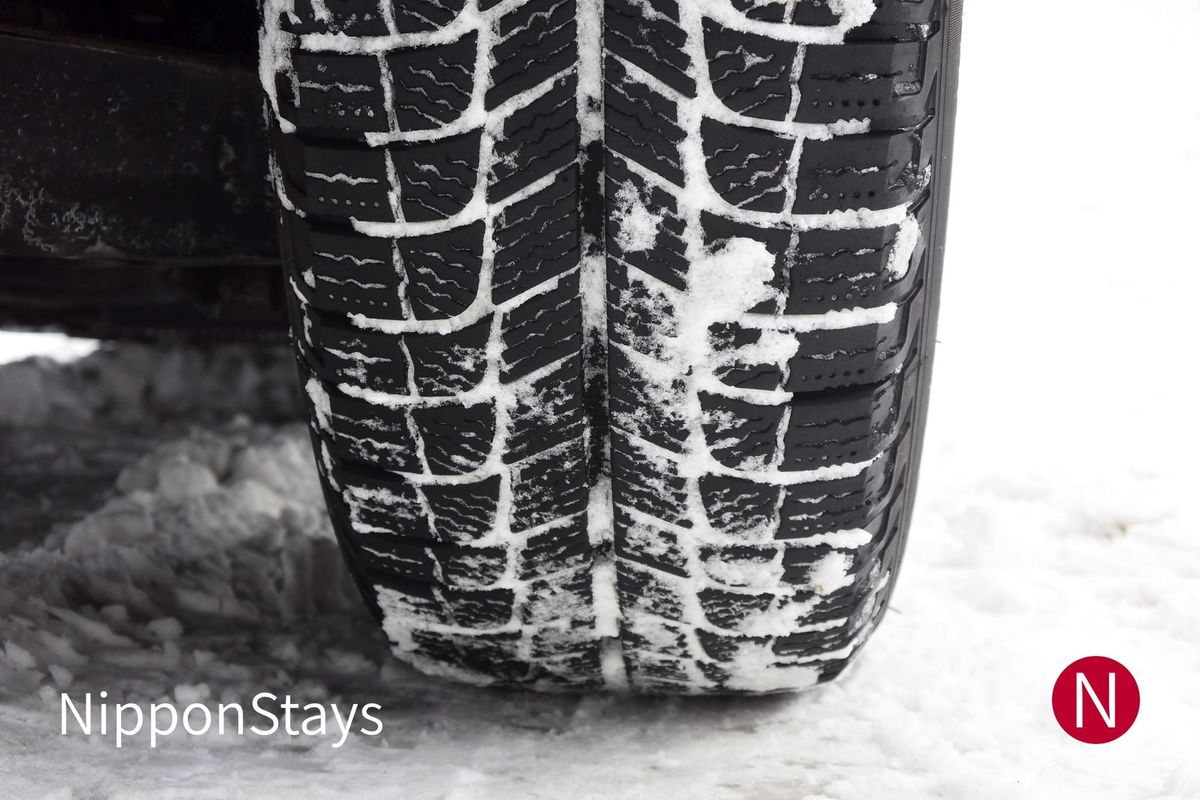
Quick Answer: A Japan rental car 4WD option is never automatic. Of the four major companies compared below (Toyota, Nippon, Orix, Times Car Rental), three charge the exact same fee to reserve 4WD by vehicle class — ¥1,650 per 24 hours, on top of any winter tyre charge — and the fourth has you request the specific 4WD model instead (terms checked November 2026). Studless tyres, by contrast, come standard on winter bookings across most of Hokkaido without you asking. What actually decides whether you get stuck isn’t luck at the counter; it’s which box you ticked when you booked.
What the four major companies actually offer
The table below compares the four companies with the widest counter network at Hokkaido and Tohoku airports, using the terms each publishes on its own site. Coverage details for getting stuck are listed only where a company spells them out; where one doesn’t, that’s worth asking about at the counter rather than assuming.
| Company | Studless standard in Hokkaido winter? | Reserve 4WD by class? | Extra charge for 4WD | Stuck-vehicle recovery |
|---|---|---|---|---|
| Toyota Rent a Car | Yes, at Hokkaido/Tohoku/Niigata/Chubu branches; the exact window varies by counter (Obihiro runs Oct 31–May 5, some Chubu counters only Dec 15–Mar 20) | Yes, as a paid designation | ¥1,650 per 24 hours (¥2,750 for the Bus class) | Not detailed on the public options page — ask at the counter |
| Nippon Rent-A-Car | Yes, Nov 1, 2026 – Apr 20, 2027 in Hokkaido | Yes, but by requesting the specific vehicle model rather than a flat class fee | No single published figure; tied to the model you request | One free stuck-vehicle recovery per contract year; extra call-outs are charged, and the service excludes unplowed roads and closed-off areas |
| Orix Rent a Car | Yes, on its Hokkaido winter plans; exact branch dates vary | Yes, as a paid designation | ¥1,650 per 24 hours (capped at 15 days’ worth) | Not detailed on the public options page — ask at the counter |
| Times Car Rental | Yes, on its standard-equipment routes; exact branch dates vary | Yes, as a paid designation | ¥1,650 per 24 hours | Not detailed on the public options page — ask at the counter |
All four keep counters inside the New Chitose rental car center, but their hours diverge once flights start running late. On past winter trips I’ve landed after most counters had wound down for the night, and Toyota Rent a Car’s was the one still staffed — that’s the reason it’s the company I’ve ended up with most often, not anything specific to its cars.
Studless tyres: standard, but check the window
Studless tyres aren’t a legal requirement the way snow chains are on some overseas mountain passes, but every major company fits them as standard equipment across Hokkaido for a set stretch of the year — and that stretch is published, dated, and different by company. Nippon Rent-A-Car’s current window for Hokkaido runs from November 1, 2026 through April 20, 2027 (Nippon Rent-A-Car’s winter season page, checked November 2026). Toyota runs a similar window store by store, with its Obihiro branch keeping studless tyres on from October 31 through May 5 — the longest window on its list — while some of its Chubu-region counters only cover December 15 through March 20 (Toyota Rent a Car’s studless-equipment page, checked November 2026).
Outside that window, or for a company that doesn’t auto-fit them for your dates, studless tyres become a paid option: Toyota charges ¥2,200 per 24 hours for a passenger or van-class car and ¥3,300 for a wagon or SUV, capped once you’re outside the standard-equipment period. Orix and Times Car Rental both quote a comparable option fee outside their own standard-equipment areas, with Times specifically noting a 10-day (240-hour) cap on how much of that charge applies. Book early enough in the season and this doesn’t come up at all — it only bites if you’re renting a two-wheel-drive class outside a company’s covered dates.
4WD: a class, not a guarantee
None of the four companies treats 4WD as something you’re owed just because you’ve booked a bigger car in Hokkaido in January. Toyota, Orix, and Times Car Rental each attach the same flat fee — ¥1,650 per 24 hours — to reserving a 4WD vehicle as its own class, separate from the studless tyre charge (Orix Rent a Car’s option pricing and Times Car Rental’s option pricing, both checked November 2026). Nippon takes a different route: rather than a class upgrade fee, its Hokkaido winter terms have you request the specific 4WD-equipped model by name, and availability depends on what that branch has on the lot that day.
In every case, it’s something you ask for, not something the counter clerk defaults to. That hasn’t stopped 4WD from showing up on the cars I’ve picked up in past Hokkaido winters — along with studless tyres as standard — but the terms above make clear that isn’t something to bank on without checking the booking page first, especially since all four companies warn that both studless and 4WD stock is limited and can sell out for your dates.
If you get stuck: what roadside assistance actually covers
Getting stuck in a snowbank and getting into an accident are two different problems, and the coverage for each is different too. Nippon Rent-A-Car publishes the clearest terms of the four: one stuck-vehicle recovery is free per contract year, additional call-outs after that are charged, and the service explicitly excludes roads that haven’t been ploughed, areas marked off-limits, and any stretch too rough for a normal vehicle to pass (Nippon Rent-A-Car’s support course page, checked November 2026). Toyota, Orix, and Times Car Rental don’t spell this out on their public pricing pages the way Nippon does, so it’s worth asking the counter directly what a winch-out costs and which roads are excluded before you drive off, not after you’re stuck.
An accident is a separate cost entirely, and a bigger one. One winter, my rental slid off the road in the snow — the car was probably written off. I called the police, then the insurance company, waited for a tow truck, and took a taxi the rest of the way home; my own out-of-pocket share came to roughly ¥100,000. That’s the number that makes the deductible-waiver option (often sold as a Collision Damage Waiver or CDW add-on) worth checking at each counter before you sign, since it caps exactly that kind of bill.
Wipers, washer fluid, and a snow brush
Equipment inside the car matters as much as what’s on the wheels. On the cars I’ve picked up in past Hokkaido winters, the wiper blades have been the winter-rated kind with a rubber boot over the frame, so they don’t ice up and skip across the glass, and there’s always been a small windscreen brush or ice scraper clipped somewhere near the door. None of them has come with a snow shovel — if you’re parking somewhere your own car might get boxed in by plough snow overnight, that’s worth buying at a convenience store rather than assuming the rental has one.
None of this shows up as a line item on a pricing page, so it’s not something you can confirm before you land. What you can confirm is the washer fluid: in freezing temperatures, ordinary summer washer fluid clouds the windscreen instead of clearing it, and every counter in Hokkaido switches to a winter-rated fluid for the season — but it’s still worth glancing at the reservoir cap before you leave the lot if you’re driving a long way between towns.
The ¥1,650 that's the same at every counter
Of the four companies compared in this guide, three — Toyota, Orix, and Times Car Rental — charge an identical ¥1,650 per 24 hours to reserve a 4WD vehicle by class, a fee that doesn’t change with car size or region. The fourth, Nippon Rent-A-Car, doesn’t publish a flat 4WD fee at all in its Hokkaido winter terms; instead, its site has you request the specific 4WD model directly (all terms checked November 2026). That’s a rare case of three competitors landing on precisely the same number, and it’s a useful one to know before you assume a quoted daily rate already includes it.
What to tick on the booking page
Once you know what to look for, working through a Japanese rental car booking form in winter takes a few extra minutes rather than a few extra worries. The table below is the checklist, matched to where it matters most.
| Tick this on the booking page | Why it matters | Where this actually plays out |
|---|---|---|
| Studless tyres confirmed for your exact dates | Standard-equipment windows differ by company and by branch; outside them, you pay an option fee or get stopped at the counter | Any drive through Hokkaido in winter |
| 4WD reserved by class (or model, at Nippon) | It’s a paid add-on everywhere, not a default, and stock runs out for popular dates | Mountain access roads, like the drive up to Kiroro from New Chitose |
| CDW/deductible-waiver level checked against your own tolerance for risk | Getting stuck free once a year and paying for an accident are two different bills | Anywhere you’re weighing driving against the resort bus |
| Passport plus International Driving Permit (or a qualifying licence) in hand at pickup | Without it, the counter can’t legally hand you the keys, whatever else is booked correctly | Just as true for a Honshu mountain rental like Takayama to Shirakawa-go |
Once the car and the paperwork are sorted, the next decision is usually where to sleep once you’ve got it — and whether a ski-in/ski-out base or a town base makes more sense for the driving you’re about to do.
Trip Essentials for Japan
Things worth booking before you land, all in English:
- eSIM — Airalo's Japan eSIM: install it at home and data works as soon as you switch off airplane mode at Haneda, Narita, Kansai, or wherever you land.
- Tickets and day trips — Klook covers the Japan Rail Pass, teamLab tickets, and shinkansen-linked day trips; booking ahead skips the ticket-window line.
FAQ: Winter Rental Cars in Japan
Do I need an International Driving Permit to rent a car in Japan?
Yes, unless you hold a Japanese licence or a licence from Switzerland, Germany, France, Belgium, Monaco, or Taiwan with a certified Japanese translation attached. Everyone else needs an International Driving Permit issued under the 1949 Geneva Convention on Road Traffic, valid for driving in Japan for one year from the day you land or until the permit itself expires, whichever comes first (National Police Agency guidance on foreign driving licences, checked November 2026).
Are studless tyres actually standard, or do I need to ask for them?
Within each company’s published Hokkaido window — for example, Nippon’s runs November 1, 2026 through April 20, 2027 — studless tyres come fitted automatically with no option to select. Book outside that window, or with a company whose dates for your branch don’t cover your travel, and you’ll pay an option fee instead, up to ¥3,300 per 24 hours for a wagon or SUV at Toyota.
How much extra does reserving 4WD cost?
¥1,650 per 24 hours at Toyota, Orix, and Times Car Rental, on top of any studless tyre charge. Nippon Rent-A-Car doesn’t list a flat figure and instead has you request the specific 4WD model when you book. All four treat it as something you ask for, not something a bigger car category guarantees.
What happens if I get stuck in the snow?
At Nippon Rent-A-Car, one stuck-vehicle recovery is free per contract year, and it excludes unplowed roads and areas marked off-limits — drive past a closure and you’re on your own until it clears. The other three companies don’t publish the same detail, so ask at the counter what a winch-out costs before you need one, not after.