Custom Zori in Kyoto: What a Fitting Is Actually Like
A made-to-measure zori fitting at Gion Naito: both feet measured separately, three to four months' wait, and a comfort you only notice at the end of the day.

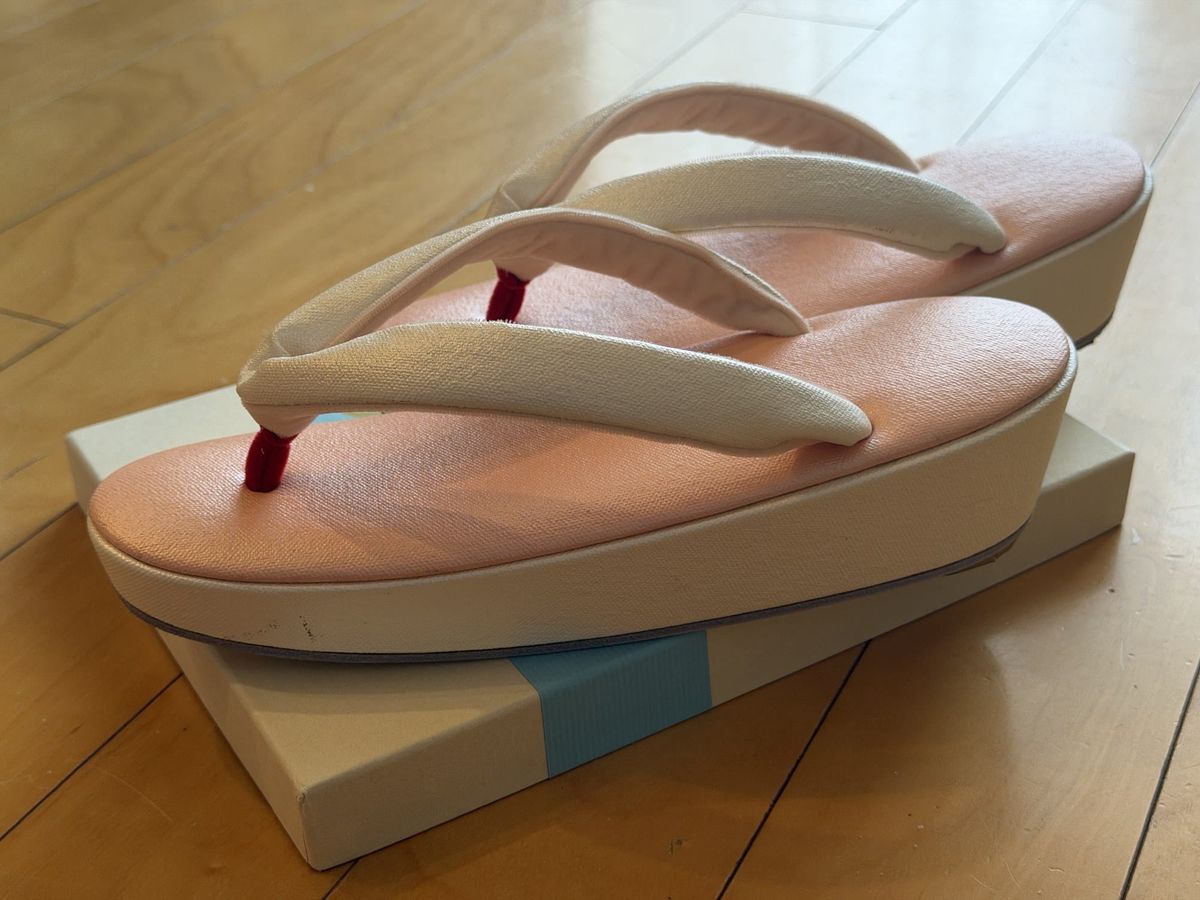
Ordering custom zori in Kyoto is not a souvenir purchase. At Gion Naito, a maker of Kyoto footwear working under the trade name kyo-hakimono-tsukasa since 1897 and now in its fifth generation, a made-to-measure pair took three to four months and arrived by post long after we had flown home. The appointment itself is the part a visitor can actually have: about an hour, one-on-one, both feet measured separately, and a long conversation about what you intend to wear the sandals with. Go for that. And if you need something to carry home this week, the same house sells a ready-made line, OJOJO NAITŌ, from a second shop in the same Gion block and online all year (checked August 2026) — a modern sandal rather than formal zori, but built by the people who measure feet for a living.
The appointment is the thing you can book
We booked by direct message on Instagram rather than walking in. That was a decision about nerve as much as logistics: the shop front is a glass case of footwear behind a wooden lattice on Nawate-dori, and from the street it reads as somewhere you should already know about. Booking removed the question of whether we were allowed to be there. The shop's own leaflet asks you to phone first (075-541-7110), so treat that as the route it expects and the message as the one that worked for us.
Two practical things came out of that message. First, we asked in advance whether our daughter, then six or seven, could come along, and she could. Second, we had a time, which mattered more than we expected, because the shop keeps afternoon hours: 13:00 to 18:00, closed Tuesdays and on the second and fourth Sunday of each month (checked August 2026). A seven-night trip gives you six afternoons at best to get there, five if your Sunday falls on the second or the fourth — and none of them before lunch. Anyone planning a morning of temples in Higashiyama and a fitting afterwards has the order right. The ready-made shop described below, in the same block, opens at 11:00 instead — so a morning is only lost if the fitting is the whole point of the visit.
Inside, we gave our name, were asked to sit, and then spent the better part of an hour with one person and no other customers in the way. Nobody hurried us toward the case by the window — and the shop's own printed material explains why: the footwear on the display shelves is there as samples, not as stock (checked August 2026). There is nothing to point at and buy.
They ask what you will wear it with before they ask anything else
The first real question was not about size or colour. It was about occasion: which kimono, worn where, how often. We said we wanted something for ordinary outings that would also carry a school ceremony, and that we wanted to feel better wearing it than not.
That order of questions is the same thing we ran into when buying a folding fan in Kyoto, where a fan for tea, a fan for dance and a fan for formal dress are three unrelated objects sharing one English word. Kyoto's specialist shops start from use and work back to the object. If you arrive having already decided on a look, you are answering a question nobody asked.
Both feet, measured separately, and a pattern kept on file
Then came the measuring: height and width taken for the left foot and the right foot as separate problems, not one measurement applied twice. A pattern was made from it and kept at the shop against our name, so a future pair can start from the file rather than from scratch.
This is the whole difference, and it is worth being blunt about what it buys you and what it costs you.
| Ready-made zori | Made to measure at Gion Naito | |
|---|---|---|
| Wait | Carry it out of the shop | Three to four months, posted to you |
| Fitting | Choose the nearest size | Left and right measured separately |
| Repeat orders | Start again each time | Pattern kept on file under your name |
| Repairs | Usually replace | Built to be repaired — the shop services pairs it made 30 and 50 years ago |
| Best for | A trip, a rental kimono, a first pair | Someone who already wears kimono and knows why |
The file is not a sales device. Gion Naito says plainly that a good number of its customers are still wearing pairs it made 30 and 50 years ago, brought back for repair rather than replaced (checked August 2026). That is the timescale the price is being asked to cover, and it is the reason the colour question below is a serious one.
We are not publishing what we paid. We were shown a range before the appointment and the final figure sat inside it, but our record of the number is a memory rather than a receipt, and a wrong price in an article like this is worse than no price. The shop does not publish a rate card either; ask when you book, because the answer depends on what you are asking them to make.
The colour advice that decided it
We arrived with one fixed idea: the top of the sandal and the sides should be different colours. We ended with white sides and a pink top that was, frankly, younger than the age we were about to admit to. That hesitation was real — these are made to be repaired and worn for years, and a colour you outgrow is an expensive mistake.
What settled it was a sentence from the other side of the counter. Once the sandal is on, the top is the part almost nobody else sees. It is the surface you look down at. So it should be the colour that lifts you, not the colour that photographs discreetly.
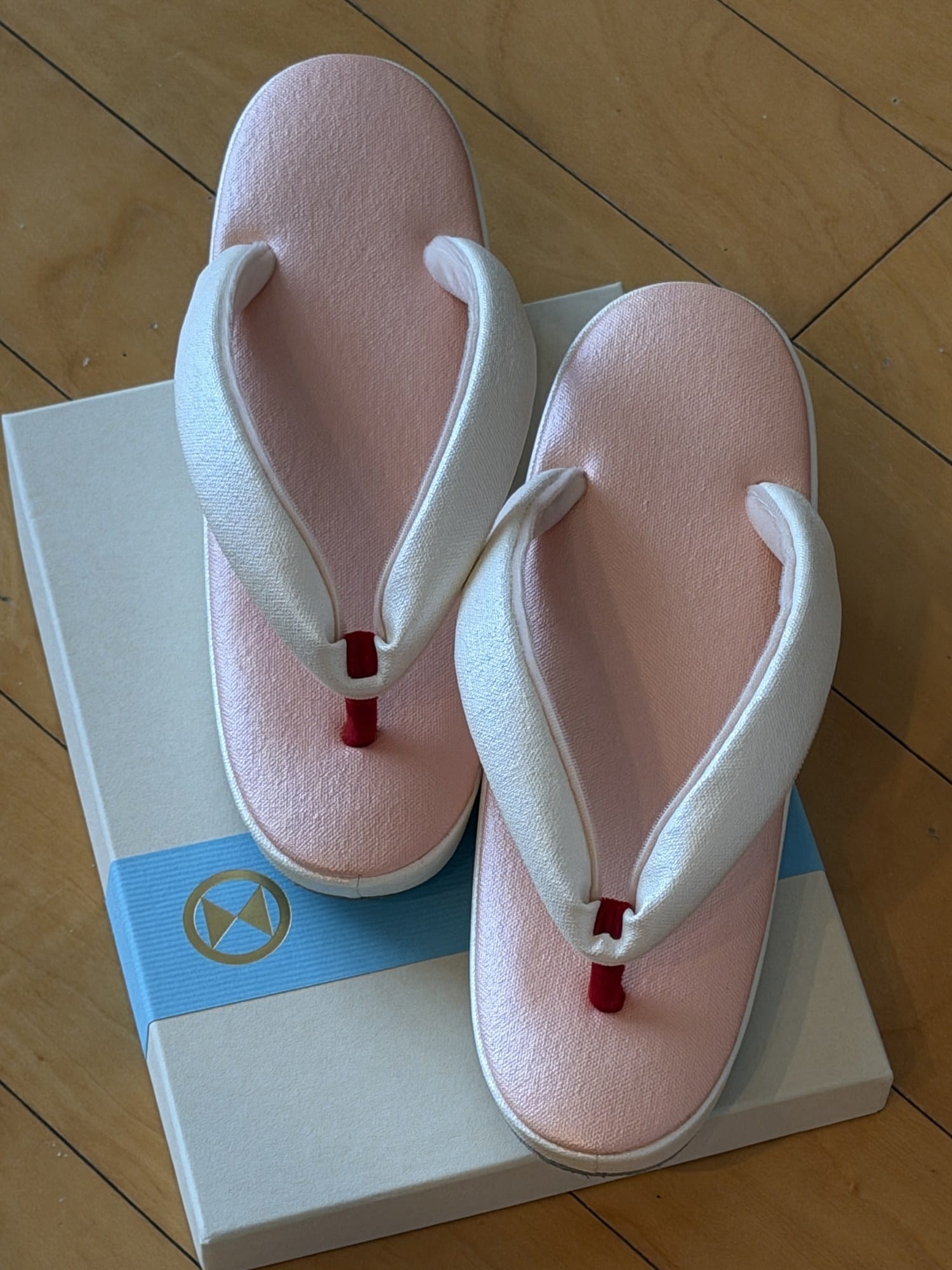
We think that is the single most useful thing we brought home from the shop, and it is free. It also reframes the transaction: this is not a shop where you point at the case. It is a shop where you describe a life and someone tells you what that means for the object.
What you notice is the absence of something
Here is the honest version of the payoff, because the romantic version is wrong. There was no glass-slipper moment. The first wearing did not feel like being lifted off the ground.
The pair sat in its box for about a year before an occasion came up. Then, at the end of a full day out, came the actual discovery: wait — how was today? Oh. I am not tired at all.
The sensation while wearing them is close to nothing, and that is the point. Not lightness — fit. The things that make ordinary zori and geta a small negotiation all day, the awareness of a slab under the foot, the way they have to be managed on stairs and slopes, the low-grade wrongness of the walk, were simply absent. Since then, if it is dry, this is the pair that gets worn.
Set against the other Kyoto workshops we have spent time in, the pattern holds: these three were founded in 1689, 1823 and 1897, and the youngest of them is 129 years old (checked August 2026). None of them sells a feeling at the counter. They sell an object that behaves correctly for years, and the feeling turns up later.
The thing nobody mentions until you own a pair
They do not go out in the rain. As we understand it, water taken up around the thong travels into the body of the sandal, so a wet street is a real risk rather than a fussy rule. Anyone who wears kimono seriously keeps a separate rain pair; ask about that at the fitting if your trip is in June.
The same house sells something you can carry out of the shop
The fitting room keeps no stock, but the company does. OJOJO NAITŌ — formerly JOJO Naitou — is Gion Naito's ready-made line: the zori structure rebuilt as a modern sandal, with a swimwear-grade thong, a silicone toe post, a cork footbed and a rubber outsole. It is not formal footwear and will not stand in for it at a ceremony. It has its own shop at Kameicho 43-2, in the same Gion block as the fitting room, open 11:00 to 18:00 and closed Tuesdays, and the full range is on the maker's own online shop all year (checked August 2026).
| Line | What it is | From |
|---|---|---|
| CoJOJO | Heel-less, sold as posture training | from ¥16,500 |
| OJOJO 01 / 02 | The everyday sandal | from ¥30,800 |
| KODORI | Platform line, cut to work with kimono | from ¥71,500 |
| Tabi socks | Split-toe, to go under any of it | from ¥2,420 |
| Spare parts | Toe post, thong, outsole, insole | from ¥2,200 |
Tax-included prices from the maker's own catalogue; checked August 2026.
The last row matters more than the prices. Of the 34 items in that catalogue in August 2026, 13 are spare parts — a shop that sells you a sole on its own is expecting the sandal back, which is the made-to-measure argument priced in public. Shipping is a flat domestic rate with nothing said about sending anything abroad, so buy in person or have it delivered to your hotel.
If you cannot reach Kyoto, eight of the shops carrying the ready-made line are department stores, and the maker's own list puts it in the men's building at Isetan Shinjuku, first basement (checked August 2026). The made-to-measure side travels once a year instead, taking a week on the kimono floor of Nihonbashi Mitsukoshi each April — 12 to 18 April in 2023, 3 to 9 April in 2024, the invitation arriving with our own pair. The dates move every year, so confirm before you build a trip around them.
Where to stay for an afternoon appointment in Gion
The shop sits on Nawate-dori (Yamato-oji) just south of Shijo — Gion Nawate Shijo-sagaru, Higashiyama-ku, Kyoto 605-0803 — and its own map sends visitors out of Keihan Gion-Shijo by Exit 6 or Exit 1 (checked August 2026). That puts it inside the Gion and Higashiyama cluster rather than near Kyoto Station. If you have a fitting booked, stay east of the river and you can walk to it — see our fuller guide to hotels in Gion and Higashiyama, or the case for the area against the station in Kyoto Station vs Gion. For a stay with more of the same craft logic, machiya stays in Higashiyama put you in a restored townhouse a few streets away.
| Hotel | Area | From | Suits |
|---|---|---|---|
| Imperial Hotel Kyoto | Gion Kobu, in the Yasaka Kaikan | from ¥133,000 | A landmark building in Gion Kobu, 55 rooms; opened March 2026 |
| The Shinmonzen | Shinmonzen-dori, Gion | from ¥190,000, direct only | Nine rooms on the antique-dealers' street, north of the shop |
| AKARI Kyoto Gion (formerly Kyoto Inn Gion) | Gion, Shijo | from ¥13,000 | Walking distance on a budget |
| THE HOTEL HIGASHIYAMA KYOTO TOKYU | Higashiyama | from ¥35,000 | Mid-range, east of the river |
| Park Hyatt Kyoto | Ninenzaka | from ¥165,000 | Making the appointment part of a bigger trip |
Rates are "from" floors that move with the season; checked July 2026, and August 2026 for the Imperial.
There is a second way to choose, and it is about language. The shop asks you to phone first, and the appointment runs in Japanese. A long-established Kyoto house can put a member of staff on the phone with you: the same move as asking a concierge abroad about something you cannot arrange yourself. No introduction is needed; ours was arranged without one. Whether it helps depends on the day and who picks up.
| Long-established house | Trading since | Area | From price (2 guests) |
|---|---|---|---|
| Tawaraya Ryokan | 1704 | Fuyacho Anekoji, Nakagyo — west of the river | Not published; enquire |
| Hiiragiya Ryokan | 1818 | Fuyacho Anekoji, Nakagyo — west of the river | from ¥103,000 for two |
| The Westin Miyako Kyoto | 1890 | Keage, Higashiyama | from ¥33,000 for two |
The two lists barely overlap. Tawaraya and Hiiragiya are at Fuyacho Anekoji, west of the river: roughly a 20-min walk, or a short taxi. The Westin Miyako is further out at Keage. The walkable list is not only mid-range — The Shinmonzen has been on Shinmonzen-dori since 2021 and the Imperial Hotel Kyoto opened inside the Yasaka Kaikan in March 2026, both minutes away. What the older houses offer is not a better address but a front desk that will make the call for you. The Shinmonzen releases no rooms to the booking sites; book it direct. Ryokan rates are usually per person with two meals, not per room; confirm what is included. Checked August 2026.
Trip Essentials for Kyoto
Things worth booking before you land, all in English:
- eSIM — Airalo's Japan eSIM: install it at home and data works as soon as you switch off airplane mode at Kansai Airport.
- Airport transfer — Klook covers bus, train, and private transfers from Kansai Airport.
- Luggage storage — arriving before check-in? Radical Storage takes bags at shops near Kyoto Station for a flat daily rate.
- Tickets and day trips — Klook covers Arashiyama activities, tea ceremonies, and Nara day trips; booking ahead skips the ticket-window line.
FAQ: custom zori in Kyoto
Can a tourist order custom zori in Kyoto?
You can attend a fitting as a visitor — ours was booked by Instagram message and conducted one-on-one in about an hour. The obstacle is delivery, not access: the pair took three to four months and was posted within Japan. Ask whether they will ship to your country before you commit, because we have not confirmed that they do — the ready-made line's own shipping page covers Japan only (checked August 2026).
Can I buy Gion Naito footwear without going to Kyoto?
The ready-made line, yes: it is sold online all year and stocked by shops across Japan, including the men's building at Isetan Shinjuku (checked August 2026). Made-to-measure needs the fitting, so that means Kyoto — or the shop's April week at Nihonbashi Mitsukoshi, if the dates happen to fall inside your trip.
How long does made-to-measure zori take?
Three to four months in our case, in 2024. Nothing is carried out of the shop on the day. If you want something to wear on this trip, buy ready-made and treat the fitting as research.
What does custom zori cost?
Gion Naito does not publish a price list, and we are not quoting ours from memory. Expect a serious figure and ask for the range when you book — it depends on materials and on what you want the pair to do.
Is it worth it if I only wear kimono occasionally?
Probably not for the sandals themselves. The comfort difference is real but it shows up as not being tired after a long day, which is a benefit you only collect if you have long days in kimono. Occasional wearers get most of the value from the hour of advice.
Do I need to speak Japanese?
Our appointment was in Japanese and involved a lot of back-and-forth about use and materials, so a translation app or a Japanese-speaking friend will change what you get out of it. We have not confirmed what English support the shop offers; ask when you send the booking message.
What should I ask at the fitting?
Three that earned their keep: what do you recommend for how I actually wear kimono, which colour will I still want in five years, and what will damage these. The last one is how you find out about the rain.
Information audit: Last fact-checked August 2026 · Shop hours, closing days, address and telephone number read off the shop's own printed leaflet and brochure, held in hand August 2026, and cross-checked against the Gion shopping association's official listing · The 1897 founding year comes from the association listing; the shop's own wording is "more than 100 years" · The ready-made line's shop address and hours, catalogue prices, repair prices and shipping terms are read off the maker's own online shop, checked August 2026 · The April 2023 Tokyo dates come from the brand's own press release; the April 2024 dates from the printed invitation sent with our order · Hotel rates checked July 2026 · How this guide was researched: the fitting described here took place in January 2024 and is our own, and the photographs are of our own pair · Prices for the sandals are deliberately omitted rather than reconstructed from memory.