Buying a Folding Fan in Kyoto: Start With the Ceiling Nobody Charges For
A sensu is six objects sharing one English word — including formal fans that never open. Two Kyoto shops, founded 1689 and 1823, and what to ask in them.

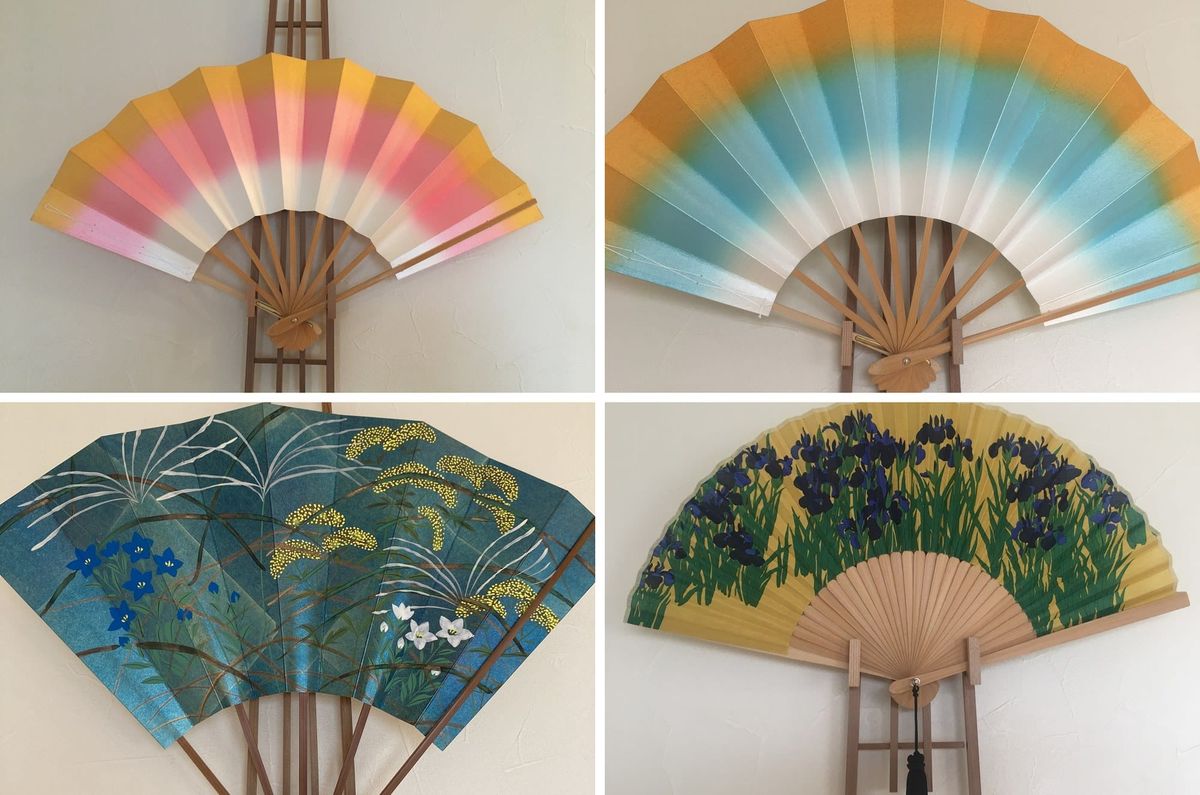
Buying a folding fan in Kyoto is easier than the shopfronts suggest, and the way in is to stop treating a fan as one object. At Miyawaki Baisen-an, founded in 1823, everyday fans start from ¥2,200 — and the same shop sells a fan-throwing game set at ¥49,500 and formal fans that are never opened at all. At Aiba, a fan maker since 1689, the round uchiwa run from ¥4,400 to ¥27,940 and many are made to hang on a wall rather than to cool you. Buy a folding sensu if you want something you will use; buy an Aiba uchiwa if you want something you will look at. Both shops are a 10-min walk apart in central Kyoto.
Start upstairs, where nothing is for sale
The doorway is the real obstacle. A Kyoto shop that has traded since the Edo period looks like somewhere you need an appointment, and most visitors walk past.
Miyawaki Baisen-an solves this better than any amount of encouragement. On the second floor, its coffered ceiling holds 48 fan-shaped paintings installed in 1902, by painters of the Kyoto school including Tomioka Tessai, Takeuchi Seiho, Tanomura Chokunyu and Kawai Gyokudo. Viewing is free, no reservation is needed, and you can go up during normal shop hours.
Tessai is not an incidental name here. He is the painter who gave the shop the name it still trades under, in 1887.
So there is a version of this visit where you buy nothing. Walk in, go upstairs, look at a ceiling that would be a ticketed attraction anywhere else, and leave. Once you have done that, the ground floor stops being intimidating.
A sensu is six different objects wearing one English word
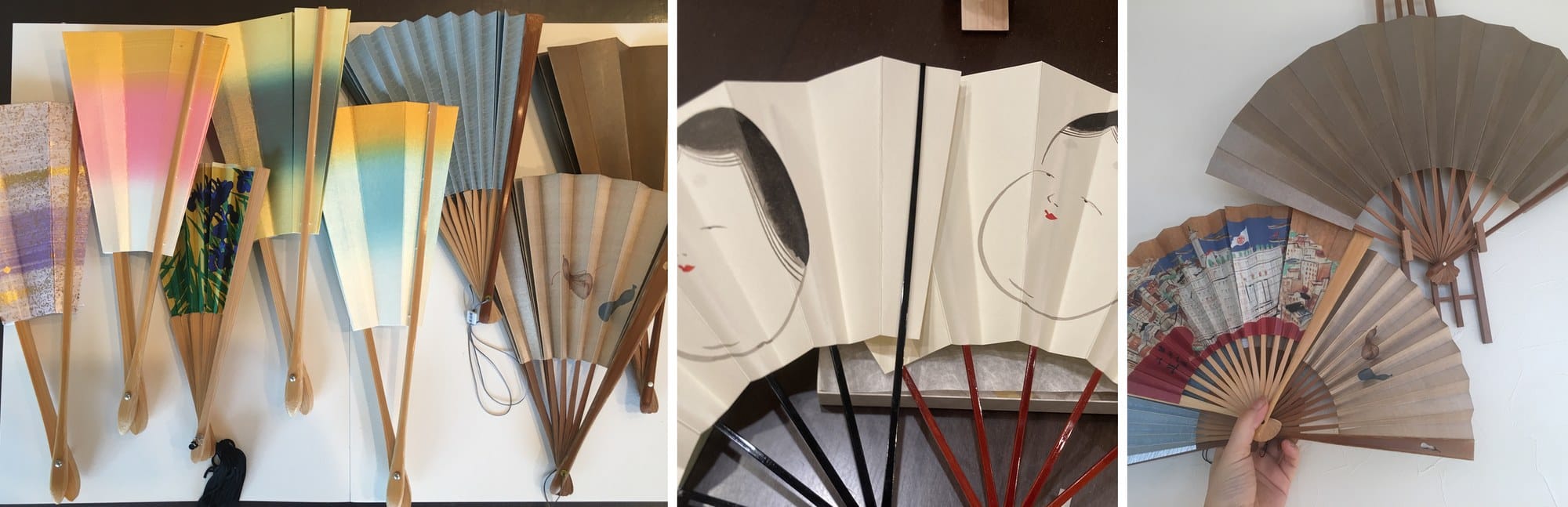
"Japanese fan" flattens a set of things that share a shape and almost nothing else. This is the part worth understanding before you choose, and it is what the staff can talk about if you ask.
To cool yourself. The everyday summer fan, opened and used. Baisen-an's start at ¥2,200, with most of the range from about ¥4,400.
For tea. A tea-ceremony fan is not there to move air. As it was described to us by a practitioner who owns six or seven of them, it is placed between people to mark a boundary and used when greeting. Patterns get matched to the season — a cherry design for cherry season — and teachers sometimes give them as keepsakes.
For dance. In Japanese classical dance the fan is a prop, handled as a cup, a flower, or whatever the piece requires.
For formal dress. The one that surprises people most: some fans used with the highest grade of formal kimono are not meant to be opened. They sit closed, tucked into the obi. Because they are seen closed, the decoration goes into lacquer, gilding and family crests, and the prices climb accordingly.
For play. Baisen-an sells tosenkyo sets at ¥49,500 — a game where you throw an open fan at a target on a stand. The set contains a butterfly target, a stand and five fans.
To look at. Decorative fans with their own hangers, which brings us to the other shop.
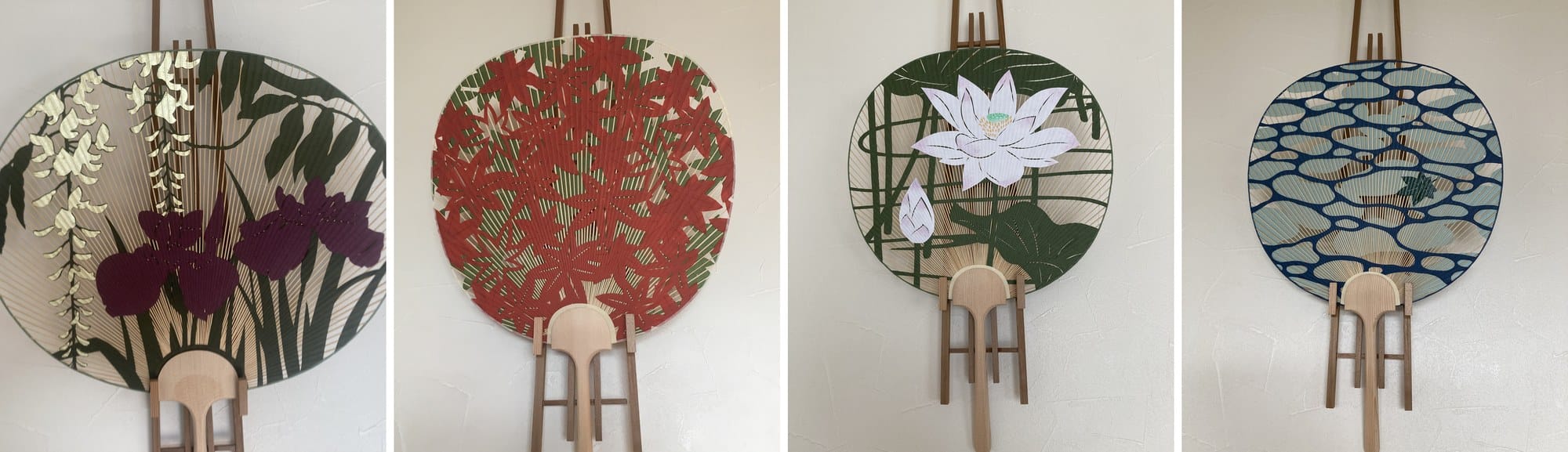
Aiba makes uchiwa to hang, not to wave
Aiba has been making Kyoto uchiwa — the rigid round fan on a handle — since 1689, and was once a purveyor to the imperial court. The shop sits one block north of Nishiki Market, at the corner by the Starbucks on Shijo-dori.
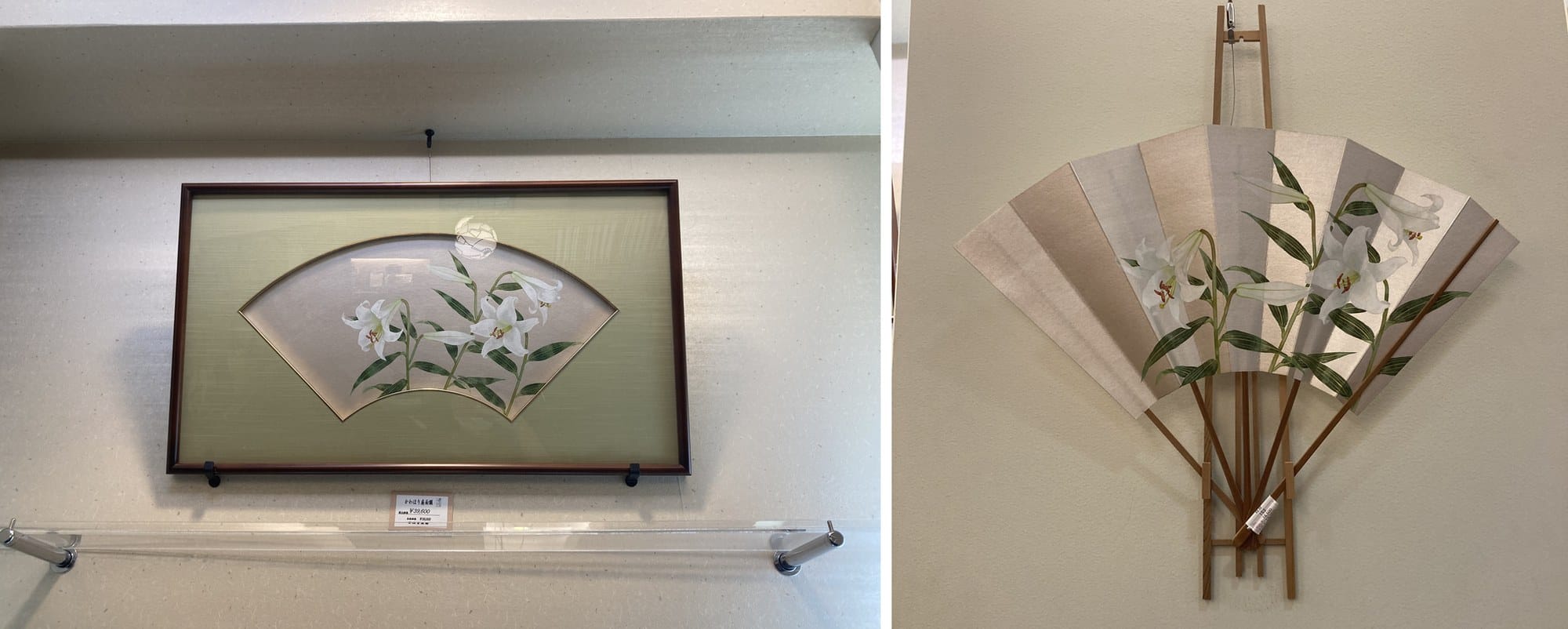
The catalogue runs from ¥4,400 for the smallest cut-out design to ¥27,940. At the top end these are wall pieces rather than tools: the ¥27,500 display uchiwa measures 41 × 36.5cm on handmade washi with real gold leaf for the moon, and comes with a bamboo stand that works either free-standing or hung.
Two practical notes. Items made to order ship in about three weeks, and pieces using gold leaf or mineral pigments take three weeks to two months — so a display piece is not a same-day purchase. And custom work starts from ¥3,000 plus design fees, which is a different figure from the ¥4,400 retail floor and is often confused with it.
| Shop | What it makes | Price range | Best for |
|---|---|---|---|
| Miyawaki Baisen-an (est. 1823) | Folding fans, sensu | from ¥2,200 | Something you will actually carry and use |
| Aiba (est. 1689) | Kyoto uchiwa, round fans | ¥4,400 – ¥27,940 | A wall piece, or a gift that gets displayed |
| Baisen-an tosenkyo set | Fan-throwing game | ¥49,500 | The souvenir nobody else brings home |
Prices checked in August 2026 from each shop's own online catalogue. Of the 98 fans Baisen-an listed online at that check, the entry price was ¥2,200 and the most expensive single fan ¥39,600 — but the shop's own FAQ states that the online range is an excerpt of what is in the store, so the ceiling in person is higher than any published figure.
What the online shop does not show you
That last point matters more than it sounds, and Baisen-an states it plainly: some items exist in the shop and not online.
The practical consequence is that browsing the website before you go tells you the price bracket but not the range. Formal and ceremonial fans, in particular, are not something you can price from a laptop.
The other consequence is firmer: Baisen-an does not ship internationally. The shop says so in English on its own site. Whatever you want has to be bought while you are in Japan, which makes the shop visit the only route rather than a nice extra.
The three questions that turn a purchase into an experience
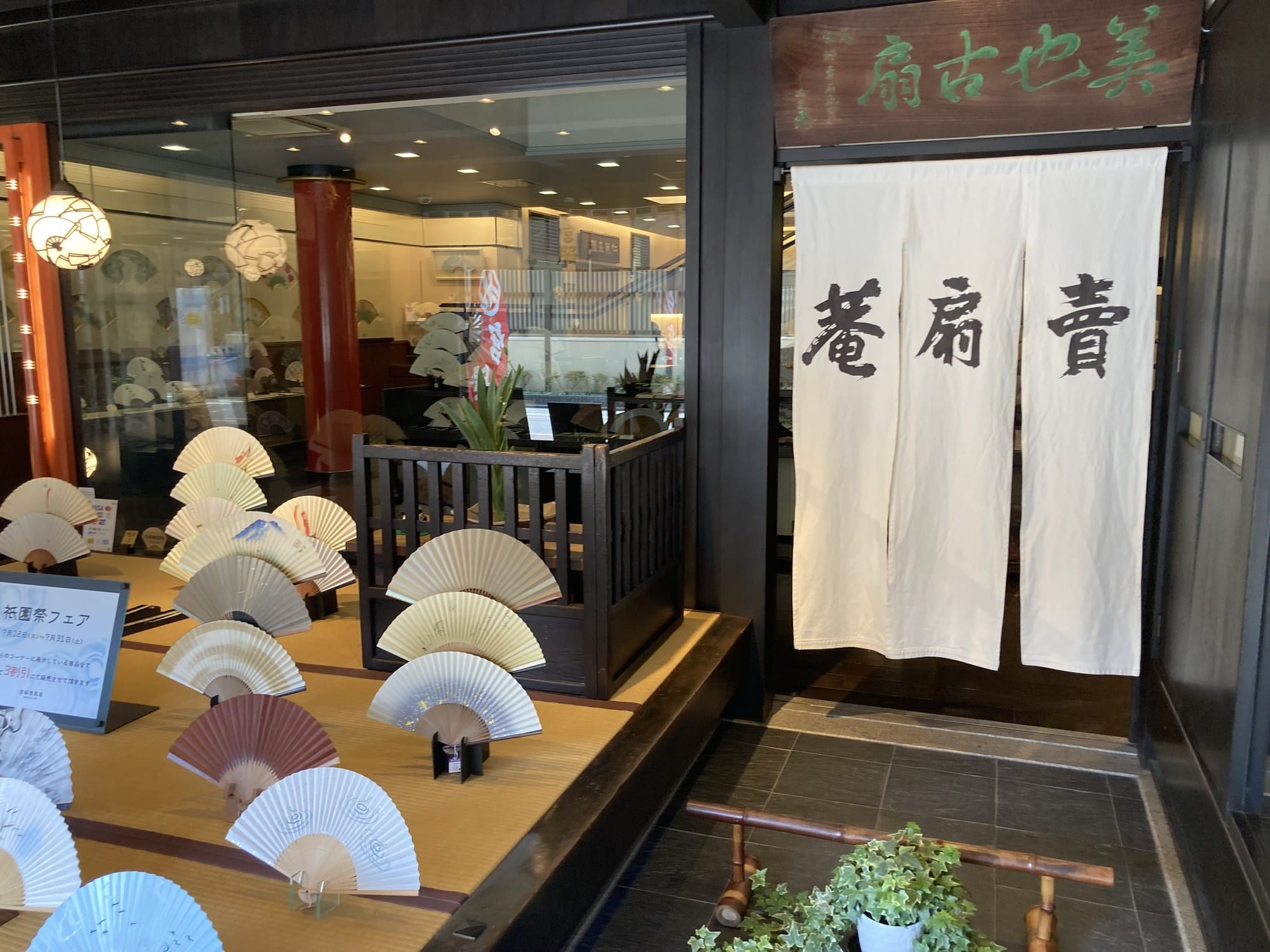
Kyoto's long-established shops read as closed to outsiders and are not. These are businesses that have been handed down for generations precisely by adapting, and a customer who is genuinely interested is a customer they want.
The move is not to walk in and point. It is to ask, politely, and let the answer choose the fan:
- How is this one used? This is the question that surfaces everything above — whether you are holding a tea fan, a dance fan or something to put in your bag.
- If I want to hang it, which would you suggest? Display and use are different categories, and the answer will not be the same object.
- What is the flower for this season right now? Seasonal motifs are the organising logic of the whole craft, and this question gets you the reason behind a pattern rather than just the pattern.
For a gift, one more idea worth stealing: match the recipient's birth month to the Japanese plant associated with that season, and choose the motif from there. It produces something more considered than the cherry blossom and gold leaf that dominate the souvenir shelves, and it gives you something to say when you hand it over.
Where to stay to make this a walk
Both shops are in Nakagyo-ku within about ten minutes of each other — Baisen-an on Rokkaku-dori, a 7-min walk from Karasuma Oike station, and Aiba on Yanaginobanba just north of Nishiki Market, a 10-min walk from Shijo or Hankyu Karasuma. Anywhere in the Kawaramachi and Sanjo area puts both on foot.
| Name | Area | Price range | Best for |
|---|---|---|---|
| Hotel Forza Kyoto Shijo Kawaramachi | Shijo Kawaramachi | from ¥6,776 for two | The cheapest way to have both shops on your doorstep |
| The Gate Hotel Kyoto Takasegawa | Kawaramachi Sanjo | from ¥21,296 for two | Being between the shops and the Kamo River |
| Mitsui Garden Hotel Kyoto Sanjo Premier | Sanjo | from ¥24,204 for two | Closest of the three to Baisen-an |
Rates are the lowest advertised for two with no dates specified, checked in August 2026.
Opening hours are worth checking against your day. Baisen-an runs 10:00–18:00, until 19:00 in summer, and is open year-round except 29 December to 4 January. Aiba runs 10:00–18:00 and closes on Sundays and public holidays — except from April to July, when it opens every day.
For the rest of the neighbourhood, our guide to what to buy at Nishiki Market covers the street one block south of Aiba, central Kyoto machiya stays covers the townhouse alternative to the hotels above, and Kyoto Station vs Gion settles the wider question of where to base yourself. If craft shopping is a thread through your trip, Japan Traditional Crafts Aoyama Square covers the Tokyo equivalent.
The other made-to-measure purchase in the same part of town is footwear. Ordering custom zori at Gion Naito describes an appointment at a house trading since 1897, where both feet are measured separately and the pair arrives by post months later, and it covers where to stay for an afternoon fitting in Gion.
Trip Essentials for Kyoto
Things worth booking before you land, all in English:
- eSIM — Airalo's Japan eSIM: install it at home and data works as soon as you switch off airplane mode at Kansai Airport.
- Airport transfer — Klook covers bus, train, and private transfers from Kansai Airport.
- Luggage storage — arriving before check-in? Radical Storage takes bags at shops near Kyoto Station for a flat daily rate.
- Tickets and day trips — Klook covers Arashiyama activities, tea ceremonies, and Nara day trips; booking ahead skips the ticket-window line.
FAQ: buying a folding fan in Kyoto
How much does a good fan cost in Kyoto?
Everyday folding fans at Miyawaki Baisen-an start from ¥2,200, with most of the range from about ¥4,400. Aiba's round uchiwa run ¥4,400 to ¥27,940, with display pieces using real gold leaf at ¥27,500. Formal and ceremonial fans cost considerably more but are not sold online, so there is no published price to quote.
Can I order a Kyoto fan from abroad?
Not from Miyawaki Baisen-an, which states on its own site that it does not ship internationally. Its online shop also carries only an excerpt of what is in the store. If you want one, the shop visit is the purchase, not the preview.
Is it rude to browse in an old Kyoto shop without buying?
No. At Baisen-an there is a specific reason to go in without buying: the second-floor ceiling holds 48 fan paintings from 1902 by Kyoto-school artists, free to view and with no reservation needed. Asking staff how something is used is welcomed rather than resented.
What is the difference between a sensu and an uchiwa?
A sensu folds and is carried; an uchiwa is rigid, round and mounted on a handle. In practice the split is also about purpose — the folding fan is the one you use, while many Kyoto uchiwa at the upper end are made to be displayed on a stand or hung on a wall.
How long does a made-to-order fan take?
At Aiba, items made to order ship in about three weeks, and pieces using gold leaf or mineral pigments take three weeks to two months. Baisen-an offers gold-lacquer name engraving at ¥660 per character to a maximum of four, with a lead time of around ten days — worth confirming in store, since it cannot be added after purchase.