Is It Cheaper to Book Two Rooms or One Family Room in Japan?
City hotels bill per room (one room usually wins); ryokan bill per adult (room count barely matters) — until a child ages out of free bed-sharing.

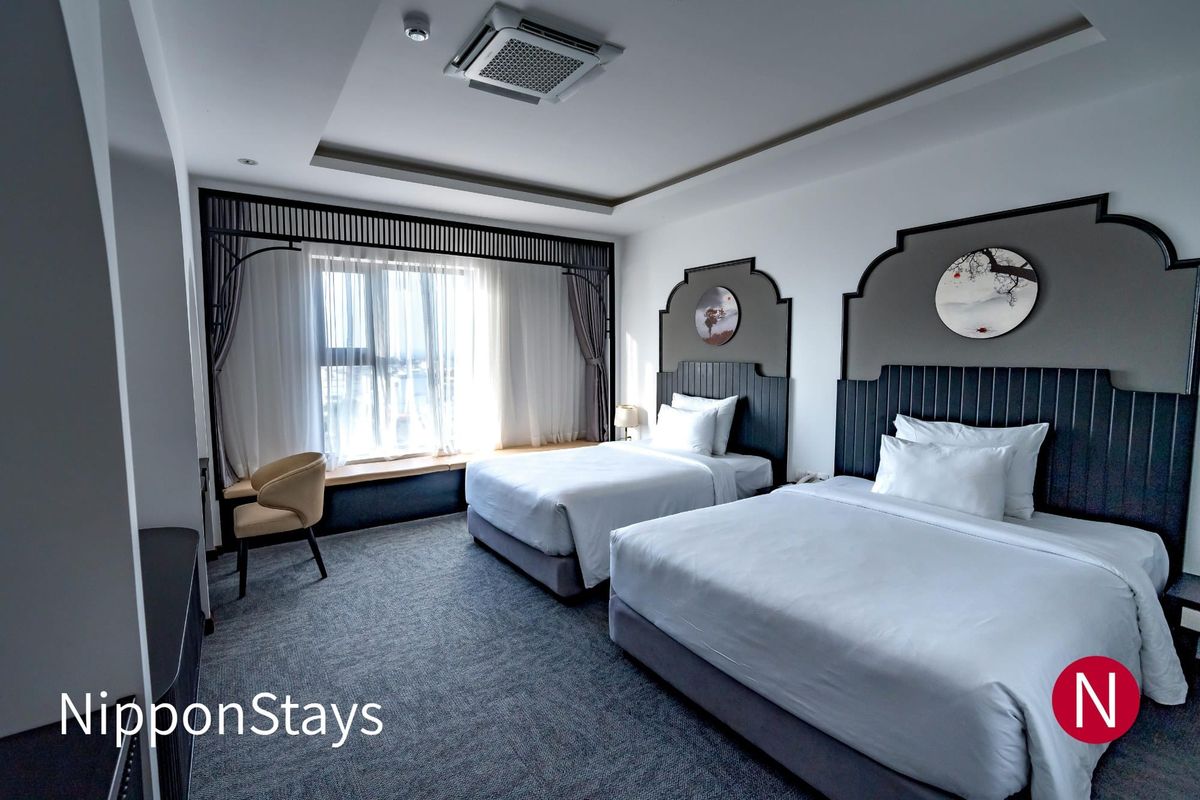
Quick Answer: Is it cheaper to book two rooms or one family room in Japan? The answer flips depending on how a property bills. At a city hotel that charges by the room — like the Sheraton Grande Tokyo Bay Hotel, whose 54 m² Family Premium Room already has five beds built in — one larger room beats opening a second, nearly full-price room, whenever a room that size exists: book one room, not two. At a ryokan that bills per adult with two meals included, like KAI Hakone, splitting into two rooms barely moves the total, so room count stops being the question that matters — the deciding factor becomes whether your youngest has aged out of the free bed-share band, not how many rooms you book.
Two pricing models, one trip
Almost every stay in Japan bills a family one of two ways, and the two ways behave differently once a fifth guest joins the booking. City hotels, business hotels and most resort-style properties charge per room: a room has a rate, that rate covers a base number of guests (usually two), and each guest beyond the base pays a fixed, comparatively small extra-bed fee up to the room's stated maximum.
Ryokan and onsen inns that serve a kaiseki dinner charge the other way — per adult, with both meals bundled into that adult's rate. There is technically no separate "room rate" at all; the total is the sum of what each guest owes for the night, tax and service included. Not every traditional inn works this way — some business-style and day-trip-friendly ryokan bill per room like a hotel — so check which model a specific property uses before assuming either one applies.
This article stays with the money, not the room list. For a shortlist of specific rooms in Tokyo, see our guide to Tokyo hotels for a family of five; for a structural alternative that sidesteps some of this arithmetic, our guide to Tokyo hotels with connecting rooms covers two-door, one-threshold bookings.
Which model applies, at a glance
The table below sorts the bookings most families are weighing into the two billing models, plus a third category worth flagging on its own.
| Property type | Charged by | What a 5th guest adds | Two rooms vs. one | Where it flips |
|---|---|---|---|---|
| City hotel — standard rooms | Per room (fixed rate, capped extra-guest fee) | A fixed extra-bed charge, if the room type allows a 5th bed at all | One larger room is usually cheaper | Only when no single room in the property sleeps five |
| City hotel — family-configured room (e.g. a Family Premium–type room) | Per room, same model, one bigger box | Nothing extra — the room is already built for five or six | One room, decisively | Rarely — but the room category itself is limited stock |
| Ryokan / onsen inn with a kaiseki dinner | Per adult; two meals bundled into each guest's rate | A full adult meal rate, once the child ages out of the free bed-share band | Nearly identical either way | Room count stops mattering; the child's age becomes the lever |
| Ski-lodge or resort with a meal plan | Often mixed — a room rate for the stay plus a separate per-person meal charge | Depends entirely on that property's own meal-plan terms | Doesn't follow either pure model | Verify the specific plan before assuming either math applies |
If Hokkaido is the actual destination, the per-room and per-adult questions apply exactly the same way — our pillar guide to Hokkaido hotels that sleep four and the property-specific Otaru hotels that sleep four guide work through this same logic hotel by hotel.
Worked example: a city hotel
Marriott's own room guide lists the Family Premium Room at the Sheraton Grande Tokyo Bay Hotel at 54 m² with five beds permanently in place — two 137 cm semi-doubles and three 97 cm singles — and puts the room's maximum at eight guests (checked September 2026, Marriott's official room guide). A family of five fits without adding a bed.
Here's why splitting rarely beats it. Call the standard two-guest nightly rate R, and the fixed extra-guest fee e. Book one room for all five and the total is R + 3e — one base rate plus three extra-guest charges. Split into two ordinary rooms instead — one holding four, one holding the fifth guest alone — and the total is 2R + e, because the second room is still charged from its own base rate no matter how few people sleep in it. At the properties checked for this guide, e is a small fraction of R: Japanese city hotels usually price a room, not a headcount, so a single occupant rarely pays much less than two would — confirm the one-guest rate on your dates before you assume otherwise. That's why one room wins unless no single room in the property sleeps five, in which case there is no one-room option to weigh against the two-room one.
Worked example: a ryokan with two meals
Hoshino Resorts' own site describes KAI Hakone — reopened after a full renovation in August 2025 — as taking bookings of "1–5 Guests" per room, with the nightly total built from each guest's own charge rather than a flat room fee (checked September 2026, Hoshino Resorts' official KAI Hakone page). Bill five guests as adults and the total is five adult, two-meal rates — whether those five sleep in one room or split across two.
Splitting doesn't remove any of that per-guest cost; the kaiseki course, the bath towels, the futons are the same five servings either way. Call each adult's per-night, two-meal rate p. One room for all five totals 5p (plus any room-capacity surcharge); split into two rooms and the total is 5p + f, where f is the second room's own facility or service charge. The per-guest total 5p doesn't move, so the gap between one room and two is just f — not a second full room rate, which is why the city-hotel math above doesn't carry over here. The real lever at a ryokan is a birthday, not a floor plan: Hoshino Resorts' own booking terms let a child share a bed for free "up to six years old, until room capacity." Past that age, the five-adult math applies regardless of how the rooms are split.
The rules that override the math
Some properties remove the whole question before the pricing model even matters. Nishimuraya Honkan's own site states a minimum stay age of 10 — children 0–9 cannot stay at all (checked September 2026, Nishimuraya Honkan's official site) — which rules that particular ryokan out entirely for a family with younger kids, no matter how the math would otherwise run.
Occupancy caps can also depend on how you're paying. A friend who redeemed Marriott points for a stay at the Westin Rusutsu Resort in 2021 found the points-stay category capped at four guests, with a ¥6,000-a-night charge for a fifth guest's extra bed — even though the property's cash-rate Triple Room and 5 Bed Room categories are built for five and seven guests respectively, per Rusutsu Resort's own room pages. That's a single 2021 data point, not a current rate, but it shows award-stay occupancy can run lower than a room's physical capacity — confirm the booking category's guest limit before you book, not just the marketing photos.
Two more rules worth checking: most Japanese properties add a peak-season surcharge around New Year — commonly December 29 to January 3, though exact dates and size vary by hotel — and very few will check a minor into a second room without a guardian present, regardless of cost. Our guide to sharing a bed with your child in Japan covers the age cutoffs and consent-form requirements property by property.
What we verified across four properties
Of the four properties checked for this guide, two bill per room and two bill per adult with meals, and two of the four remove the question entirely — one by refusing guests under 10 (Nishimuraya Honkan), one by capping an award booking at four regardless of family size (a 2021 points-redemption stay at the Westin Rusutsu Resort), checked September 2026. The pattern worth checking anywhere is simple: read the room's maximum occupancy and its billing model before you read the rate.
When two rooms win anyway
Status, not arithmetic, is the one thing that can make two rooms the better call even when the math above says otherwise. Booking two rooms under the same elite-status account can, at some properties, pull an upgrade or a lounge benefit onto both rather than one — our club lounge access guide covers a real stay where that split upgraded the whole family, and another where the second room's guests were billed full price for lounge access instead. The outcome depends entirely on the loyalty program and the property's own upgrade rules on your dates, not on anything in the tables here.
Match your trip to a scenario
The scenarios below cover the most common family bookings; treat the "what to check" column as the actual to-do list before paying for anything.
| Scenario | Cheaper option | Why | What to check before booking |
|---|---|---|---|
| Two adults + three kids under 6, city hotel | One family-configured room, if the property sells one | A second room duplicates the base room charge; extra-bed fees don't | Whether a 5-bed or family-suite category exists — most hotels sell only a handful |
| Two adults + three kids under 6, ryokan with dinner | Also one room, if it exists — but the gap to two rooms is small | Per-adult meal pricing keeps the total close either way; a second room mainly adds a facility fee | The room's own maximum occupancy and each child's bed-share age cutoff |
| Two adults + one teen + two younger kids, any property | One room, if occupancy allows — a second room for the teen alone is rarely bookable | Most properties won't check in an unaccompanied minor, regardless of price | The property's policy on guests under 18 sharing a room without a guardian |
| Five adults or teens travelling together, ryokan | Splitting across two rooms often costs about the same as one — sometimes slightly less | Five full adult meal rates apply no matter the room count; two rooms just adds one facility fee | Whether the price gap, if any, is worth the extra privacy |
Trip Essentials for Japan
Things worth booking before you land, all in English:
- eSIM — Airalo's Japan eSIM: install it at home and data works as soon as you switch off airplane mode at Haneda, Narita, Kansai, or wherever you land.
- Tickets and day trips — Klook covers the Japan Rail Pass, teamLab tickets, and shinkansen-linked day trips; booking ahead skips the ticket-window line.
FAQ: Two rooms or one in Japan
Until what age can a child share a bed for free in Japan?
It varies by property, but six years old is a common cutoff — Hoshino Resorts' KAI brand states bed-sharing is free "up to six years old, until room capacity" on its official site (checked September 2026). Some city hotels use a lower cutoff, occasionally as young as two or three, so confirm the age band for the specific property and room type before you book.
How much does an extra bed typically cost at a Japanese hotel?
It depends on the property and the booking channel, not just the room type. A friend who redeemed points for a stay at the Westin Rusutsu Resort in 2021 was billed ¥6,000 per night for a fifth guest's extra bed — a single dated data point, not a current or universal rate, since cash bookings and points stays don't always share the same fee schedule. Confirm the extra-bed charge for your dates directly with the property.
When does the New Year's premium period apply in Japan?
Most hotels and ryokan add a peak-season surcharge somewhere in the window from around December 29 to January 3, but the exact dates, and how much the rate rises, are set by each property individually. Some ryokan extend the premium period into the first full week of January, so check the property's own calendar rather than assuming a fixed window applies everywhere.
Can two children stay alone in a second room while the parents are in the first?
In practice, very few Japanese hotels or ryokan will check in a minor without a guardian present, and some ask for a signed consent form even from teenagers staying without a parent in the building. This is a policy question, not a pricing one, so it holds regardless of what splitting the rooms would otherwise cost — see our guide to sharing a bed with your child in Japan for the specifics by property type.