Where to Stay at Nekoma Mountain: The Powder and the Tree Runs Are on Opposite Sides
Nekoma Mountain has two faces. All five 2026-27 tree-run zones are on the south; the dry snow and the lakeside onsen are on the north. Where to sleep.
Quick answer: Deciding where to stay at Nekoma Mountain comes down to one fact most English write-ups skip: the resort has two faces, and they do not open on the same day or serve the same skier. The north face holds the dry snow and the long season. The south face holds every one of the five tree-run zones the resort lists for 2026-27. For the powder and the lake, sleep on the north side at Urabandai Lake Resort Goshiki No Mori, about a ten-minute drive from the north base with a free ski shuttle. For the tree runs, sleep at the south base at Hoshino Resorts Bandaisan Onsen Hotel and skip the cross-mountain commute entirely.
The two sides, side by side
Nekoma Mountain is the merger of two older ski areas on opposite flanks of the same ridge: the former Nekoma ski area on the north, and the former Alts Bandai on the south. Hoshino Resorts runs both under one lift ticket, and a connecting lift crosses the top. That is where the similarity ends.
| North side (former Nekoma) | South side (former Alts Bandai) | |
|---|---|---|
| 2026-27 season | 28 Nov 2026 - 9 May 2027 | 12 Dec 2026 - 4 Apr 2027 |
| Days open | 163 | 114 |
| Aspect | North-facing, holds dry snow | South-facing, wider and sunnier |
| Tree-run zones for 2026-27 | 0 | 5 |
| Base elevation | About 1,030 m | 700 m |
| Faces | Lake Hibara and Urabandai | Lake Inawashiro and the rail line |
| Sleep here if | You want snow quality and a lakeside onsen | You want the tree runs, or you arrive by train |
The season difference alone is worth planning around. Counted from the dates the resort published for 2026-27, the north side runs 163 days against the south side's 114 - a gap of 49 days, checked September 2026. Book a late-November or late-April trip and the south side, tree runs included, is simply not open.
What changed for 2026-27: five tree-run zones, all on the south
The resort has expanded its managed tree-run terrain from three zones to five for the 2026-27 season, across roughly 27.5 hectares. The zones are graded rather than lumped together, which is unusual in Japan:
- Frozen tree A - off the Frozen Chair, wide tree spacing, the gentlest of the three Frozen zones
- Frozen tree B - off the Frozen Chair, shallow gully features and steeper pitches, intermediate and up
- Frozen tree C - off the Frozen Chair, wider lines and gentler gradient
- Black Tree D - off the Black Valley Express or the Rock Chair, advanced only, steep enough that the resort warns about speed
- White Tree E - off the White Valley Chair, gentle, the one the resort recommends for beginners
Check the lift names against a piste map before you book a bed: the Frozen Chair, Black Valley Express, Rock Chair and White Valley Chair are all south-side lifts. Five of five zones hang off the south. Helmets are mandatory in all of them, the terrain is designated self-responsibility ground with rescue costs charged to the user, and no advance registration is required. Full detail is on the resort's own tree-run page.
I have not skied these zones - the expansion is new for the 2026-27 season - so treat the descriptions above as the operator's, not mine.
What the north side is actually like
I have skied the north side, in the 2024-25 season, and the reputation is earned. The base sits at around 1,030 m, which is high for Tohoku, and the runs face north off a ridge topping out near 1,340 m. On the day I was there the beech forest along the ridge was completely cased in rime ice while the groomers below were still soft.
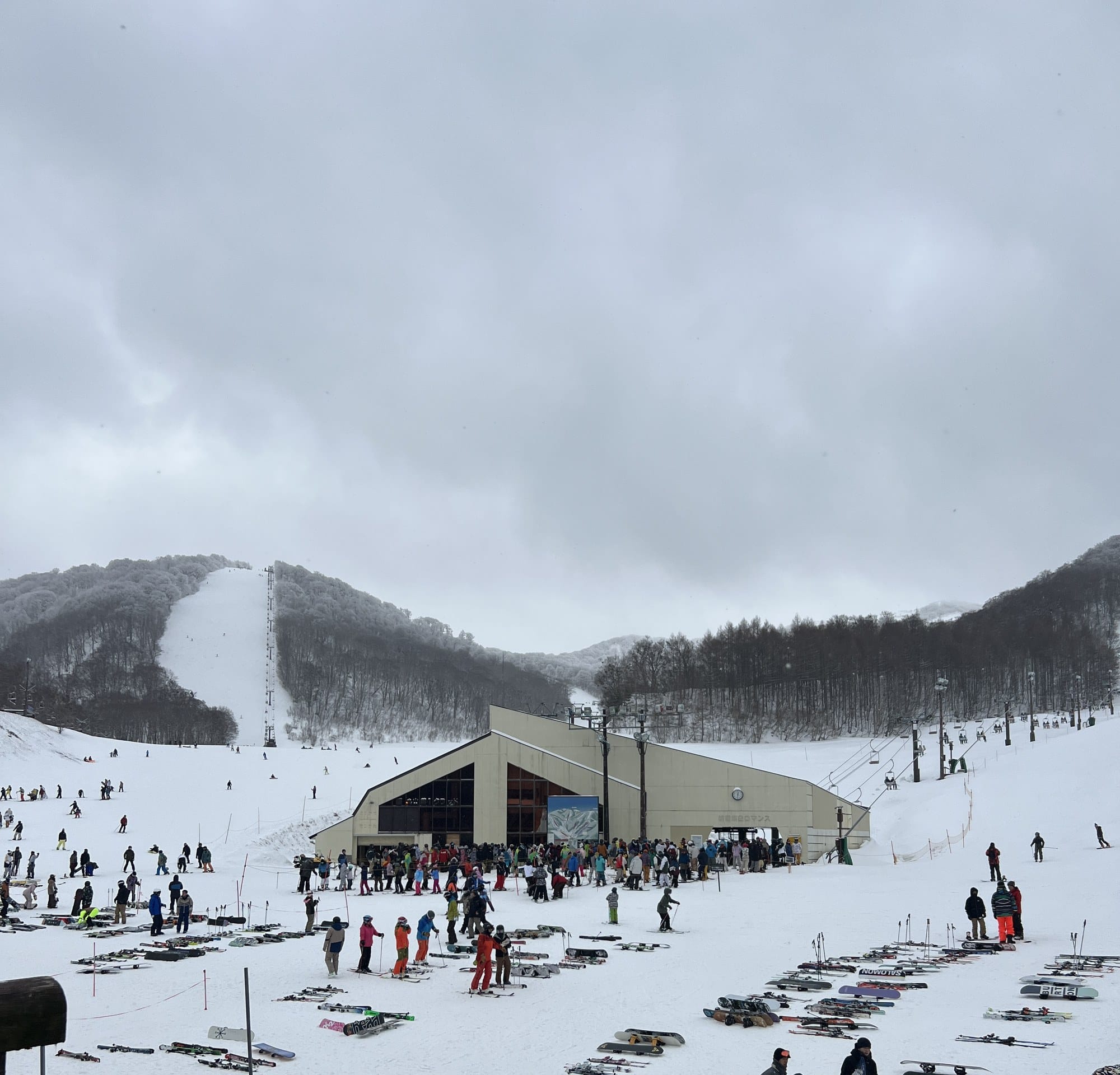
Two things follow from that photograph. First, the north base is small - one lodge, a compact lift line, and no village. There is nowhere to walk to for lunch and nowhere to walk to at night. Second, on a weekend it fills. If your plan is "ski the north face, eat at the base", build in the queue.
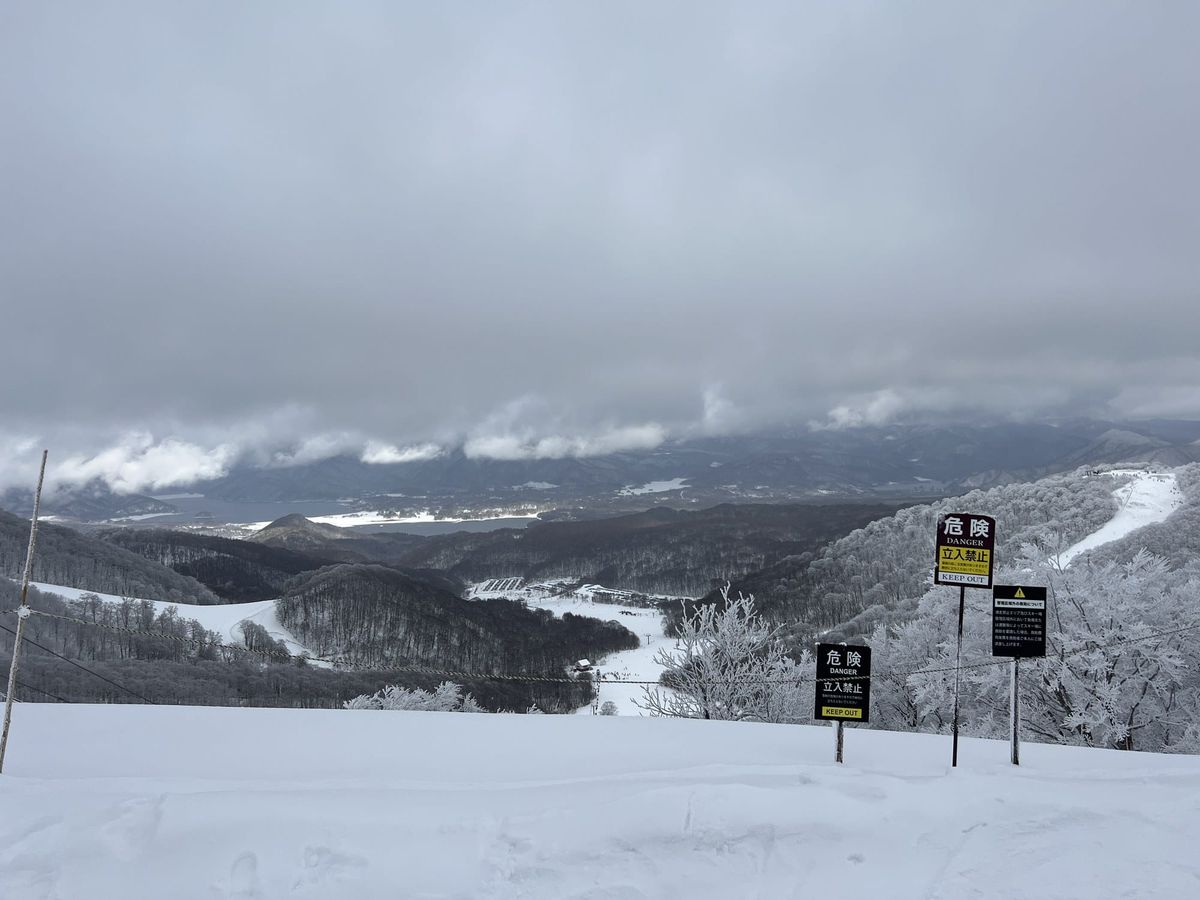
The ridge is also where the mountain shows you the geography that decides your booking. From the top you look north over Lake Hibara and the Urabandai plateau; the hotels are down there among the lakes, a road drive away. Turn around and the south side drops away toward Lake Inawashiro and the railway. The rope-and-sign boundary in the photo at the top of this article is the edge of the managed area, and it is a real line, not decoration.
Where to sleep, by what you came for
North side: the lakes and the onsen
Urabandai is a scatter of lakeside resort hotels on the plateau below the north base, roughly a ten-minute drive away. Urabandai Lake Resort Goshiki No Mori is the large one, with hot-spring baths and a free ski shuttle to the north base; reservations are required for the shuttle for groups of ten or more. Mercure Urabandai Resort & Spa sits nearby and has changed names twice - Urabandai Royal Hotel, then Active Resorts Urabandai - so English listings still carry all three, and its own site is the safest way to check what you are booking. Urabandai Kogen Hotel is the third option and pitches itself at the upper end, with Mount Bandai views and outdoor baths.
The trade-off is real: you get the good snow and a proper onsen soak, but you are driving or riding a shuttle to a base with no village, and you are a long way from the tree runs. If you are weighing a hot-spring base against a town, we have worked through that trade-off in general in onsen town or city hotel with an onsen.
South side: ski-in for the tree runs
Hoshino Resorts Bandaisan Onsen Hotel is the resort-operated hotel at the south base, with a bicarbonate hot spring and views toward Lake Inawashiro and Mount Bandai. If the five tree-run zones are the reason for the trip, this is the room that removes the commute: they are all on this side of the ridge, and you are not depending on a connecting lift running.
Groups: the room that sleeps eight
This is the part that is genuinely hard to find in English. Urabandai has a room that puts eight people in one room - eight of us stayed in one at Urabandai Lake Resort - which almost nothing at a Japanese ski resort does. The main building, Goshiki No Mori, tops out at four people per room. The eight-person configuration is a 139 sqm suite in the annex, Urabandai Lakeresort Nekomarikyu, where futons go down on a tatami bedroom. It is listed on booking sites as a separate property from the main hotel, which is why searches for the main hotel never surface it, and there is only one of it.
For a group of six to eight this changes the arithmetic completely, because the alternative at most resorts is two or three rooms and a corridor between your children and you.
Getting there, and whether to bring a car
The nearest station is Inawashiro on the Ban-etsu West Line, reached from Tokyo via the Tohoku Shinkansen to Koriyama. From Inawashiro it is about 40 minutes by bus to the north side. Urabandai Lake Resort also runs a free station pick-up. If you are moving skis by rail rather than car, the constraints are the same ones we cover in taking skis on the shinkansen.
A car is the honest answer if you want both sides on your own schedule, because the two bases are on opposite flanks of a ridge and the road between them is not short. Without one, you are committed to whichever side your hotel shuttles to, plus the connecting lift when it runs.
How it compares, and where to look next
| Base | Side | Best for | Watch out for |
|---|---|---|---|
| Urabandai Lake Resort Goshiki No Mori | North | Snow quality, onsen, families, free ski shuttle | About a 10-minute drive from the base; far from the tree runs |
| Urabandai Lakeresort Nekomarikyu | North | Groups of up to eight in one room | Listed separately from the main hotel; the big suite is one room, so it goes early |
| Hoshino Resorts Bandaisan Onsen Hotel | South | All five tree-run zones, no cross-mountain commute | South side opens two weeks later and closes five weeks earlier |
| Mercure Urabandai Resort & Spa | North | A second option when the Lake Resort is full | Renamed from Active Resorts Urabandai; old name still appears in listings |
If you are still choosing a mountain rather than a bed, our guide to where to stay for skiing in Japan sorts the country by base type, and Zao and its snow monsters is the other Tohoku resort where rime ice is the draw.
FAQ: Nekoma Mountain
Are the tree runs on the north side or the south side?
All five 2026-27 tree-run zones are on the south side, the former Alts Bandai. They are served by the Frozen Chair, the Black Valley Express, the Rock Chair and the White Valley Chair, all south-side lifts. The north side has the better snow but no listed tree-run zones.
Do I need to register to ski the tree runs?
No. The resort states that no registration is required, but a helmet is mandatory and protectors are strongly recommended. The zones are self-responsibility terrain and rescue costs are charged to the user. Ropes and tape mark the boundary and are not to be crossed.
Can I ski both sides on one ticket?
Yes. One lift ticket covers both, and a connecting lift crosses the ridge in both directions. Plan around the calendar rather than the ticket: the south side does not open until 12 December 2026 and closes 4 April 2027, while the north side runs 28 November 2026 to 9 May 2027.
Which side should a family with small children stay on?
The north side, for the shuttle and the onsen hotels, unless you specifically want the beginner-graded White Tree E zone, which is on the south. Urabandai is also where the eight-person room is, which matters more for a group than any run does.
Is there a village at the base?
No. The north base is a single lodge with no walkable restaurants or bars, and the accommodation is spread around the lakes below. Plan your evenings at the hotel.
Last fact-check: September 2026. Season dates, lift names and tree-run details from the resort's own tree-run page and lift guide; shuttle and hotel detail from Urabandai Lake Resort. Firsthand observations are from the north side in the 2024-25 season.