Karuizawa vs Kusatsu: Highland or Hot Spring
One is on the shinkansen and one is not — and that decides the trip length before the scenery does. Both turn weeks before Tokyo, at 1,000 m and 1,200 m.

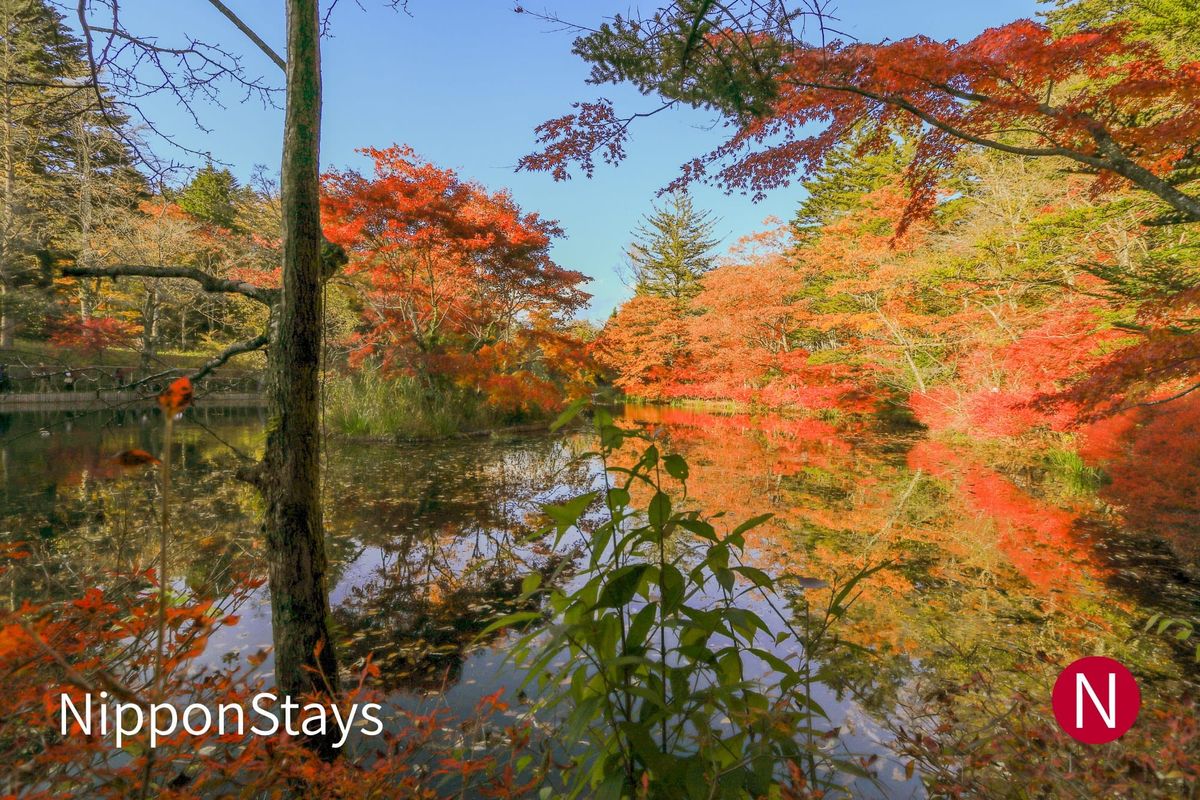
Karuizawa vs Kusatsu looks like a choice between a highland resort and a hot spring town, and it is — but the decision that actually matters is transport. Karuizawa is on the shinkansen, about an hour from Tokyo, which makes it a day trip or a casual overnight. Kusatsu is not on any railway — you go by direct express bus from Shinjuku, or by rail and a local bus — and that turns it into a two-night proposition. Both turn from mid-October into early November, weeks before Tokyo does. Our picks: Hotel Indigo Karuizawa for the walking, Kusatsu Onsen Hotel Boun for two nights in the baths, or from ¥14,000 for two in Tokyo if you would rather commute out for the day.
One is on the shinkansen, the other is not
This is the practical fork, and it decides more trips than the scenery does.
Karuizawa has a shinkansen station on the Hokuriku line. You can leave Tokyo after breakfast, walk in larch woods for the afternoon, and be back for dinner — or stay a night without the journey dominating the itinerary. That accessibility is why it became a highland resort in the first place.
Kusatsu has no station. There are two ways up, and they are not equivalent.
The Joshu Yumeguri-go express bus from Shinjuku runs direct. Bus Terminal Shinjuku to Kusatsu Onsen Bus Terminal takes from about three hours fifty minutes up to nearly five depending on which service you take, at roughly ¥2,500–3,700 one way, or from around ¥2,200 on an advance fare. There are no changes and no connection to miss, and it drops you in the town — the yubatake is roughly a five-minute walk from the terminal — rather than at a station below it. Reserve it: autumn weekend services fill, and both the fare and the journey time move with the day and the season (checked August 2026).
Look at when those buses leave and the shape of the trip becomes obvious. Departures are spread across the middle of the day rather than stacked at dawn, so a bus out of Shinjuku puts you in Kusatsu in the afternoon, and the last one of the day arrives at night. There is no version of this where you leave after breakfast and are back for dinner.
Rail plus a local bus takes you to a nearby town and up from there. It gives you more departures and more flexibility if your plans move, at the cost of a connection at both ends.
Either way, nobody does Kusatsu as a comfortable day trip from Tokyo, and trying to is the most common way to have a bad time there.
| Area | Access from Tokyo | Autumn setting | Realistic trip length |
|---|---|---|---|
| Karuizawa | Shinkansen, around an hour | Larch and maple woods, gorge walks, cycling | Day trip or one night |
| Kusatsu | Direct bus from Shinjuku, ~3h50; or rail plus bus | Steep valley around a hot spring town | Two nights |
We have not been to either in autumn. What follows is built from published timing and access rather than from a visit, and journey times should be checked against current schedules for your dates.
Both are high, which is why they are early
Karuizawa sits at roughly 1,000 m and Kusatsu higher still, around 1,200 m. Both are far enough above the Kanto plain to turn two to three weeks ahead of Tokyo — mid-October into the first days of November, depending on the year.
That makes this pair a good answer for a specific problem: an October trip to Tokyo where the city itself is still green. You do not have to fly north to find colour; you have to go up.
Kusatsu's extra couple of hundred metres puts it marginally ahead, but the difference between the two is days rather than the weeks you get from a pair like Nikko's lake and its valley town.
What the two days actually look like
Karuizawa is an outdoor day. The area is built around walking and cycling — woods, a gorge, wide flat roads between them, and a shopping district by the station that functions as the wet-weather fallback. It suits a group that wants to move.
Kusatsu is an evening. The town centres on the yubatake, the hot water field in the middle of it, and the point of being there is bathing, walking the small streets between baths, and eating. The autumn colour is the setting rather than the activity.
That difference matters more than it sounds. If you have one free day in an otherwise urban trip, Karuizawa gives you a day. Kusatsu gives you an evening, and to reach that evening you spend most of a day travelling.
Onsen changes what a wet day looks like
Rain is where the two diverge most. A wet day in Karuizawa removes the walking and the cycling, and leaves you with the shops — pleasant, but not what you came for.
A wet day in Kusatsu removes almost nothing. The baths are the destination, the town is compact enough to walk between them under an umbrella, and steam and low cloud arguably improve the yubatake rather than spoiling it.
If your dates are fixed and the forecast is poor, that asymmetry is a reason to pick the onsen town even though it costs you a day of travel.
Which one to sleep in
Sleep in Karuizawa if you want one highland night inside a Tokyo trip without losing two days to transport, or if the walking and cycling are the point.
Sleep in Kusatsu — for two nights, not one — if the bath is the reason for the trip. One night there means arriving tired and leaving early, which wastes the journey.
Sleep in Tokyo and day-trip to Karuizawa only. This works genuinely well, and it is the option most short-trip visitors should take.
| Where you sleep | Area | From price (2 guests) | Best for |
|---|---|---|---|
| Hotel Indigo Karuizawa | Karuizawa, ~1,000 m | Upper-mid | Walking and cycling from the door |
| Karuizawa Prince Hotel West | Karuizawa, ~1,000 m | Mid | Station-side, with the woods and the shops both close |
| Hotel Rosso Karuizawa | Karuizawa, ~1,000 m | Mid | One highland night on a tighter budget |
| Kusatsu Onsen Hotel Boun | Kusatsu, ~1,200 m | Ryokan, upper-mid | Two nights built around the baths |
| Kusatsu Hotel 1913 | Kusatsu, ~1,200 m | Upper-mid | A short walk to the yubatake |
| Kusatsu Onsen Hotel Ichii | Kusatsu, ~1,200 m | Mid | Making the long bus journey worth two nights |
| ANA InterContinental Tokyo | Tokyo | from ¥14,000 | Day-tripping to Karuizawa and keeping one base |
These are normal-season from-rates at two guests, and both highland areas price differently in the October window. Treat the number as a way of ranking the options rather than as a price, and put your own dates in. The middle column is a band rather than a rate. Because Kusatsu costs you most of a day each way, the Kusatsu rows assume two nights — a single night there is the one booking in this table that reliably disappoints. For where these two sit against the rest of the country, see our guide to autumn timing across Japan.
Height buys you three weeks
Setting the two against the city they are reached from: at roughly 1,000 m and 1,200 m, Karuizawa and Kusatsu turn two to three weeks before central Tokyo at near sea level (checked August 2026). For an October visitor that is the whole argument — the colour is not a month away, it is an hour up the shinkansen.
Trip Essentials for Japan
Things worth booking before you land, all in English:
- eSIM — Airalo's Japan eSIM: install it at home and data works as soon as you switch off airplane mode at Haneda, Narita, Kansai, or wherever you land.
- Tickets and day trips — Klook covers the Japan Rail Pass, teamLab tickets, and shinkansen-linked day trips; booking ahead skips the ticket-window line.
FAQ: Karuizawa and Kusatsu in autumn
Do they turn at different times?
Only marginally. Kusatsu is a couple of hundred metres higher and runs slightly ahead, but both fall in the mid-October to early-November band. Neither buys you a second window the way a big altitude gap does elsewhere.
Can I do either as a day trip from Tokyo?
Karuizawa, yes — the shinkansen makes it about an hour and it is a comfortable day. Kusatsu, no. Whether you take the direct express bus from Shinjuku or go by rail and change to a local bus, the journey takes most of a day each way, which is why it needs two nights rather than one.
Which is better for an early start?
Karuizawa, if you have slept there — the woods and gorge are best before the day arrivals. In Kusatsu the early morning matters less, because the baths are open early and the town is small enough that timing is not a competition.
Which is better in the rain?
Kusatsu, clearly. The baths are the destination rather than a consolation, and the town works under an umbrella. A wet day in Karuizawa takes away the walking and leaves shopping.