Japan Family Hotels: Should You Book Dinner Included?
Room only, breakfast, half board or all-inclusive? How Japan family hotels split meals, kids' pricing and free-sleeping rules across 5 resorts.
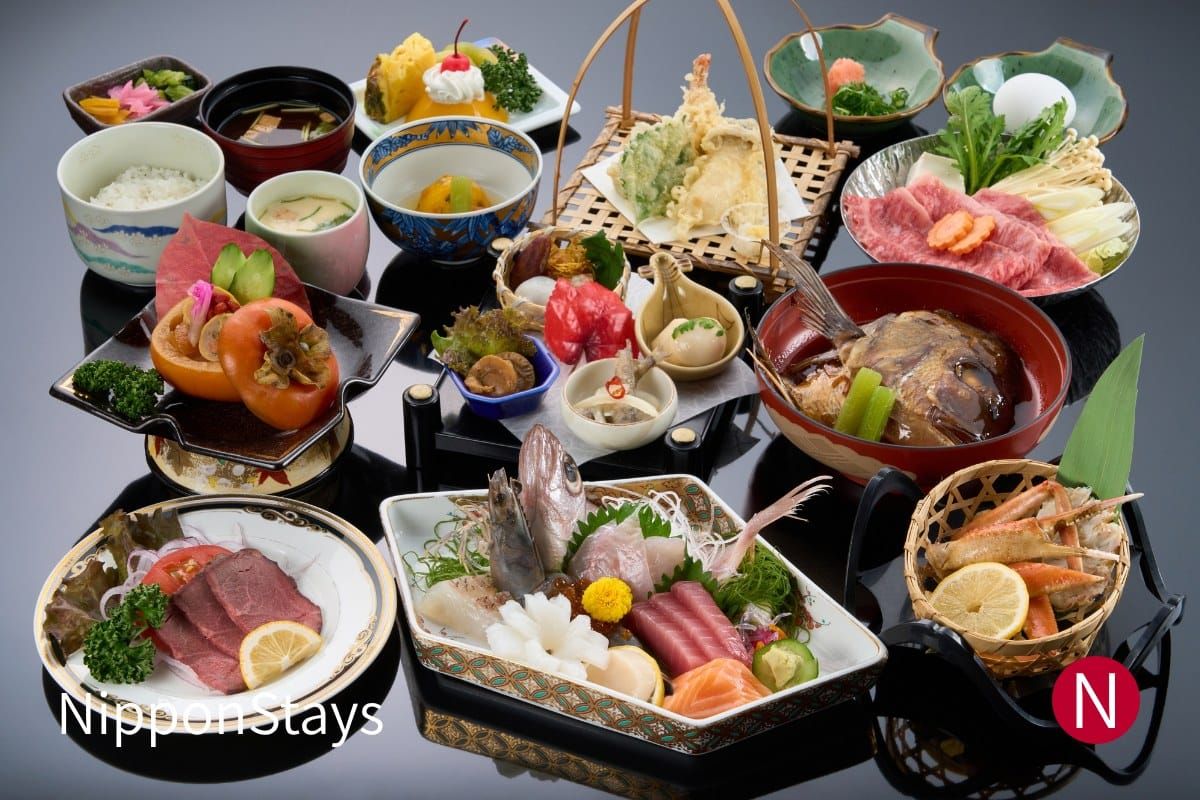
For a family staying at a Japanese resort, the meal plan question comes down to four choices: room only, breakfast included, half board (one night's dinner plus the next morning's breakfast), or all-inclusive. Anda no Mori Izu Ippekiko and Kanucha Bay Hotel & Villas both run buffet dinners with time-slotted seatings, while Grand Mercure Yatsugatake and Grand Mercure Minamiboso bundle dinner, breakfast, drinks and (at Minamiboso) some activities into one all-inclusive rate. Japan family hotels that quote half board rarely include lunch, alcohol, or late-night snacks in that price — those stay separate unless a property specifically says otherwise. The condition that changes the answer is age: several of these resorts make a child's own meal free or cheap under a certain age, but that is a food rule, not a room rule, and it does not follow that the child also sleeps free.
What "half board" actually includes
Half board — often written "1 night, 2 meals" on Japanese booking pages — normally means one dinner and the following morning's breakfast, nothing more. Lunch, drinks beyond a set non-alcoholic pour, late-night ramen, and paid activities are booked and billed separately unless the property states otherwise.
Two of the resorts covered here go further than half board. Grand Mercure Yatsugatake bundles dinner, breakfast, basic lounge drinks and snacks, and the bathhouse into the room rate — an all-inclusive plan, not half board. Grand Mercure Minamiboso does the same, and in summer (July 18 to September 23, 2026) the outdoor garden pool is also included at no extra charge. Anda no Mori Izu Ippekiko sits in between: dinner and breakfast are buffet-style, and every drink at dinner — including alcohol — is free-flowing, which is unusual for a half-board plan and worth checking before you assume it is not included. RISONARE Yatsugatake, Kanucha, and Phoenix Seagaia Ocean Tower do not publish whether a fixed half-board plan exists at all; each guest books a room type and then adds meals as a separate reservation, so "1 night, 2 meals" is not a default there.
| Meal plan type | What it includes | Fits which family | Confirm before booking |
|---|---|---|---|
| Room only | No meals; you choose every restaurant | Families who want to eat off-site or self-cater | Whether the resort is far enough from other dining that this is impractical |
| Breakfast included | Breakfast buffet, nothing else | Families who go out for lunch and dinner or want flexibility | Buffet hours and whether it is a shared or age-specific seating |
| Half board (1 night, 2 meals) | Dinner + next morning's breakfast; lunch, alcohol, late-night snacks separate | Families who do not want a nightly restaurant search after a full day of play | Seating times, whether it is a fixed course or buffet, and children's menu availability |
| All-inclusive | Dinner, breakfast, basic drinks/snacks, bathhouse, and sometimes activities in the room rate | Families who want to stay on-site and not track extra charges | Which drinks and activities are actually covered — "all-inclusive" is not standardized between hotels |
What the kitchen does for children
The resorts covered here treat children's food very differently. RISONARE Yatsugatake is the most explicit: at its buffet restaurant, YYgrill, dinner is ¥4,340 and breakfast ¥1,960 for ages 7–11, dropping to ¥3,100 and ¥1,400 for ages 4–6, with children 3 and under eating free, and baby food (rice porridge, purées, toppings) also free. At its course-menu restaurant, OTTO SETTE, dinner for ages 7–11 is ¥8,470 and ages 4–6 ¥6,050, but baby food there costs ¥500 per item — unlike the free baby food at YYgrill.
Anda no Mori does not publish a children's meal price, but baby food, formula, and a child's bib are all free, across a wide range of brands and stages (Kewpie from 5 months, Wako-do up to 16 months, Snow Brand Meguminon formula), and a "Kids Omurice" is on the dinner menu. Kanucha waives the room charge for a preschooler who uses no bed and eats no meals, and — a separate rule — preschoolers eat breakfast free at two of its nine restaurants (Paradis and Kamitsuki). Its baby food is not a fixed menu: families reserve a specific restaurant in advance and tell the kitchen what the child needs, or bring their own to be warmed. Grand Mercure Yatsugatake stocks baby food for the 5-to-12-month range in its all-inclusive buffets. Kamenoi Hotel Aso Park Resort's dinner buffet has a dedicated kids' corner, but its site does not publish a children's price or baby-food details. Phoenix Seagaia Ocean Tower runs a buffet at its Garden Buffet Pine Terrace but does not publish a child's price, menu, or baby-food policy either.
The adult half of the meal
A half-board or all-inclusive plan is not only a convenience for parents managing a toddler's schedule — it is also where these resorts put their regional cooking. Grand Mercure Yatsugatake's buffets run live-cooking stations and a rotation that includes hoto, the thick Yamanashi noodle stew, alongside the wider spread. Grand Mercure Minamiboso builds its dinner and breakfast buffets around local Minamiboso ingredients. Anda no Mori runs its buffet through its Pasar restaurant in three 90-minute dinner seatings (4:30pm, 6pm, and 7:30pm) with breakfast open on a free-flow basis from 7am to 10am (last entry 9:30am) — seatings that work as well for two adults wanting a slower dinner as for a family on a schedule. A meal plan built around one restaurant's buffet is not the same trade-off as a-la-carte dining out every night, but at these resorts it is not a downgrade for the adults either.
Sleeping free is not eating free
The two savings get bundled together in marketing copy, but they are separate rules. A "free" young child usually means one of two different things: free to share the existing beds in the room, or free to eat at the buffet — a resort can offer either without the other.
Grand Mercure Yatsugatake combines both, but only on its own-site booking plan: children aged 0–6 can share a room with no charge for the room or their meals (up to two per booking), while a child of elementary-school age is charged the same as an adult for both. Kanucha separates the two rules cleanly: a preschooler with no bed and no meals costs nothing extra on the room, and, independently, breakfast is free for preschoolers only at two specific restaurants — dinner, or breakfast elsewhere on-site, is not covered by either free rule. RISONARE Yatsugatake's free-dining age (3 and under) is not the same cut-off as its room-sharing policy (up to age 6). The practical rule: check the room's child-sleeping age limit and the restaurant's child-eating age limit as two separate numbers, and compare quotes at the same family size and meal inclusion — a half-board rate for one property against a room-only rate for another tells you nothing useful.
Of the five properties checked for this guide, three publish a specific children's meal price (RISONARE Yatsugatake, on two different menus) or a specific free-meal condition (Kanucha, Anda no Mori), while two — Kamenoi Hotel Aso Park Resort and Phoenix Seagaia Ocean Tower — do not publish any children's meal pricing or age cut-off at all (checked September 2026). Treat the unpublished ones as a question to ask at booking, not as "probably the same as the others."
Choosing a plan for your trip
| Your trip looks like | Meal plan to book | What to confirm at reservation |
|---|---|---|
| Full day of on-site play, no energy left to go out | Half board or all-inclusive | Dinner seating times and whether it's fixed-course or buffet |
| Toddler or baby with specific food needs | Any plan, but confirm baby-food availability first | Whether baby food is free (RISONARE's YYgrill, Anda no Mori) or paid (RISONARE's OTTO SETTE) |
| Want to try local restaurants in the area | Breakfast included or room only | Distance and transport to off-site dining — see our guide on getting there without a car |
| Budgeting for a specific family size and ages | Any plan, once ages are set | Room-sharing age limit and meal-eating age limit are two separate numbers — ask both |
Whichever plan you land on, confirm current children's pricing and seating times with the resort directly before you book.
For the wider case on why a resort night can be worth adding to a Japan itinerary, see our guide to Japan family resorts as the holiday itself. If a food allergy is part of your planning, our guide to food allergies in Japan with kids covers what to hand the kitchen before you arrive. Families weighing a dinner plan against eating in a hotel lounge instead should also see why a club lounge is not a dinner substitute. For two of the named resorts above, our dedicated guides go deeper on the whole stay: Kanucha Resort with kids and Anda no Mori Izu with kids.
Sources checked for this guide: RISONARE Yatsugatake dining, Anda no Mori Izu Ippekiko dining, Grand Mercure Yatsugatake, Kanucha Bay Hotel & Villas, and Phoenix Seagaia Ocean Tower.
Trip Essentials for Japan
Things worth booking before you land, all in English:
- eSIM — Airalo's Japan eSIM: install it at home and data works as soon as you switch off airplane mode at Haneda, Narita, Kansai, or wherever you land.
- Tickets and day trips — Klook covers the Japan Rail Pass, teamLab tickets, and shinkansen-linked day trips; booking ahead skips the ticket-window line.
FAQ: Meal Plans at Japan Family Resorts
Does "half board" at a Japanese resort include lunch?
No. Half board — "1 night, 2 meals" on Japanese sites — normally means dinner on the night you arrive plus breakfast the next morning. Lunch, alcohol beyond any stated free-flow window, and late-night snacks are booked and paid separately unless a property explicitly says otherwise.
If my child's room stay is free, is their food also free?
Not automatically. Room-sharing and meal inclusion are separate rules set by each resort. Kanucha, for example, waives the room charge for a preschooler with no bed and no meals, but only makes breakfast free for that same age group at two specific restaurants — a different rule for a different meal. Always check the age cutoff for the bed and the age cutoff for the meal as two separate numbers.
Which of these resorts is genuinely all-inclusive?
Grand Mercure Yatsugatake and Grand Mercure Minamiboso both bundle dinner, breakfast, basic lounge drinks and snacks, and bathhouse access into the nightly rate, with Minamiboso also including its summer outdoor pool. Anda no Mori Izu Ippekiko is not labeled all-inclusive but comes close on drinks: dinner includes free-flowing alcohol as well as soft drinks, which is unusual for a half-board plan.
Is baby food provided free at every resort?
No — it varies even within one property. RISONARE Yatsugatake gives free baby food at its buffet restaurant, YYgrill, but charges ¥500 per item for baby food at its course-menu restaurant, OTTO SETTE. Anda no Mori Izu Ippekiko provides baby food, formula, and a bib free of charge across multiple brands and age stages. Kanucha does not run a fixed baby-food menu; instead you reserve a specific restaurant in advance and tell the kitchen what your child needs.