Can You See Flowers in Japan in February? Plum to Sakura
Yes: Atami plum blooms from mid-Jan, Kawazu cherry opens Feb 7, plus Kairakuen and Dazaifu, fill February. Where to go, day trip or overnight.

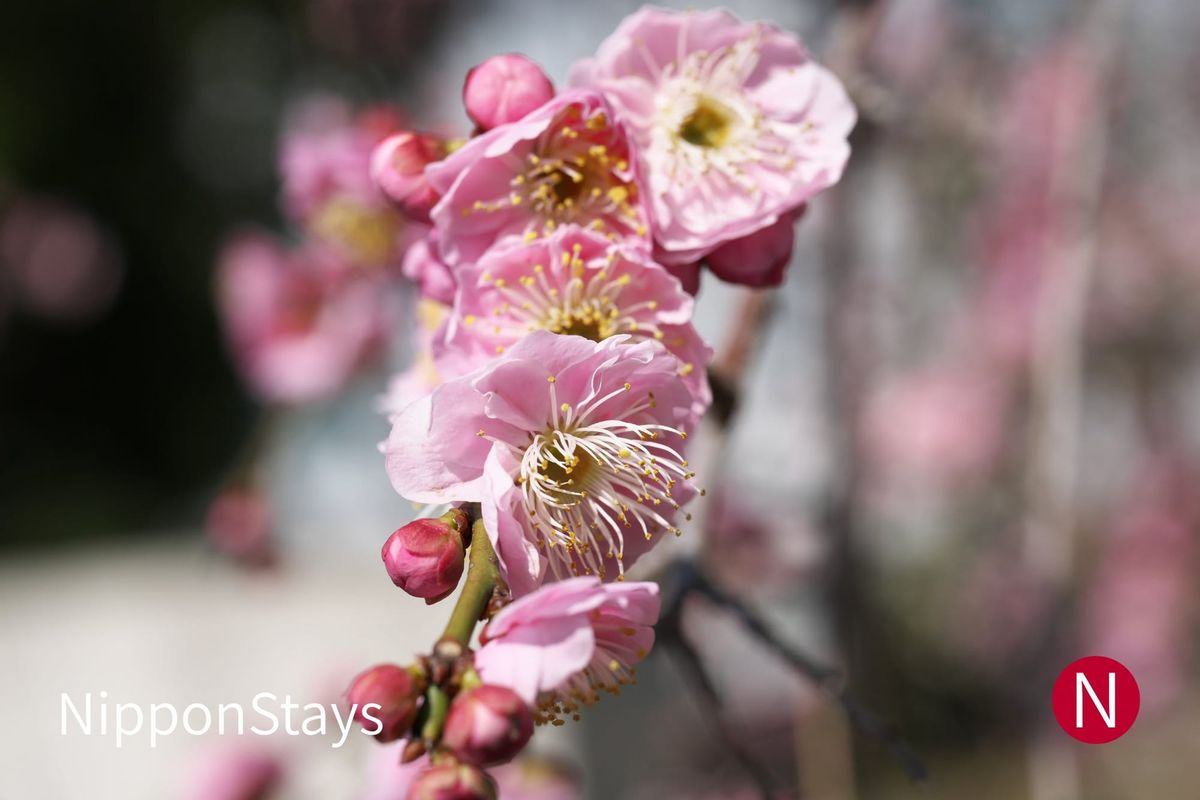
Quick Answer: Can you see flowers in Japan in February? Yes — plum first, then early cherry. Atami's plum garden usually opens earliest, in mid-January, and runs into March. Kairakuen in Mito and the grounds of Dazaifu Tenmangu fill most of February with plum. Kawazu's early cherry typically opens in the first full week of February and runs about a month. The one thing that changes this plan: only Kawazu had set its 2027 dates when we checked in September 2026 (February 6 to March 7); for the others, what you see are last season's confirmed dates, not this year's. If Atami is your pick for a same-day or overnight plum trip from Tokyo, one option a 10-minute walk from the station with its own onsen bath is Pearl Star Hotel Atami.
Seven places, seven windows: where flowers are actually blooming in February
Every one of the seven flower events below runs on its own calendar, and none of them lines up with Tokyo's cherry blossom season. The table shows each spot's most recently confirmed dates — some are the 2026 edition, already finished by the time you read this, and some are places that track bloom rather than run a fixed festival.
| Place | What blooms | Most recent confirmed window | Date status | From Tokyo or Fukuoka |
|---|---|---|---|---|
| Atami Baien (Atami Plum Garden) | Plum — about 470 trees, 60 varieties | Jan 10 (Sat) – Mar 8 (Sun), 2026 | 2026 actual (82nd edition); 2027 not yet announced | ~45 min by Kodama shinkansen, then a 10-min walk from Atami Station |
| Itogawa Atami-zakura | Atami-zakura, an early cherry variety along the Itogawa canal | Jan 10 (Sat) – Feb 8 (Sun), 2026 | 2026 actual (16th edition); 2027 not yet announced | Same as above; the canal walk starts a few minutes from Atami Station |
| Kawazu Sakura Festival | Kawazu-zakura, an early cherry (30-day run) | Feb 7 (Sat) – Mar 8 (Sun), 2026 | 2027 set: Feb 6 (Sat) – Mar 7 (Sun), by the festival committee (official site not yet updated) | About 2h15 from Tokyo by Kodama shinkansen plus an Odoriko transfer at Atami (the fastest route; the direct Odoriko takes somewhat longer) |
| Kairakuen (Mito Plum Festival) | Plum — about 3,000 trees, 100 varieties | Feb 11 (Wed/holiday) – Mar 22 (Sun), 2026 | 2026 actual (130th edition); 2027 not yet announced | About 70–80 min from Tokyo or Ueno on the Hitachi/Tokiwa limited express |
| Dazaifu Tenmangu | Plum, tracked by bloom rather than a fixed festival | Usually mid-Feb to mid-Mar; tracked yearly, not festival-gated | Usual range (no fixed festival dates) | About 15 min from Fukuoka's Tenjin district on the Nishitetsu line |
| Yushima Tenjin | Plum | Usually early Feb to early Mar | Usual range (2027 festival dates not yet published at the time of this check) | A few minutes' walk from Ochanomizu or Yushima stations, central Tokyo |
| Nakijin Gusuku (Okinawa) | Kanhizakura, an early-flowering cherry | Jan 29 (Wed) – Feb 2 (Sun), 2025 (18th edition, most recent confirmed on the official site) | Usual range (official site: mid-Jan to early Feb yearly; 19th/2026 and 20th/2027 not yet posted there) | Reached via Naha, Okinawa — not a Tokyo or Fukuoka side trip |
Why February is the cheapest month to chase flowers in Japan
February sits ahead of the one price spike that dominates spring travel to Japan: the main Tokyo/Kyoto cherry blossom season, which typically opens in the second half of March and pulls room rates and train reservations up with it. None of the seven spots above compete with that crowd — Atami and Kawazu peak in January and February precisely because their varieties flower six to ten weeks earlier than a standard Tokyo cherry tree, and Kairakuen and Dazaifu are plum, not cherry, so they never touch sakura pricing at all. If you're also weighing a December trip against a February one for reasons beyond flowers — snow, illuminations, New Year crowds — that trade-off is covered separately in our December vs. February comparison; this guide sticks to the flowers themselves.
Atami: Japan's earliest plum garden, 45 minutes from Tokyo
Atami Baien is usually the first flower event of the year to open anywhere covered on this site, and the trip is short enough to do without a reservation made months out. In 2026 it ran January 10 to March 8, open 8:30–16:00 throughout; admission was ¥300 for adults (¥100 for Atami residents and anyone staying overnight at a city hotel or ryokan, free for junior-high age and under) through February 24, then free for everyone for the final two weeks to the March 8 close — confirmed on the city's official tourism page. A ten-minute walk away, the Itogawa canal carries its own early-cherry event on the same general January-to-February clock. Whether a day trip from Tokyo is enough, or you should book a room and stay for the evening onsen, is exactly the question our Atami day-trip-or-overnight guide works through in detail.
Kawazu: the early cherry that opens as the plum season ends
Kawazu Sakura Festival is the one event on this list that's genuinely cherry blossom, not plum, and it opens about three to four weeks after Atami's plum garden gets going. The 2026 edition (its 36th) ran a fixed 30 days, February 7 to March 8, confirmed directly on the festival's official site — and the festival committee has already set the 2027 edition for the same 30-day pattern, February 6 to March 7 (reported by Daiichi-TV on August 9, 2026; the official site was still showing 2026 when we checked in September 2026). February 6 is also Lunar New Year 2027, which is worth knowing before you book: a festival opening weekend that coincides with Lunar New Year tends to draw more Chinese New Year travelers into the first few days. Our Kawazu guide breaks down when a day trip works and when the evening lights make an overnight stay worth it.
Mito and Dazaifu: the two plum grounds that carry February
Kairakuen, one of Japan's three great gardens, is where most of Mito's February happens. The 2026 edition — its 130th — ran February 11 (a Wednesday holiday) through March 22, with the garden itself open 6:00–19:00 and adult entry at ¥320, both confirmed on the official Mito tourism site. A separate evening lantern event runs on selected nights in the back half of the season; whether that's worth staying over for, and where, is what our Kairakuen guide covers.
Dazaifu Tenmangu doesn't run a ticketed matsuri with fixed dates the way Atami and Mito do — its plum trees are tracked bloom by bloom on the shrine's own site rather than gated to a festival calendar. The freshest fact here: the shrine's main hall finished a multi-year renovation and reopened for front-facing worship on 19 September 2026, after about three and a half years of visitors praying at a temporary hall instead — confirmed directly on the shrine's own announcement, dated the same day. Our Dazaifu guide covers what that means for a February visit and where to stay in Tenjin.
Okinawa and Yushima: flowers you don't need an overnight for
Two more spots round out February without asking for a hotel booking at all. Nakijin Gusuku, a UNESCO World Heritage castle ruin in Okinawa's north, runs a kanhizakura festival most years from late January to early February, with the trees lit each evening; the most recent edition confirmed on its own site is the 18th, January 29 to February 2, 2025, and the 2026 and 2027 dates hadn't been posted there as of this check. It's a warm-weather alternative if you're based around Naha or Motobu rather than Tokyo, and our Nago–Motobu hotel guide covers where to stay nearby. Yushima Tenjin, a shrine a few minutes' walk from Ochanomizu or Yushima stations in central Tokyo, runs its own plum festival in the same general window as Atami and Kairakuen — no train transfer beyond the Tokyo subway, and it fits inside a stay booked around our Akihabara–Ochanomizu–Ueno area guide.
None of the seven had 2027 dates when we checked
Of the seven flower events in this guide, 1 had set its 2027 dates when we checked in September 2026 — Kawazu, whose festival committee fixed February 6 to March 7 in August, though even its official site still showed 2026. Of the other four that run as dated, numbered festivals, each official site still shows only its most recently confirmed edition (2026 for Atami's plum garden and cherry and for Kairakuen; 2025 for Nakijin Gusuku). The other two, Dazaifu and Yushima, don't publish year-ahead dates at all because they track bloom rather than run a fixed calendar. That's not unusual this far out: Japanese flower festivals typically confirm the next year's dates two to four months ahead, once the previous season closes. It does mean the specific dates in the table above are a guide to the pattern — when in the year, how long, which weekday it starts — rather than a booking target for 2027. Recheck each festival's own site (linked from the guides above) once you're within two to three months of travel.
Matching your trip length to a flower spot
| Trip length | Base | Which spot fits | Read next |
|---|---|---|---|
| Day trip, no hotel needed | Tokyo | Yushima Tenjin plum, or Atami plum garden on an early train | Akihabara–Ochanomizu–Ueno guide / Atami day-trip guide |
| One night | Atami | Plum garden by day, onsen and Itogawa cherry by evening | Atami day-trip-or-overnight guide |
| One night | Kawazu | Early cherry by day, festival lights after dark | Kawazu day-trip-or-overnight guide |
| Half-day detour, no hotel | Fukuoka (Tenjin) | Dazaifu Tenmangu plum, about 15 min each way | Dazaifu plum guide |
| One night | Mito | Kairakuen plum, with a second day free for a detour further north | Kairakuen guide |
Trip Essentials for Japan
Things worth booking before you land, all in English:
- eSIM — Airalo's Japan eSIM: install it at home and data works as soon as you switch off airplane mode at Haneda, Narita, Kansai, or wherever you land.
- Tickets and day trips — Klook covers the Japan Rail Pass, teamLab tickets, and shinkansen-linked day trips; booking ahead skips the ticket-window line.
FAQ: Flowers in Japan in February
Can you actually see flowers in Japan in February, or is it too early?
Yes — February is plum season across most of the country, and it's also when the earliest cherry varieties open. This guide covers seven spots that were all confirmed in bloom or in festival during February in their most recent season, from Atami's plum garden (opened January 10 in 2026) to Kawazu's early cherry (opened February 7 in 2026).
Is Atami's plum garden really earlier than Tokyo's cherry blossoms?
Yes, by a wide margin. Atami Baien opened January 10 in its 2026 edition, roughly ten weeks ahead of Tokyo's cherry blossoms, which typically open in the second half of March. The two seasons don't overlap.
Do I need to stay overnight to see Kawazu's cherry blossoms?
No. The fastest way from Tokyo is about 2 hours 15 minutes — a Kodama shinkansen to Atami, then an Odoriko transfer — which is workable as a day trip on a weekday; the direct Odoriko with no transfer takes somewhat longer. An overnight only adds value if you specifically want the evening lights, which is covered in our dedicated Kawazu guide.
Which is easier to reach without a car, Kairakuen or Dazaifu?
Both are straightforward by rail. Kairakuen is about 70–80 minutes from Tokyo or Ueno on the Hitachi or Tokiwa limited express; Dazaifu Tenmangu is about 15 minutes from Fukuoka's Tenjin district on the Nishitetsu line. Neither needs a rental car.