Can You See Snow at an Onsen in December in Japan? Here's Where
Yes, some onsen towns are reliably snowy by December in Japan. JMA normals show which villages get snow by Christmas, and which usually do not.
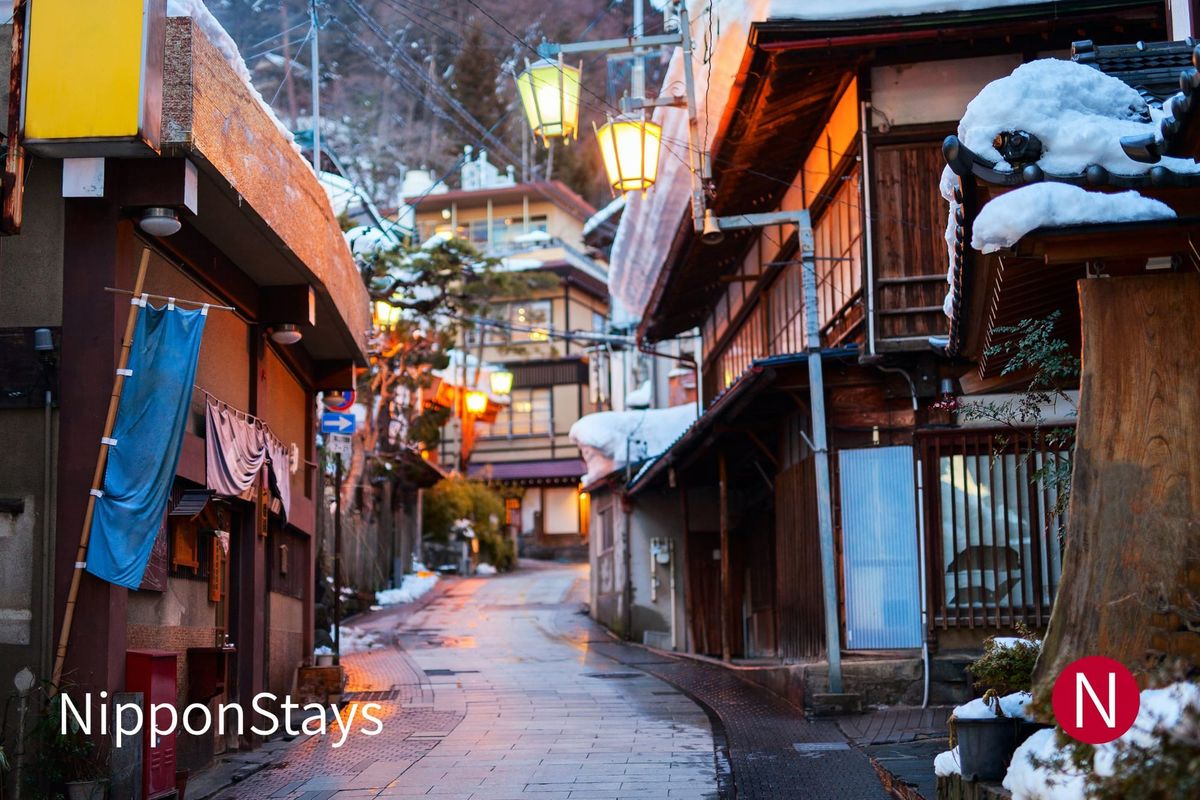
Quick Answer: Can you see snow at an onsen in December in Japan? Yes, in some towns — snow on the ground by Christmas is close to a sure thing at Sukayu Onsen and Ginzan Onsen — the nearest official Japan Meteorological Agency stations to each show a normal start of lasting snow cover well before December 25 (1991–2020 normals, checked September 2026). Noboribetsu Onsen, Nyuto Onsen, Okuhida and Kusatsu are close calls on paper, but all four sit higher and colder than the reference city used to measure them, so the snow usually arrives on the ground there before the chart below suggests. Kinosaki Onsen and Arima Onsen are the two to skip if snow is the point — their normals don't turn until January. For a room where snow is already reliable, Notoya Ryokan at Ginzan Onsen and Taenoyu at Nyuto Onsen are both open through the winter.
Normal snowfall dates for onsen towns across Japan
Japan's 1991–2020 climate normals — the 30-year averages the Japan Meteorological Agency (JMA) publishes for each of its official stations — show a spread of about four weeks in when different onsen towns typically get their first lasting snow cover — from December 14 at Aomori to January 11 at Toyooka — and at Kobe snow cover so rarely lasts that there is no normal for it at all. None of the mountain onsen villages below has its own long-record official station, so each row uses the nearest one that does; where that reference city sits noticeably lower and milder than the actual onsen village, the note underneath says so.
| Onsen town | Nearest JMA station | Normal first snow | Normal start of lasting snow cover (≥1cm) |
|---|---|---|---|
| Sukayu Onsen (Aomori) | Aomori | Nov 8 | Dec 14 |
| Ginzan Onsen (Yamagata) | Shinjo | Nov 14 | Dec 18 |
| Noboribetsu Onsen (Hokkaido) | Muroran | Nov 2 | Jan 1 |
| Nyuto Onsen (Akita) | Akita | Nov 15 | Dec 30 |
| Okuhida Onsen (Gifu) | Takayama | Nov 17 | Dec 31 |
| Kusatsu Onsen (Gunma) | Karuizawa | Nov 17 | Jan 1 |
| Nozawa Onsen (Nagano) | Nagano | Nov 18 | Jan 2 |
| Kinosaki Onsen (Hyogo) | Toyooka | Dec 5 | Jan 11 |
| Arima Onsen (Hyogo) | Kobe | Dec 13 | No normal (cover rarely lasts) |
All dates above are 1991–2020 normals from JMA's seasonal normal-value tables, checked September 2026. Four of the reference stations sit lower or milder than the onsen village it stands in for — Akita city for Nyuto Onsen, Takayama for Okuhida, Karuizawa for Kusatsu (Kusatsu Onsen has no dedicated official station; Karuizawa, a similarly elevated mountain resort roughly 30km northeast, is the nearest one that publishes this statistic), and Nagano city for Nozawa Onsen. For all four, the real onset of snow on the ground at the onsen village itself is more likely to be earlier than the date shown than later.
Towns likely white by Christmas
Two onsen towns clear December 22 on their reference station's normal for lasting snow cover: Sukayu Onsen and Ginzan Onsen.
Sukayu Onsen, in the mountains above Aomori city, has the earliest normal of the nine towns here — December 14 at the Aomori station, itself already one of the snowier prefectural capitals in the country. Whether to stay overnight there or visit on a day trip from Aomori is its own decision, covered in our separate guide to Sukayu Onsen in winter.
Ginzan Onsen, the lantern-lit riverside village in Yamagata, sits close behind at December 18 on the Shinjo normal. Notoya Ryokan, a wooden inn on the river side of the village with a cave bath kept as a private soak, is open through the season; for the rest of the Ginzan lineup and how it stacks up against Nyuto Onsen for a car-free winter trip, see where to stay in Ginzan Onsen and our Ginzan-versus-Nyuto comparison.
Noboribetsu Onsen, on Hokkaido rather than Honshu, is a closer call than its northern location suggests: the Muroran normal for lasting snow cover is January 1, just after Christmas rather than before it. Muroran is a coastal station, though, and Noboribetsu Onsen sits inland in the hills, so snow on the ground at the onsen itself is more likely to arrive earlier than that date than later. Our Noboribetsu guide covers which inns sit closest to the sulfur-scented Jigokudani valley.
Noboribetsu Onsen, Nyuto Onsen, Okuhida Onsen, Kusatsu Onsen and Nozawa Onsen are the borderline cases: their reference stations' normals land between December 30 and January 2, right around the holiday rather than safely before it. Because all five onsen villages are higher in elevation and colder than the city used to measure them, the practical odds are better than the raw date implies. Taenoyu at Nyuto Onsen sits at its own named bus stop with no transfer needed, and our guide to the Nyuto Onsen inns covers the rest of the valley. For Okuhida and Kusatsu, see which of Okuhida's five onsen villages to sleep in and where to stay by Kusatsu's snowy Yubatake; for Nozawa, our Nozawa Onsen lineup.
Towns that usually aren't
Kinosaki Onsen and Arima Onsen are both classic winter onsen trips, but neither one is a safe bet for snow already on the ground by Christmas.
Kinosaki Onsen sits inside Toyooka city, so the Toyooka station is effectively a local reading rather than a stand-in for somewhere else — and its normal for lasting snow cover doesn't start until January 11, nearly three weeks after Christmas. Kinosaki's appeal in December is the willow-lined canal and the seven public bathhouses, not a snowy street scene; if you're travelling with kids, our Kinosaki family guide covers the bathhouse age rules.
Arima Onsen, in the hills above Kobe, is the least snowy town in this guide by a wide margin: the Kobe normal for the first snowfall of any kind is December 13, but the first day with at least 1cm on the ground doesn't come until January 23, and snow cover there so rarely lasts that JMA publishes no normal for lasting snow cover at all. A December trip to Arima should be planned around the hot springs and the old town, not around seeing snow.
If you can move your dates instead of the town
Shifting a trip from mid-December into February closes more of the snow gap than switching from one borderline onsen town to another — by February, all nine reference stations in the table above already have lasting snow cover well established, including Kinosaki and Arima. The trade-offs beyond snow (crowds, prices, daylight hours) are covered in our December-versus-February winter trip comparison, so this guide won't repeat them here. If snow monsters rather than an onsen are the actual goal, that's a different itinerary — see where to stay for the Zao snow monsters.
Snow odds and where to read next, town by town
The table below condenses every town from this guide into one line each: whether the normal points to snow by December 25, how travelers usually get there in winter, and which guide covers the hotel decision.
| Town | Snow by Dec 25 likely? | Getting there in winter | Where to read next |
|---|---|---|---|
| Sukayu Onsen | Yes | JR bus from Aomori Station | Sukayu: stay or day trip |
| Ginzan Onsen | Yes | Shinkansen to Oishida, then taxi or shuttle | Where to stay in Ginzan |
| Noboribetsu Onsen | Probably (elevation) | JR plus local bus, or highway bus from Sapporo/New Chitose | Where to stay in Noboribetsu |
| Nyuto Onsen | Probably (elevation) | Akita Shinkansen to Tazawako, then local bus | Nyuto Onsen inns compared |
| Okuhida Onsen | Probably (elevation) | Bus from Takayama | Okuhida's 5 onsen villages |
| Kusatsu Onsen | Close call | JR bus from Karuizawa or Naganohara-Kusatsuguchi | Where to stay in Kusatsu |
| Nozawa Onsen | Close call | Bus from Iiyama Station (Hokuriku Shinkansen) | Where to stay in Nozawa |
| Kinosaki Onsen | Unlikely | Direct JR limited express from Kyoto or Osaka | Kinosaki with kids |
| Arima Onsen | Unlikely | Bus or train via Kobe | Our onsen and ryokan hub |
Trip Essentials for Japan
Things worth booking before you land, all in English:
- eSIM — Airalo's Japan eSIM: install it at home and data works as soon as you switch off airplane mode at Haneda, Narita, Kansai, or wherever you land.
- Tickets and day trips — Klook covers the Japan Rail Pass, teamLab tickets, and shinkansen-linked day trips; booking ahead skips the ticket-window line.
FAQ: Snow at an Onsen in December
Which onsen town is most likely to have snow on the ground by Christmas?
Based on the nearest official weather stations, Sukayu Onsen (measured at Aomori) has the earliest normal start of lasting snow cover, December 14, followed by Ginzan Onsen (measured at Shinjo, December 18). Both figures are 1991–2020 JMA normals, checked September 2026.
Is snow guaranteed on an onsen trip in December?
No. A "normal" is a 30-year average, not a promise for any single year, so even Sukayu Onsen can occasionally have a late or thin start to the season. What's more reliably true every year is the ranking between towns: low-elevation towns such as Kinosaki (normal cover from January 11) and Arima (first 1cm on the ground from January 23) are a poor bet for snow at any point before the new year, in an average year or an unusual one.
Why do some of these towns use a nearby city's weather station instead of their own?
Sukayu, Nyuto, Ginzan, Okuhida, Kusatsu and Nozawa don't have their own long-record official station with published 1991–2020 normals, so each is matched here to the nearest one that does — Aomori, Akita, Shinjo, Takayama, Karuizawa and Nagano city respectively. Because the actual onsen villages sit higher in the mountains than these reference cities, snow on the ground at the village itself typically arrives at least as early as the date shown, and in several cases earlier.
If snow is the priority, is December or February the safer month?
February, at every town in this guide except Arima. Eight of the nine reference stations show lasting snow cover established by February (Kobe, the station for Arima, has no lasting-snow normal at all), while December is exactly where the five borderline towns (Noboribetsu, Nyuto, Okuhida, Kusatsu, Nozawa) can still go either way depending on the year. See our December-versus-February comparison for the other trade-offs, since snow isn't the only thing that changes between the two months.