Atami Plum Festival: Day Trip From Tokyo or Sleep There?
Atami Plum Festival: day trip or overnight? Early Kodama gets you there in ~55 min; stay for the 8:30 opening and Itokawa night sakura.

Quick Answer: A day trip to the Atami Plum Festival works if you can leave Tokyo on an early Kodama (about 45 minutes to Atami Station) and walk the roughly 10 minutes up from Kinomiya Station to the garden gate — you'll be inside before the weekend crowds arrive and back in Tokyo by early evening. Stay overnight instead if you want the garden at opening with almost no one else in it, an evening soak after a day outdoors, or a look at the Itokawa river's early cherry blossoms lit up after dark (mid-January to early February most years). For an overnight, Toyoko Inn Atami Ekimae is the practical pick 4 minutes from Atami Station, and Atami New Fujiya Hotel is the onsen-and-buffet pick with a free shuttle from the station.
Day trip, half-day trip, or overnight: what each one gets you
The choice comes down to how early you can leave Tokyo and how much of the evening you want in Atami rather than back home. The table below lines up the three realistic plans against what you actually see and what you miss.
| Plan | Leave Tokyo | At the garden by | Back in Tokyo by | What you miss |
|---|---|---|---|---|
| Early day trip | Before 7:00 (Kodama) | Garden opens at 8:30 | Early evening | Evening onsen; night sakura along the Itokawa |
| Midday day trip | Mid-morning | Late morning, after the first coach-tour rush | Evening | The quiet opening hour; both evening extras |
| Overnight | Any time | Next morning at 8:30, ahead of most visitors | Day 2, whenever you like | Nothing — but you pay for a room |
The day trip that works: first Kodama, garden at opening
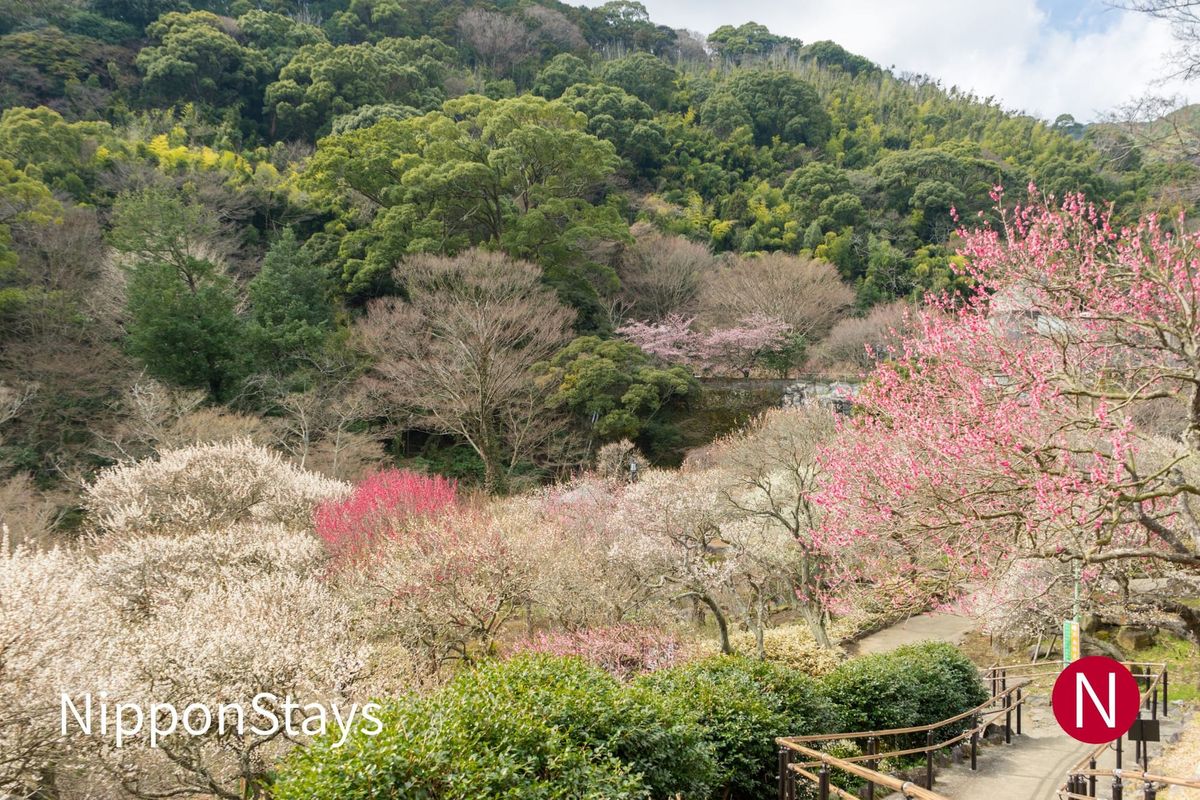
Leaving Tokyo on one of the first Kodama departures of the morning puts you at Atami Station in roughly 45 minutes — the Tokaido Shinkansen's Kodama service, the slower of the two trains that stop at Atami, is scheduled at around 43 to 45 minutes depending on the specific departure. From there it's the 10-minute walk from Kinomiya Station (see the routing note below) or a short bus ride from Atami Station itself, and the garden's paid gate opens at 8:30 during the festival (Atami City official visitor information, checked September 2026). Arriving at or just after opening matters more here than at most sights in Japan: Atami Baien is a compact 4.4-hectare garden with roughly 469 plum trees across 60 varieties, and its paths narrow noticeably once the tour coaches that run through Izu unload mid-morning.
The return leg is the easy part — Kodama and the faster Hikari both call at Atami on the way back to Tokyo through the afternoon and evening, so you're not locked into one departure. If you're stopping at Atami on the way to or from a longer Shinkansen trip, our practical guide to Tokyo Station and the Shinkansen covers platform layout and luggage storage before you commit to a same-day return.
Kinomiya or Atami Station: which way to the garden
Kinomiya Station, one stop before Atami on the JR Ito Line, is the closer approach: the garden's own access information puts it at about a 10-minute walk from the station, uphill but on ordinary streets rather than a trail. Most Shinkansen day-trippers will still arrive at Atami Station first, since that's where the Kodama stops — from there, the walking option is roughly 30–40 minutes uphill and not the practical choice with limited time, so take the bus instead. From Atami Station's bus terminal, a local bus reaches the "Umeen" (梅園) stop in about 15 minutes, and the garden entrance is about a 2-minute walk from there (Atami City official visitor information, checked September 2026). Confirm the exact bay number and departure frequency on the day at the terminal's signboard — timetables shift between seasons.
If you're arriving by the JR Ito Line rather than changing at Atami, getting off one stop early at Kinomiya and walking in is usually faster door to door than continuing to Atami and doubling back by bus.
Three reasons to sleep in Atami instead
None of these require staying more than one night, and none of them are available on a same-day return.
- The garden at opening, not at 11am. Staying over means you can be at the 8:30 gate on your own schedule rather than racing a morning Kodama, and you get the quiet, low-light photos before the coach groups arrive.
- An onsen soak after a day of walking. Atami is a hot-spring town first and a flower-viewing stop second — a day trip skips the actual reason most Japanese visitors come here.
- The Itokawa river's cherry blossoms, lit up after dark. Separately from the plum festival, Atami's early-blooming "Atami Sakura" line the short Itokawa river walk near Atami Station and are illuminated nightly from 16:30 to 23:00 during their own festival — the 2026 edition (the 16th running of the event) ran January 10 to February 8 (Atami Tourist Association event listing, checked September 2026). The 2027 edition's dates were not yet announced at the time of writing; based on recent years, mid-January to early February is the working assumption for planning, not a confirmed date.
What the numbers actually say: checked September 2026
Of the 82nd Atami Plum Garden Festival's roughly eight-week run (January 10 to March 8, 2026), only the first 46 days required a paid ticket — the garden dropped to free admission for its final 12 days, from February 25 through the March 8 close, while keeping the same 8:30–16:00 opening hours throughout (Atami Tourist Association event listing, checked September 2026). Paid admission during that window was ¥300 for adults, ¥100 for Atami city residents and anyone staying overnight in a city hotel or ryokan, and free for anyone junior-high age or younger. If your travel dates land in the back half of the festival window, that's a real saving worth timing around, not just a footnote — check the current year's cutoff date before you buy anything, since it can move.
Where to sleep if you stay: two picks, two different trips
We're naming two hotels here on purpose, not the full run of Atami's dozens of properties — this article is about whether to stay at all, not which of everything to pick. Both were confirmed operating from their own official sites in September 2026.
| Stay | Walk to Atami Station | Onsen bath | Best for |
|---|---|---|---|
| Toyoko Inn Atami Ekimae | 4-min walk | No — standard business-hotel unit bath, no hot-spring bath advertised on its own site | An early departure the next morning; simple, budget, no-frills sleep |
| Atami New Fujiya Hotel | 15-min walk, or a free shuttle from the station running about every 30 minutes from 14:00–17:30 | Yes — hot-spring baths as part of an all-inclusive resort stay (buffet dinner, free-flow drinks) | The full onsen evening, especially if you're not rushing out early the next day |
If you'd rather weigh Atami against a second base for the same trip, our comparison of Atami versus Hakone in February covers which one suits a car-free winter weekend better, and if you're traveling with young children, our head-to-head of Atami's two big family resorts covers the kids'-facilities side that this guide doesn't. For a broader look at planning a car-free onsen stay, see our onsen and ryokan hub, and if you're traveling with a baby or toddler, our guide to onsen bathing with kids in Japan covers the family-bath logistics before you book either property.
Trip Essentials for Atami
Things worth booking before you land, all in English:
- eSIM — Airalo's Japan eSIM: install it at home and data works as soon as you switch off airplane mode at Haneda or Narita.
- Tickets and day trips — Klook covers Atami fireworks tours; booking ahead skips the ticket-window line.
FAQ: Atami Plum Festival
Is Atami Plum Garden a day trip or an overnight from Tokyo?
Both work. An early Kodama gets you to Atami Station in about 45 minutes, and the garden opens at 8:30, so a day trip is realistic if you leave before 7am. Stay overnight if you want the garden at opening without racing a train, an evening onsen, or the Itokawa river's night-lit cherry blossoms — none of which a same-day return leaves time for.
How much does it cost to get into Atami Plum Garden?
During the paid part of the 2026 festival (January 10–February 24), admission was ¥300 for adults, ¥100 for Atami residents and city hotel guests, and free for junior-high age and under. From February 25 through the March 8 close, entry was free for everyone. Check the current year's dates before you buy a ticket, since the paid-to-free cutoff moves each year.
What's the fastest way from Tokyo without a car?
Take the Tokaido Shinkansen Kodama from Tokyo Station to Atami Station (roughly 45 minutes), then either walk about 10 minutes from Kinomiya Station one stop earlier, or take the local bus from Atami Station's bus terminal toward the "Umeen" stop (about 15 minutes) and walk the last 2 minutes from there to the garden gate.
Do I need to book a hotel weeks in advance?
For festival weekends, yes — Atami's rooms fill up through December for a January-through-March run, well before the 2027 festival dates are even confirmed. A weekday overnight is far easier to arrange close to your travel dates than a Saturday during the free-admission final weeks, when day-trip crowds are heaviest.