Kyoto's Autumn Leaves in the Rain: Go North Instead
Rain is not a lost day in Kyoto — it changes where you should be. Walk-through temples lose most of their value; places you look out from get better.

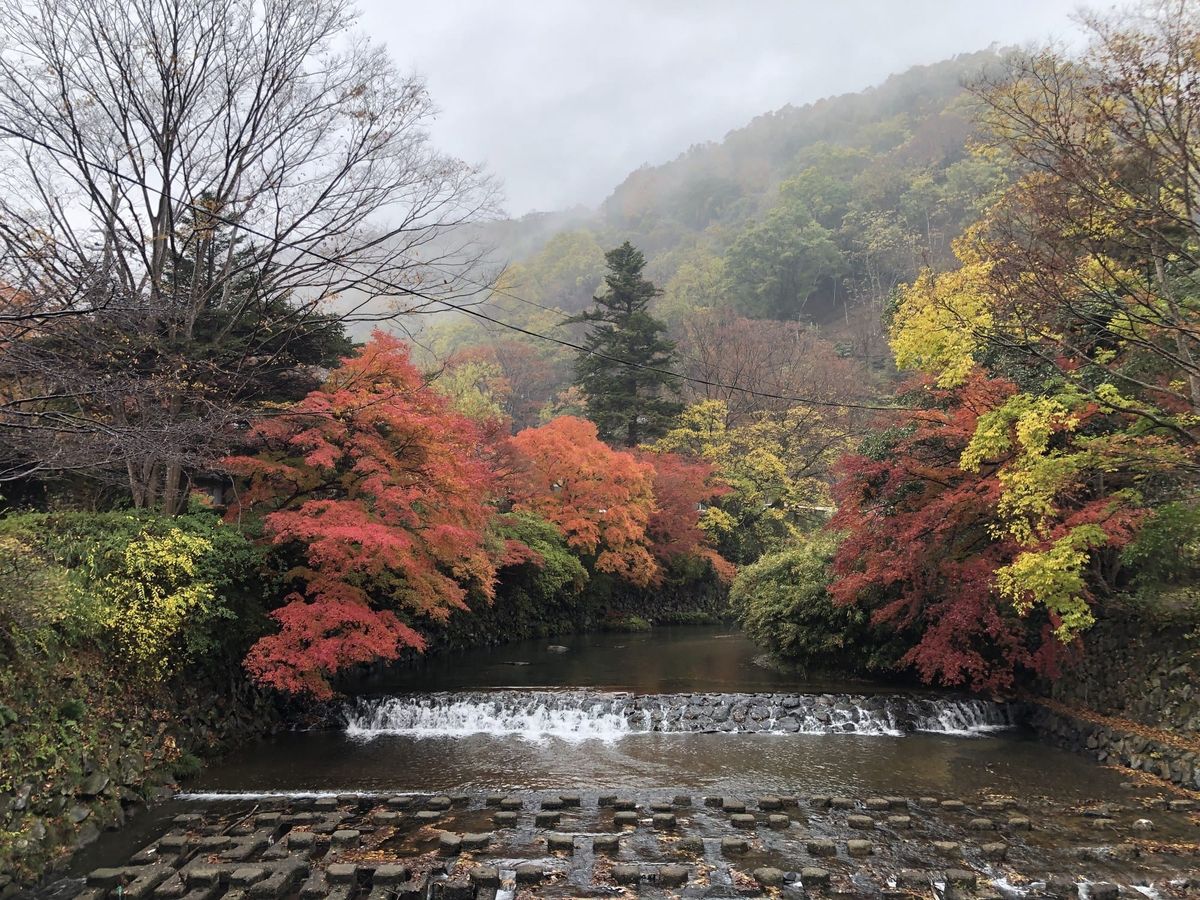
Kyoto's autumn leaves in the rain are not a lost day, but rain does change where you should be. The walk-through temples — the ones with wide grounds and a circuit you follow — lose most of what makes them worth the admission. The places that improve are the ones you look out from: a shoin above a valley, a garden seen from under a roof. On the wet morning of our 2021 trip we were beside the Takano River at Yase by 9:20, in fog, and it produced the pictures we still use.
What mist does to a valley
On a clear day a wooded hillside is a single mass of colour. In fog it separates into layers — the near trees sharp, the middle ones softened, the ridge behind reduced to a grey outline — and the reds read against the grey in a way they never do against blue. That is not a consolation prize. It is a different photograph, and it is only available in weather most visitors treat as a write-off.
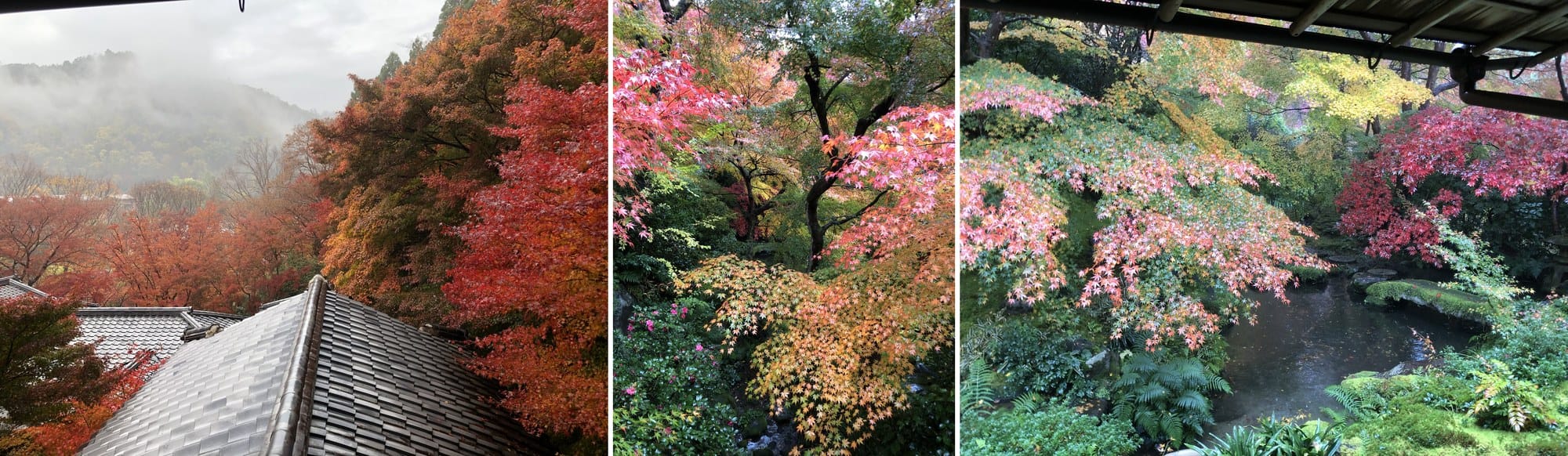
The second thing rain does is to the ground. Moss goes the deep saturated green that dry moss cannot manage, and wet stone darkens so that fallen leaves on it stand out individually rather than as a scatter. Gardens built around moss and stone — which is most of the good ones in the north-east — are at their best in exactly the conditions people cancel for.
Go north-east: Yase and the valley
The Eizan Electric Railway runs north-east from Demachiyanagi into the hills, and this is where a rainy Kyoto morning should go. The valley narrows, the cloud sits on the slope, and the temples up there are built to be looked out from rather than walked through.
Our own timings from that morning: the river at 9:20, inside a shoin at 9:35 looking out over tiled roofs into the mist, and in the garden below by 10:07. Fifty minutes for the whole stop including the walk up from the station.
One practical note: the approach roads up there are narrow and there is essentially no parking. Take the train, and take an umbrella rather than a hood — you will be stopping to look up.
What to swap, and what to swap it for
The useful way to plan a wet day is not "indoor things" but "things you look out from".
| If your plan was | Swap it for | Why |
|---|---|---|
| A pond circuit you walk around | A garden viewed from a veranda | You are under a roof and still looking at the same maples |
| Wide temple grounds | A valley view from above | Mist gives depth that open ground cannot |
| A hillside walking route | The Eizan line north-east | The train does the climbing and the windows do the viewing |
| A night illumination | Somewhere lit that you reach without a queue | Rain and a ticketed queue is the worst combination of the trip |
The one thing rain genuinely ruins
Long walking routes between temples. The value of a route like the Kinukake-no-Michi in the north-west is the walking itself — three temples strung along one road — and in steady rain that becomes an errand. If your plan for the day was a multi-temple walk, move it rather than shorten it, because a rushed version of a walking day is worse than a different day entirely.
Rain is also the cheapest day to change your mind
There is a scheduling argument for keeping your wet day flexible, and it is specific to Kyoto in late autumn. The most sought-after autumn sites run timed entry, advance tickets or — in one case in the north-east — a postal ballot decided months earlier. Those are exactly the plans you cannot move when the forecast turns, and standing in a ticketed queue in rain is the worst hour of any Kyoto trip.
So build the fixed bookings around the days you can walk, and leave the unticketed places for whenever the weather decides. Most of what is worth seeing in the north-east valley needs nothing but the fare and the admission at the gate, which means a wet morning costs you nothing to redirect into.
The corollary is worth stating: if you have a ticket for a specific date and it rains, go anyway. A garden you view from a veranda is unaffected, and the crowd will be thinner than the ticket count suggests because other people will have decided the day was ruined.
Where to stay if you want a rain plan
The relevant question for a wet morning is how quickly you can be somewhere the weather suits, and from central Kyoto the north-east valley is a train ride plus a change. From the north of the city it is a single line.
| Name | Area | From price (2 guests) | Best for |
|---|---|---|---|
| The Prince Kyoto Takaragaike | Takaragaike / Kokusaikaikan | from ¥30,000 | Being closest to the north-east valley when the forecast turns |
| Cross Hotel Kyoto | Kawaramachi | from ¥26,000 | Walking to Demachiyanagi for the Eizan line |
| The Westin Miyako Kyoto | Okazaki / Higashiyama | from ¥38,000 | Eastern temples on foot when the rain is light |
Prices are from-rates at two guests and rise steeply in late November, when autumn turns Kyoto into a different market from the rest of the year. A wet-day plan is also cheaper to hold from further out: staying in Osaka costs you the early start but not much else, and the north-east valley is reachable from there on the same day you decide to go. Of the four Kyoto autumn mornings we have photographed with timestamps, one was fog and rain — and it is the one that produced the images we still use (checked August 2026). For the wider question of which base suits which trip, see where to stay in Kyoto and Kawaramachi versus Kyoto Station. The three bases and what each one gives up are set out in where to stay in Kyoto for autumn leaves. These are normal-season from-rates and they are not a guide to what you will pay in the last two weeks of November. In that window the same room routinely sits several tiers higher, the cheapest rooms in any property go months ahead, and a rate you saw in August will not still be there. Treat every number here as a way of ranking these places against each other, not as a price. Put your own dates in before you plan around any of them.
Practical things that make a wet day workable
Take an umbrella rather than a rain jacket with a hood — hoods cut your view upward, and looking up is most of what you are there for. Expect to take your shoes off at temple buildings, so wet socks are the real problem rather than wet feet; a spare pair weighs nothing. Wet stone steps in gardens are genuinely slippery, and the moss beside them is not a surface to test.
Kyoto is not the only place where rain changes the answer rather than ruining it. Gorge and garden stays elsewhere in Japan are built for exactly this weather, and where a hotel sits decides whether a wet forecast costs a traveller the day or improves it. Rain on an autumn-leaves trip names the stays where it helps.
Trip Essentials for Kyoto
Things worth booking before you land, all in English:
- eSIM — Airalo's Japan eSIM: install it at home and data works as soon as you switch off airplane mode at Kansai Airport.
- Airport transfer — Klook covers bus, train, and private transfers from Kansai Airport.
- Luggage storage — arriving before check-in? Radical Storage takes bags at shops near Kyoto Station for a flat daily rate.
- Tickets and day trips — Klook covers Arashiyama activities, tea ceremonies, and Nara day trips; booking ahead skips the ticket-window line.
FAQ: Kyoto autumn in the rain
Do temples close in heavy rain?
Gardens generally stay open, but individual buildings and viewing platforms sometimes close in strong wind or storms, and outdoor evening illuminations are the first thing to be cancelled. Check the temple's own site on the morning rather than assuming the published schedule holds.
Are umbrellas allowed in gardens?
Usually yes for walking areas, and usually not on wooden verandas where they drip onto the boards. Most places provide a stand at the entrance. Take one you do not mind leaving in it.
Where can I dry off?
Temple buildings where you sit and view a garden are the natural place, since you take your shoes off at the entrance and are under a roof for as long as you like. This is another argument for choosing look-out-from places over walk-through ones on a wet day.
Is the mist reliable?
No. It sits in the valleys north-east of the city on some wet mornings and not others, and it usually lifts as the day warms. If you want it, go early — we were beside the river at 9:20 and it had thinned considerably by the time we came back down.