Asahikawa Airport vs New Chitose Winter Flights (2026)
Asahikawa Airport maintains a 99%+ on-time rate in winter vs New Chitose's 2-5% monthly cancellations. Here's when to choose AKJ and how to connect to Sapporo.
The short answer on Asahikawa Airport vs New Chitose winter flights: Asahikawa Airport (AKJ) wins on reliability, with a documented 99% or higher on-time rate year after year — compared to New Chitose Airport (CTS), which sees cancellation rates of roughly 2–5% per winter month and occasional mass strandings during blizzards. If your trip takes you anywhere near Asahikawa, Furano, or Daisetsuzan, book through Asahikawa Airport. Rates at JR INN Asahikawa start from ¥7,000 for two per night. The condition that changes this advice: if you're staying in Sapporo city only, New Chitose is still the faster and more frequent option — just monitor the forecast in January and February.
The numbers: on-time reliability by airport in winter
Asahikawa Airport has maintained a 99% or higher on-time flight rate for four consecutive fiscal years (FY2015–FY2018, per Aviation Wire and the Asahikawa City official site), with a peak of 99.7% in FY2018. The airport's own catchphrase — "Just 99% On-Time Flights" — isn't just marketing. It's backed by public data and repeated independent reporting.
New Chitose Airport, by contrast, is Japan's busiest domestic snow-season airport, handling far more flights and a much larger passenger throughput. That scale comes with vulnerability. In winter months (December through February), cancellation rates at New Chitose average around 2–5% per month. In a severe blizzard, the numbers spike hard: in January 2025, a single storm cancelled 56 flights in one day and left 7,000 passengers stranded overnight.
Of the two airports compared here, Asahikawa Airport's on-time record in winter conditions is significantly stronger — a gap confirmed by the airport's own published statistics (checked July 2026).
Why Asahikawa holds up in heavy snow
Asahikawa receives more snow than New Chitose — annual snowfall exceeds 550 cm, roughly double what falls in Chitose. Yet the airport keeps flying. Two structural factors explain this.
First, the runway footprint is smaller. Asahikawa has a single 2,500m × 60m runway. New Chitose runs two parallel runways with vastly more surface area and taxiway length to clear. The amount of snow that needs to be removed before the first morning departure is simply more manageable at Asahikawa.
Second, the snow removal team is exceptional. A specialist unit nicknamed "WAX WINGS" is staffed largely by local farmers from the surrounding towns of Higashikagura, Higashikawa, and Biei — people who spend winters operating heavy agricultural machinery and transfer those skills directly to runway snow clearing. They mobilize before 4 a.m. and aim for "blacktop" — fully cleared asphalt — before the first inbound flight. This system has been covered by NHK and Hokkaido Shimbun, and the logistics behind the 99% rate are well documented in regional media (verified July 2026).
The traveler's move: when New Chitose is snowed in, fly to Asahikawa
Here's the useful bit if you're the kind of traveler who plans contingencies: when a winter storm hits Hokkaido and New Chitose starts cancelling flights, Asahikawa Airport is often still operating normally. That means you have options — before the situation escalates.
This is easier to execute in advance than as a same-day scramble. If your itinerary already includes Asahikawa, Furano, Biei, or Daisetsuzan — or if you're planning to ski at Kamui Ski Links — you can simply route your entire Hokkaido trip through Asahikawa Airport from the start. Land at Asahikawa, make your way into the city or north Hokkaido, and fly home from Asahikawa too. You avoid New Chitose entirely.
If you're already booked on a New Chitose flight and a storm develops, the proactive move is to call your airline as soon as cancellation risk appears and ask about rerouting via Asahikawa. Airlines will sometimes accommodate this at no extra cost when mass disruptions are likely. You can also book on Asahikawa flights outright if alternatives are available.
The fallback for arriving passengers is also worth knowing: if New Chitose is closed and you need to reach Sapporo, ANA and other carriers have occasionally operated diversion arrivals at Asahikawa during severe storms. The Asahikawa–Sapporo surface connection is straightforward (see below). This is the kind of thing that separates a traveler who handles Hokkaido winter smoothly from one who ends up sleeping on a terminal floor.
How the Asahikawa–Sapporo connection works
If you land at Asahikawa Airport and need to reach Sapporo — or if you're planning this as a deliberate routing — the surface leg is manageable and reasonably priced.
- Airport to Asahikawa Station: Asahikawa Airport Bus, operated by Asahikawa Denkikidou, runs approximately 7 times daily. Journey time is about 40 minutes; fare is around ¥750. Buy a ticket at the vending machine in the arrivals hall.
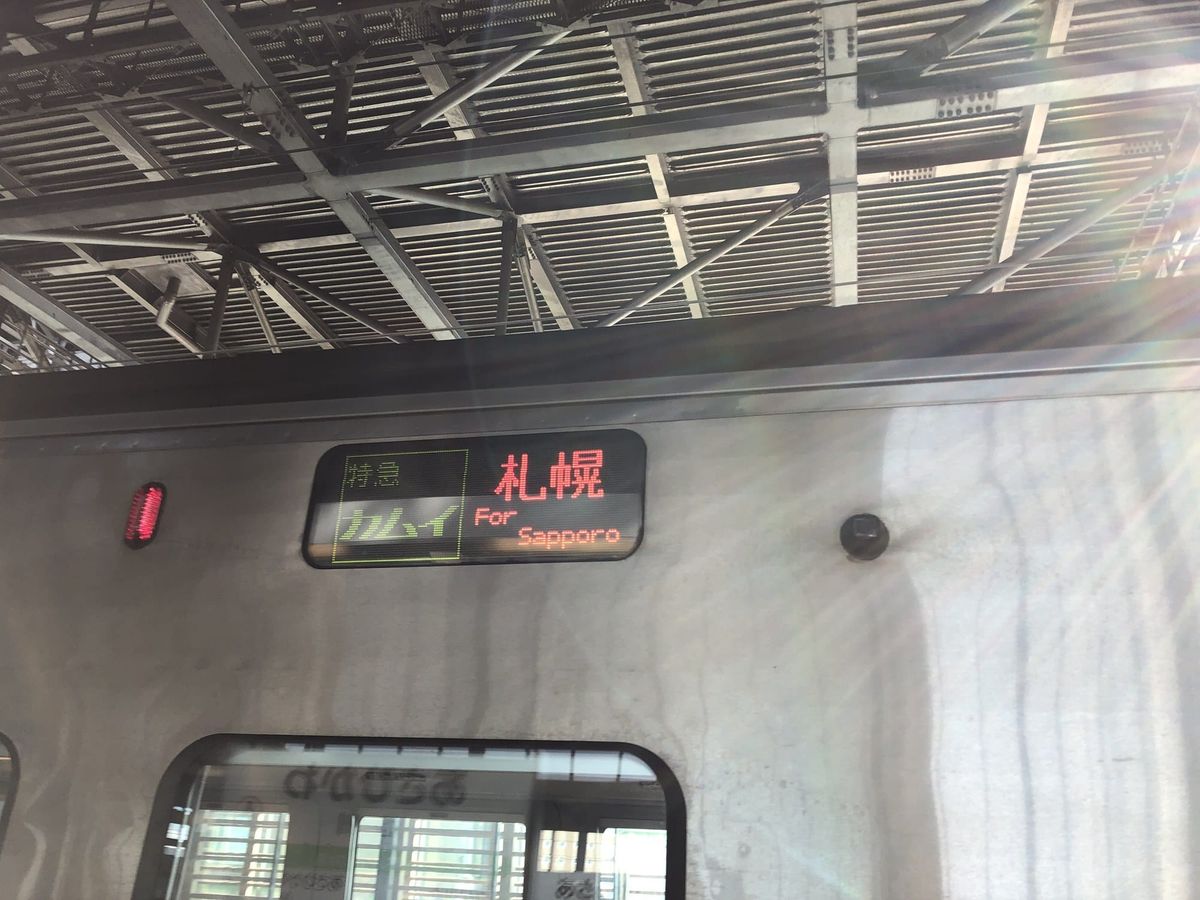
- Asahikawa to Sapporo by limited express (Lilac/Kamui): About 1 hour 25 minutes, from ¥5,440 in reserved seating (April 2025 figures, JR Hokkaido). Discount tickets (Toku-da-ne) bring this down to around ¥2,720 when booked in advance.
- Asahikawa to Sapporo by highway bus (Asahikawa Express): Around 2 hours 5 minutes in summer, 2 hours 25 minutes in winter. Fare from ¥2,500. A budget option if schedule allows.
Total door-to-door from Asahikawa Airport to Sapporo Station by the express train option: roughly 2 hours 10 minutes including the airport bus leg. That's comparable to the worst-case commute from a snowed-in New Chitose, without the uncertainty.
At a glance: Asahikawa Airport vs New Chitose for winter arrivals
| Factor | Asahikawa Airport (AKJ) | New Chitose Airport (CTS) |
|---|---|---|
| Winter on-time rate | 99%+ (documented 4-year run, FY2015–FY2018) | ~95–98% in normal winters; drops sharply in blizzards |
| Risk of mass stranding | Low — single runway, smaller scale | Documented events: Jan 2025 (7,000+ stranded overnight) |
| Routes (Tokyo) | Haneda (JAL, ANA, Air Do); seasonal Nagoya | Haneda + Narita + most domestic hubs |
| Route frequency | Limited — fewer daily departures | Many frequencies per day, year-round |
| Access to Sapporo | ~40-min bus to Asahikawa Station, then ~85-min limited express | ~37-min airport JR rapid direct to Sapporo |
| Best for | North Hokkaido trips, skiers, winter certainty | Sapporo-based stays, maximum schedule choice |
| Stays nearby | JR INN Asahikawa from ¥7,000 for two | Multiple airport/near-airport options |
Who should plan this from the start vs treat it as Plan B
Route your entire trip through Asahikawa Airport if: your destinations are Asahikawa city, Kamui Ski Links, Furano, Biei, Asahidake, or Daisetsuzan; you're traveling in January or February when blizzard risk is highest; you have a hard return deadline (a connecting international flight, a work meeting); or you genuinely want the most snow-reliable entry into Hokkaido.
One group cannot treat it as Plan B. From 11 December 2026 United flies San Francisco to New Chitose nonstop, but only three days a week — so a missed or cancelled flight is not a few hours' wait, it is two or three days. The route explained sets out the schedule and what the frequency means for planning.
Keep New Chitose as your main airport if: you're staying primarily in Sapporo, Otaru, or southern Hokkaido; you want maximum flight frequency and competitive fares; or your trip is flexible enough to absorb a weather delay without real cost.
Treat Asahikawa as a Plan B if: you're already booked on New Chitose but are monitoring a developing storm — know in advance that Asahikawa is available, check it early, and don't wait until New Chitose officially cancels before calling your airline.
For a longer stay in Asahikawa, see where to stay when you land at Asahikawa. If you're still routing through New Chitose, what to eat if you're routing through New Chitose is worth bookmarking. And once you're on the surface leg, onward to Sapporo by train or bus covers where to base once you arrive.
Representative Asahikawa stays for winter arrivals
| Hotel | Area | Price range | Best for |
|---|---|---|---|
| JR INN Asahikawa | Asahikawa Station front | From ¥7,000/night for two (varies by season) | Arrivals by airport bus → station, JR-connected travelers, budget-conscious winter stays |
| OMO7 Asahikawa by Hoshino Resorts | Central Asahikawa | From ¥15,000/night (varies by season) | Skiers heading to Kamui Ski Links; 24-hr WAX BAR on site |
Trip Essentials for Asahikawa
Things worth booking before you land, all in English:
- eSIM — Airalo's Japan eSIM: install it at home and data works as soon as you switch off airplane mode at Asahikawa Airport. Comparing providers? See our Japan eSIM guide.
- Airport transfer — Klook covers bus, train, and private transfers from Asahikawa Airport.
- Tickets and day trips — Klook covers Hokkaido ski passes, Asahiyama Zoo tickets, and Furano-Biei day tours; booking ahead skips the ticket-window line.
FAQ: Asahikawa Airport and winter flight disruptions
How often does Asahikawa Airport cancel flights in winter?
Asahikawa Airport has maintained a documented 99% or higher on-time flight rate across four consecutive fiscal years (FY2015–FY2018), including a peak of 99.7% in FY2018. The airport publishes this figure officially and it has been independently reported by Aviation Wire and NHK. Winter cancellations at Asahikawa are rare compared to most Hokkaido airports. The snow removal team (known locally as WAX WINGS, staffed largely by local farmers) clears the single runway to blacktop before every first morning flight, even after heavy overnight snowfall.
What routes fly into Asahikawa Airport?
As of July 2026, Asahikawa Airport (AKJ) is served primarily by flights from Tokyo Haneda operated by JAL, ANA, and Air Do, with a seasonal Nagoya (Chubu) route in the Dec–Jan winter window. Seasonal and charter services may add additional routes. The route network is narrower than New Chitose, so check current schedules if your departure city isn't Tokyo. The Hokkaido Airports official site (hokkaido-airports.com/en/asahikawa) lists current departures.
How do I get from Asahikawa Airport to Sapporo?
Take the Asahikawa Denkikidou airport bus to Asahikawa Station (about 40 minutes, around ¥750), then board a JR limited express Lilac or Kamui service to Sapporo (about 1 hour 25 minutes, from ¥5,440 in reserved seating, or from ¥2,720 with a Toku-da-ne discount ticket). Total journey is roughly 2 hours 10 minutes. A highway express bus from Asahikawa to Sapporo also runs for around ¥2,500 but takes about 2 hours 25 minutes in winter conditions.
Should I switch to Asahikawa if New Chitose cancels my flight?
If you have flexibility and a storm is developing, contacting your airline early — before mass cancellations are announced — gives you the best chance of rerouting to an Asahikawa flight. Don't wait until New Chitose officially cancels and rebooking queues become unmanageable. The Asahikawa option works best when you initiate the call during the first signs of disruption, not after the terminal is already full. If you're already in the air and diverted, Asahikawa's airport-to-Sapporo surface connection (bus + limited express) makes it a workable landing point.