Five Nights North of Kyoto: Worth Leaving the Centre?
For two nights, stay central. For five, the north wins. What five late-November nights at Takaragaike bought us — including a light-up with no ticket.
Staying north of Kyoto in autumn is the wrong call for one or two nights — you will spend your short time on trains. For five, the calculation changes. We spent five nights in late November at The Prince Kyoto Takaragaike, at the northern end of the Karasuma subway line, and by the third day the thing we valued most was not being in the middle of it. From ¥30,000 for two, with the Eizan line to Yase in one direction and a straight subway run to Kyoto Station in the other.
The four things that made the north work
None of these matter on a short trip. All of them compound over five nights.
You stop commuting into the crowd. A central base puts you inside the busiest part of Kyoto every time you leave the room, including the times you are only going to dinner. From the north you travel deliberately: you go in, you do the thing, you come back out.
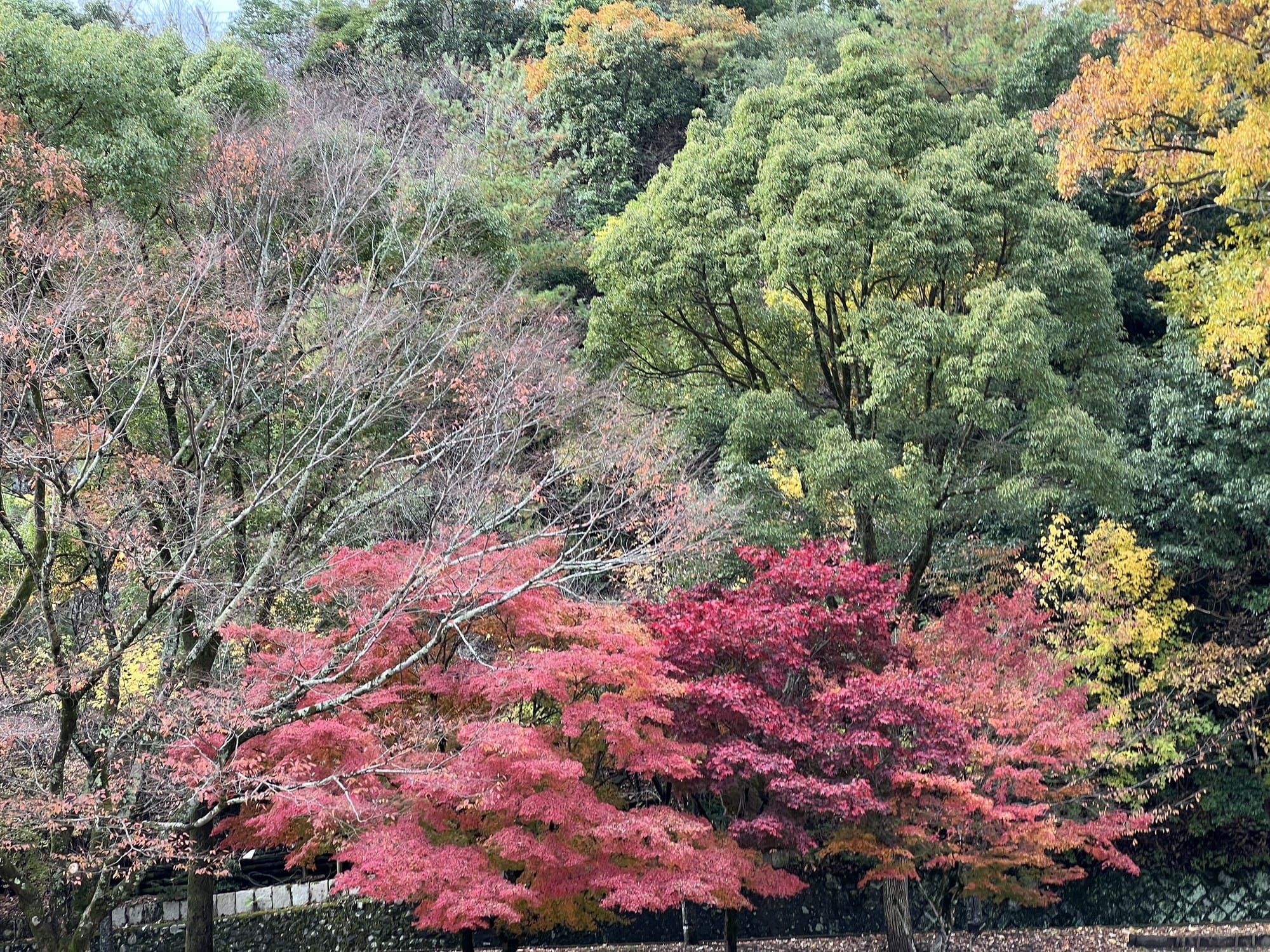
The wet-weather option is close. The Eizan Electric Railway runs from Demachiyanagi up to Yase, and the north-east valley is where Kyoto's autumn works best in rain. On the morning it rained on our 2021 trip we were at the Takano River by 9:20 — mist on the hillside, and a garden that was better for it.
Kokusaikaikan is the end of the line. Karasuma-line trains start there, so you get a seat going in — which matters more than it sounds when you are doing it every day for five days with a camera bag.
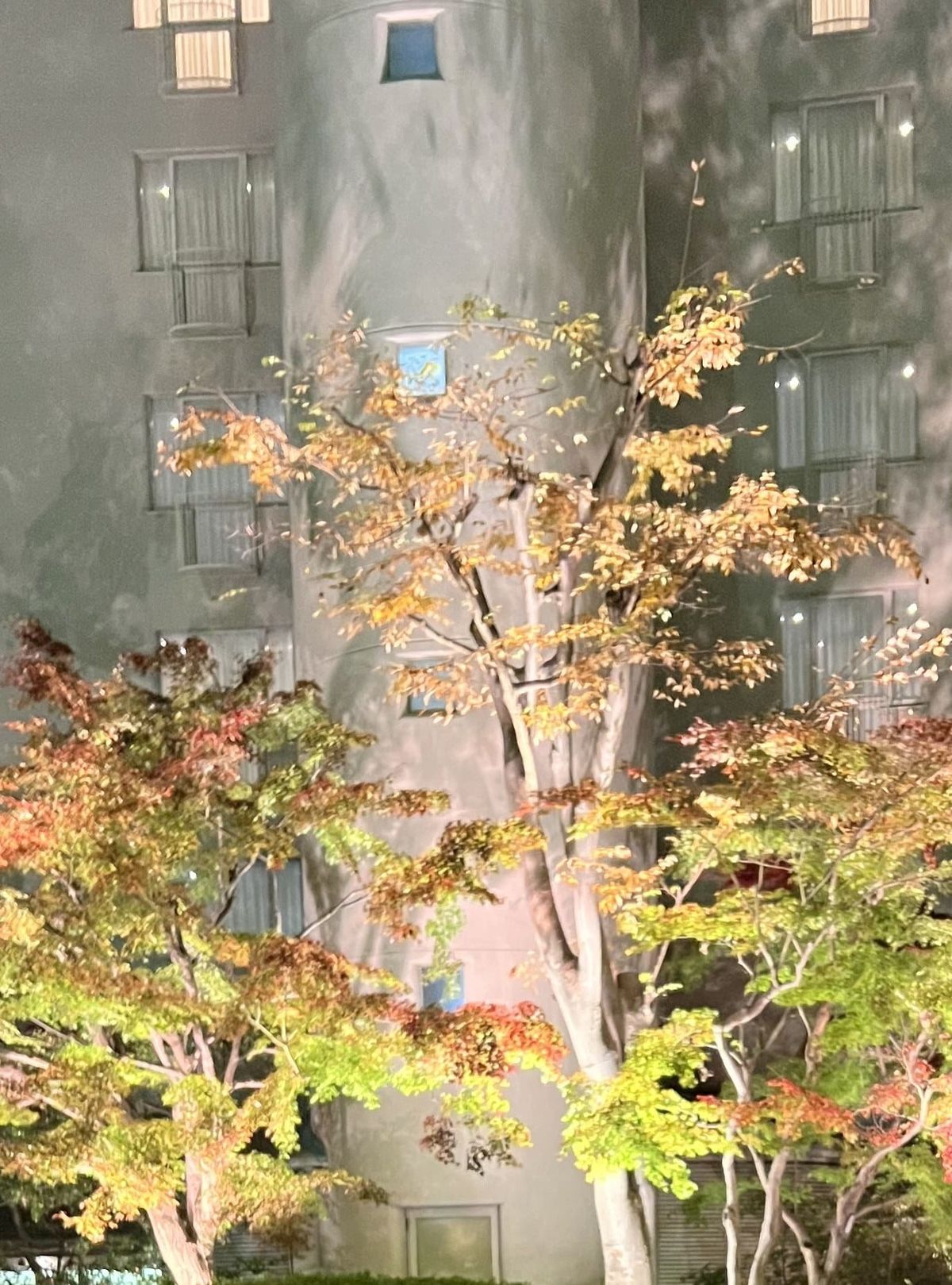
The maples in the courtyard are lit at night. This is the one that surprised us. On our last evening we did not go out at all: the hotel's central courtyard was floodlit, and the trees against the curved concrete were as good as anything we had queued for. No ticket, no closing time, no walk back to a station.
The building is part of the reason to be there
This is not a generic resort hotel with a garden. It was designed by Togo Murano and opened in 1986 — one of the last projects of a career that ran most of the twentieth century — and it is built as a ring, with a courtyard at the centre open the full height of the building.
The curves are deliberate. The Kyoto International Conference Center stands directly next door, and it is emphatically rectilinear; Murano answered it with an ellipse, a spiral staircase and a wave in the ceiling, using the slope of Mount Hiei behind as the thing the building bends around. You can read the argument between the two buildings from the road outside, which is not something you can say about most hotels.
None of that is a reason to travel to Kyoto. It is a reason to pick this hotel over another at the same price, and if you are going to be looking at it for five days, it earns its place.
What five nights in one room is actually like
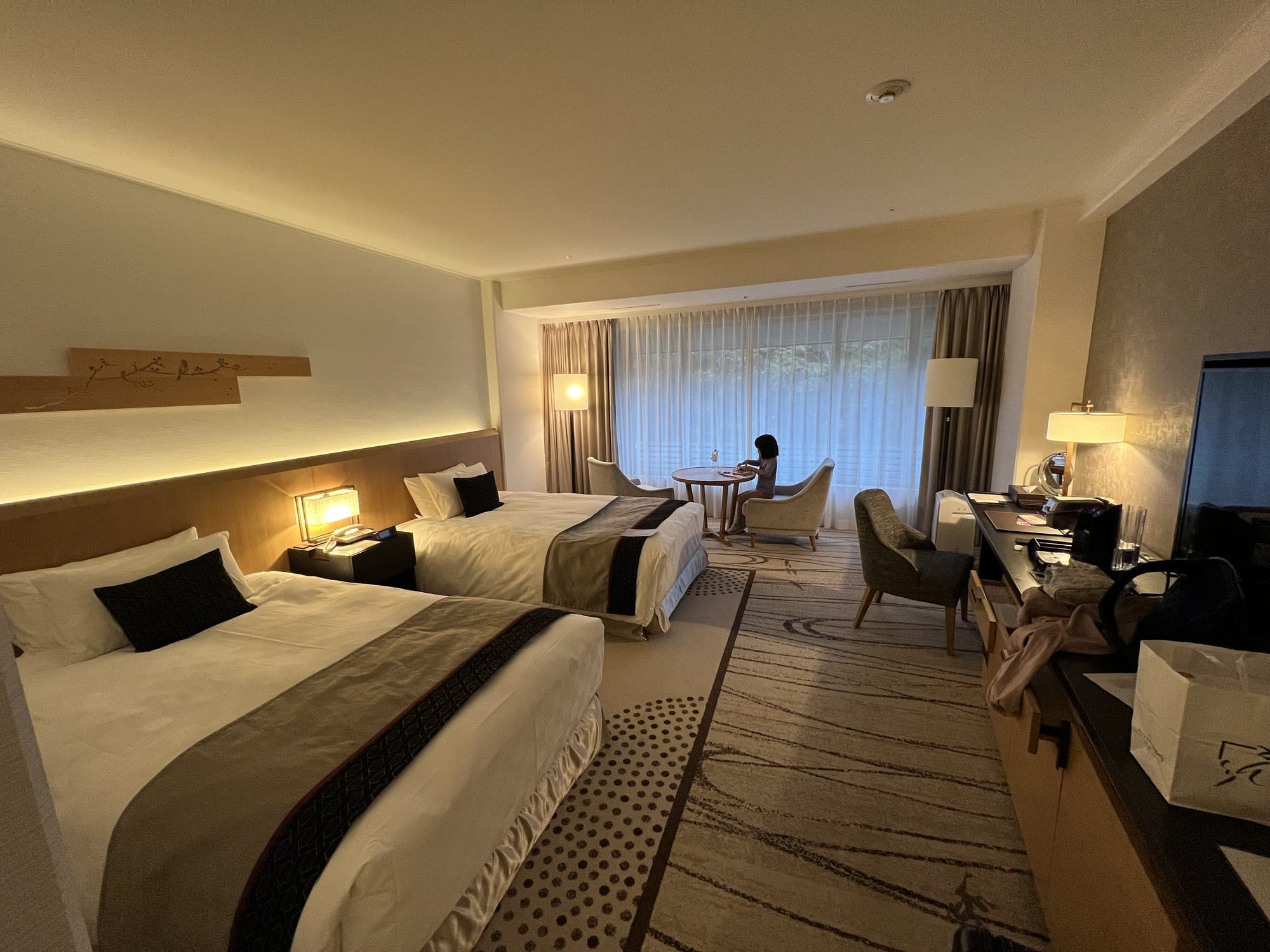
The rooms are large by Japanese standards — a twin with a full seating area by the window, not a chair wedged beside the bed — and after the third day that stops being a luxury and starts being the reason the trip works. You can spread out a map, leave a suitcase open, and come back mid-afternoon without feeling you are in a corridor.
The windows face the grounds rather than a street, and the quiet at night is the genuine article. There is a trade: dinner options within walking distance are limited compared with anywhere central, and you will eat in the hotel or plan to come back from the city.
When not to do this
Three cases where the north is the wrong answer, stated plainly:
One or two nights. You do not have the days to spend on the journey in and out. Stay central and accept the crowds.
Evenings are the point of the trip. If you want Pontocho, bars, and a walk home afterwards, being at the end of the subway line is exactly wrong.
You are moving hotels mid-trip. The advantage here is cumulative. Two nights north and three nights central gives you the disadvantages of both.
North or central: the actual comparison
| North (Takaragaike) | Central (Kawaramachi / Nijo) | |
|---|---|---|
| To Kyoto Station | Karasuma line, seat from the terminus | Shorter, but standing in the peak |
| Evening options | Hotel, or plan to return from the city | Walk out and choose |
| Rain plan | Eizan line to Yase in about half an hour | Requires a trip north anyway |
| Quiet | Grounds, not a street | Depends entirely on the room |
| Best trip length | Four nights or more | One to three nights |
Where to stay in the north
| Name | Area | From price (2 guests) | Best for |
|---|---|---|---|
| The Prince Kyoto Takaragaike | Takaragaike / Kokusaikaikan | from ¥30,000 | Long stays, rain plans, and a lit courtyard you do not have to queue for |
| The Westin Miyako Kyoto | Okazaki / Higashiyama | from ¥38,000 | Being able to walk to a temple gate before it opens |
| Cross Hotel Kyoto | Kawaramachi | from ¥26,000 | Shorter trips where evenings matter as much as mornings |
Prices are from-rates at two guests and move sharply with the season; autumn and cherry-blossom season are a different market from the rest of the Kyoto year. The north is one answer to that; staying in Osaka and travelling in is the other, and for some trips it is the better one — you trade the early morning for a room at a normal price. Over our five nights in late November we left the grounds on four of them — on the fifth we watched the courtyard maples lit from inside (checked August 2026). For the year-round comparison of Kyoto bases, see where to stay in Kyoto, and for the luxury end specifically, luxury hotels in Kyoto. The north is one of three bases we compare in where to stay in Kyoto for autumn leaves. These are normal-season from-rates and they are not a guide to what you will pay in the last two weeks of November. In that window the same room routinely sits several tiers higher, the cheapest rooms in any property go months ahead, and a rate you saw in August will not still be there. Treat every number here as a way of ranking these places against each other, not as a price. Put your own dates in before you plan around any of them.
Trip Essentials for Kyoto
Things worth booking before you land, all in English:
- eSIM — Airalo's Japan eSIM: install it at home and data works as soon as you switch off airplane mode at Kansai Airport.
- Airport transfer — Klook covers bus, train, and private transfers from Kansai Airport.
- Luggage storage — arriving before check-in? Radical Storage takes bags at shops near Kyoto Station for a flat daily rate.
- Tickets and day trips — Klook covers Arashiyama activities, tea ceremonies, and Nara day trips; booking ahead skips the ticket-window line.
FAQ: staying north of central Kyoto
How long is the subway to Kyoto Station?
Kokusaikaikan is the northern terminus of the Karasuma line and Kyoto Station is on the same line with no changes. Check the current timetable for the exact journey time on your dates — the practical point is that trains start at your station, so you begin the day sitting down.
Is there anywhere to eat nearby?
Not in the way there is in Kawaramachi. Plan to eat in the hotel or to come back from the city after dinner. Over five nights we did both, and the second option is fine if you are already returning by subway rather than making a special trip.
Is it good with children?
Yes, for the same reason it suits long stays: room space and grounds you can walk in without a road. Takaragaike Park is a five-minute walk and is a genuine park rather than a garden with an admission gate.
Does the courtyard light-up need a ticket?
No — it is the hotel's own courtyard, visible from inside the building and from the ground floor, with no admission and no closing time. That is the specific thing that makes a northern base work in the one week of the year when every ticketed light-up in Kyoto has a queue.
Which is better for autumn, north or central?
North if you are staying four nights or more, or if your trip includes rain and you want the Yase valley within half an hour. Central if you have three nights or fewer, or if evenings out are part of why you came.