Kinkaku-ji, Ryoan-ji, Ninna-ji: 2h30, Going Backwards
Start at Ninna-ji and finish at the Golden Pavilion. We walked all three, visits included, in two and a half hours: 09:56, 10:53, 12:28.
Kinkaku-ji, Ryoan-ji, Ninna-ji — most itineraries run them in that order, starting with the famous one. Do it the other way round. Start at Ninna-ji in the west, walk east through Ryoan-ji, and finish at the Golden Pavilion — we covered all three, visits included, in two and a half hours, arriving 09:56, 10:53 and 12:28. Going west to east means you meet the biggest crowd last, when you have already seen the two quieter temples, rather than queueing at the gate before you have seen anything.
The route everyone recommends, and what it does to your morning
Kinkaku-ji is the busiest single site in north-west Kyoto, and it is at the eastern end of the Kinukake-no-Michi, the road that links the three temples. Guides tend to start there because it is the one visitors have heard of, which means arriving at the moment the first tour coaches do, then walking west into two temples you now have less patience for.
Reversing it costs nothing. The same road, the same three admissions, the same walk — but the queue comes at the end, after the parts that reward an unhurried look.
Our timings, west to east
These are timestamps from one November morning, not an estimate. Each arrival is when we were inside the grounds, and the gaps include both the walk and the previous temple's visit.
| Temple | Arrived | Gap from previous | What takes the time |
|---|---|---|---|
| Ninna-ji | 09:56 | — | Large grounds; the pagoda and belfry are spread out |
| Ryoan-ji | 10:53 | 57 min | One garden, viewed sitting down; the walk is short |
| Kinkaku-ji | 12:28 | 95 min | A one-way circuit you cannot rush or reverse |
The two gaps are not the same length, and that is the useful part. Our three timestamps put 57 minutes between the first two temples and 95 between the last two — the second half of the morning absorbed far more time than the first (checked August 2026). Budget accordingly: the back end of this route is where a schedule slips.
What each of the three is actually for
They are not three versions of the same thing, and knowing what each one does makes the order easier to accept.
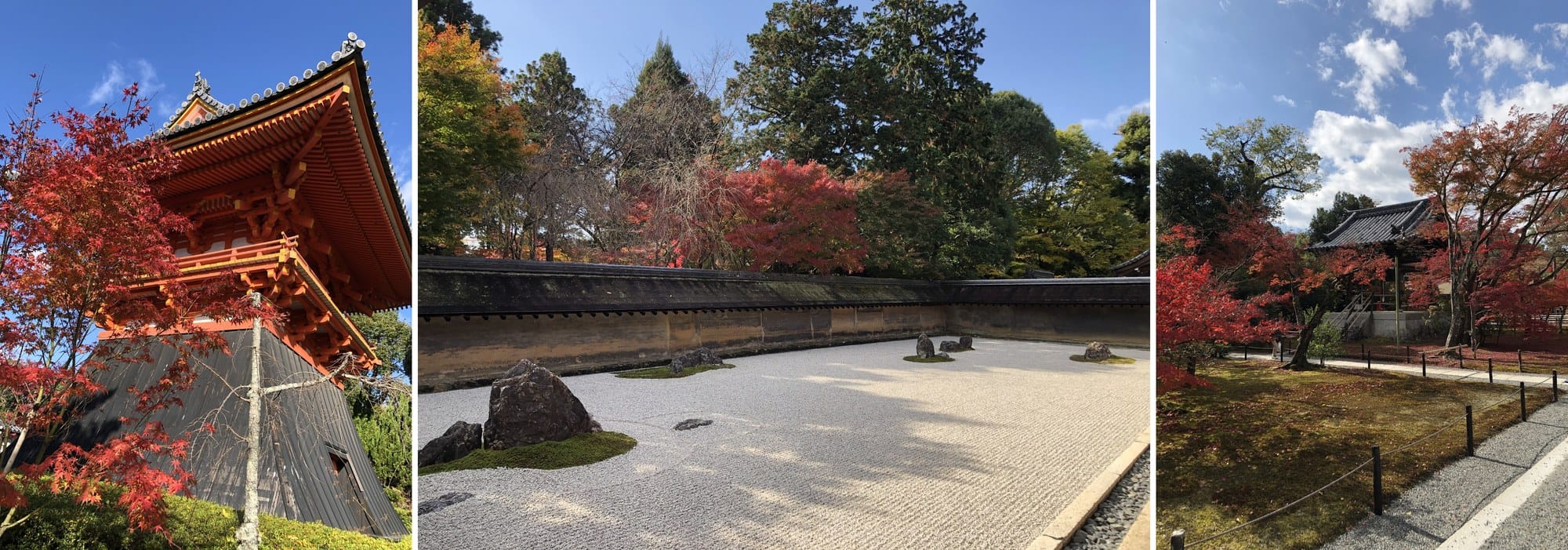
Ninna-ji is space. The grounds are wide enough that even in late November you can stand in front of the belfry — a dark timber base under a vermilion upper storey — with maples in the frame and nobody in it. It is the only one of the three where you can wander without a route.
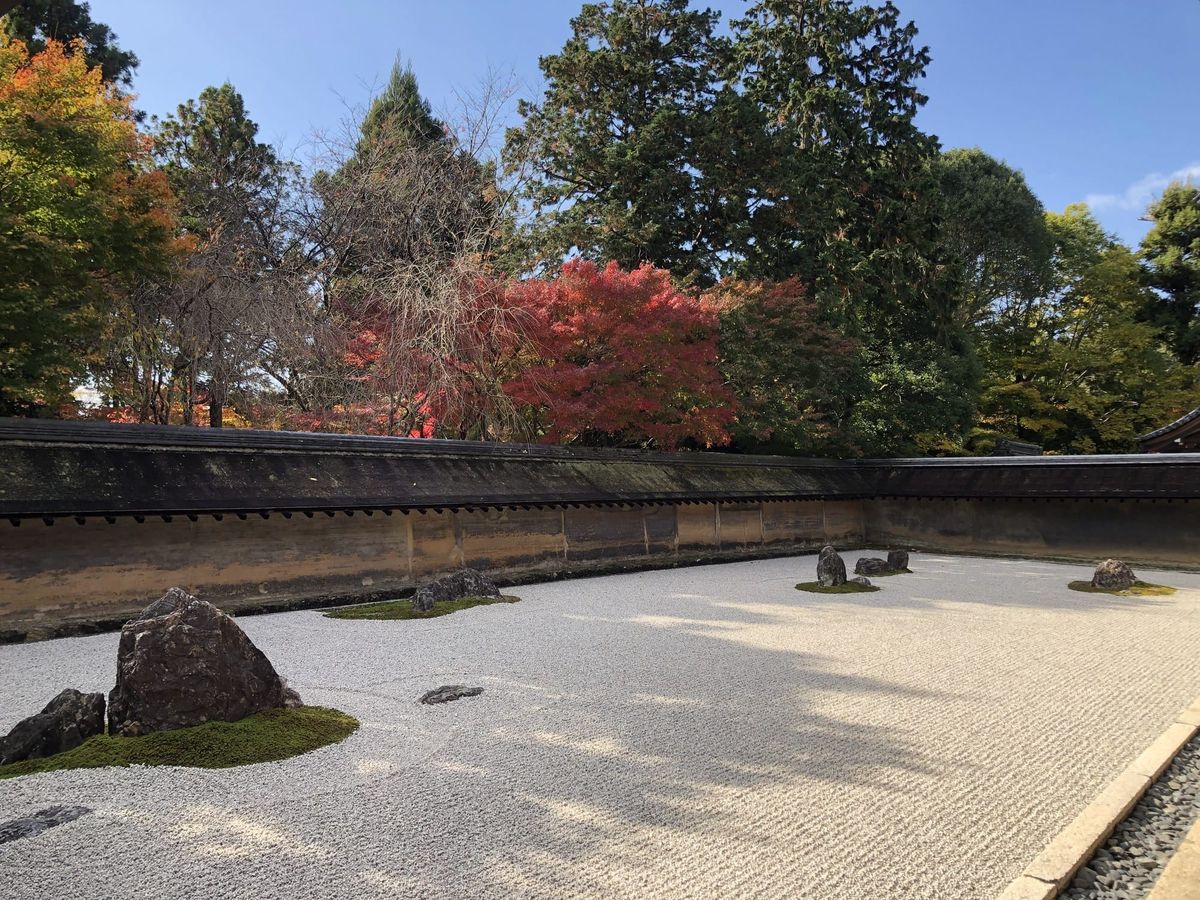
Ryoan-ji is not a view. It is a Rinzai Zen temple of the Myoshin-ji school, and its garden is a place built for thinking rather than looking. You sit on the veranda in front of fifteen rocks set in raked white gravel, with an earth wall behind and maples showing above it, and that is the entire composition — not a single tree or blade of grass inside the garden itself.
What is unusual is how little the temple tells you. The garden is attributed to the late Muromachi period, but the designer and the intended meaning are not settled; one traditional reading calls it tora no ko watashi, a tiger carrying her cubs across water, and there are others. No plaque resolves it. That refusal is the point: a dry landscape garden in the Zen tradition is an object of contemplation, and the work of arriving at a reading is left to the person sitting on the boards.
It matters that this sits in the middle of the walk. Kinkaku-ji at the other end belongs to the same Rinzai tradition — the Golden Pavilion is part of Rokuon-ji — but it was built as a shogun's retreat and covered in gold leaf, and it is meant to be seen. Ryoan-ji is meant to be sat in front of. Doing them in one morning puts those two ideas side by side, which is a better reason to walk this road than the fact that the temples happen to be near each other.
Kinkaku-ji is a circuit. The path runs one way around the pond and you move with everyone else. You do not choose where to stand. Coming to it last, with the other two already behind you, changes how much that matters.
The walk itself
The Kinukake-no-Michi links the three, and walking it is the point — the alternative is a bus that covers the same ground with a wait at each end. Check current bus routes and fares before you rely on them; services in the north-west change with the season and the city's bus map is not intuitive on a first visit.
What we can say from the timings above is that the whole thing, on foot and including all three visits, fits inside a morning with time to spare. If you start at 09:30 you are done before 12:30, which leaves the afternoon for somewhere else entirely.
If you only have time for one
Take Ryoan-ji, unless the Golden Pavilion is on your list for its own sake. It is the shortest visit, it is the one that changes least when it is busy — you are sitting and looking at a wall of gravel either way — and in autumn the maples show above the earth wall rather than around the garden itself, which is a quieter effect than the postcard version of Kyoto.
If you are travelling with someone who has never been to Kyoto, that logic inverts. Kinkaku-ji is the image they came for, and skipping it to be contrarian is not a favour.
Where to stay for a north-west morning
There is very little accommodation immediately around these three temples, and that is worth knowing before you spend an evening searching for it. The area is residential, and the practical choice is between central Kyoto — one bus or a subway-plus-bus away — and the station area, which trades a longer morning trip for easier arrival with luggage.
| Name | Area | From price (2 guests) | Best for |
|---|---|---|---|
| Cross Hotel Kyoto | Kawaramachi / central | from ¥26,000 | Closest of the three to a direct bus north-west |
| Hotel Forza Kyoto Shijo Kawaramachi | Shijo-Kawaramachi | from ¥18,000 | Straightforward mid-range base in walking distance of dinner |
| The Thousand Kyoto | Kyoto Station | from ¥32,000 | Arriving and leaving by shinkansen with bags |
Prices are from-rates at two guests and rise steeply in the last two weeks of November — autumn and spring are effectively a separate market in Kyoto, and a room that is unremarkable in June is not in late November. If the numbers stop making sense, staying in Osaka and travelling in is what a lot of repeat visitors do. For the wider comparison of which base suits which trip, see Kawaramachi versus Kyoto Station, and for the year-round picture our guide to where to stay in Kyoto. For the autumn version — three bases for three different trips — see where to stay in Kyoto for autumn leaves. These are normal-season from-rates and they are not a guide to what you will pay in the last two weeks of November. In that window the same room routinely sits several tiers higher, the cheapest rooms in any property go months ahead, and a rate you saw in August will not still be there. Treat every number here as a way of ranking these places against each other, not as a price. Put your own dates in before you plan around any of them.
Trip Essentials for Kyoto
Things worth booking before you land, all in English:
- eSIM — Airalo's Japan eSIM: install it at home and data works as soon as you switch off airplane mode at Kansai Airport.
- Airport transfer — Klook covers bus, train, and private transfers from Kansai Airport.
- Luggage storage — arriving before check-in? Radical Storage takes bags at shops near Kyoto Station for a flat daily rate.
- Tickets and day trips — Klook covers Arashiyama activities, tea ceremonies, and Nara day trips; booking ahead skips the ticket-window line.
FAQ: walking Kinukake-no-Michi in autumn
Can I do all three with a bus pass?
Yes, and it is the standard alternative to walking, but check the current routes and fares before you count on them. Our own timings — 09:56, 10:53 and 12:28 — were on foot, and the walking sections are what make the order easy to change if you decide mid-morning to skip one.
How long does it really take?
Two and a half hours for all three, including the visits, is what we measured: 09:56 at Ninna-ji to 12:28 at Kinkaku-ji. That is a moving pace with no long stops. Add an hour if you want lunch in the middle or a proper sit at Ryoan-ji.
Is it doable in the rain?
Less well than most Kyoto routes, because the value here is in walking between the three. Ninna-ji's grounds and Kinkaku-ji's circuit are both outdoors with little shelter. If the forecast is wet, this is the morning to swap for somewhere you look out from rather than walk through.
When do the maples turn here?
Our own photographs of these three temples are dated 23 November, and other Kyoto autumns we have recorded fall between 21 and 25 November. Treat late November as the centre of the range rather than a fixed date — it moves by a week or more between years.