Hiroshima to Matsuyama Ferry in Winter: Where to Sleep
Hiroshima to Matsuyama ferry in winter: jet vs. cruise ferry fares, which hotel gets you the 7:30am boat, and the land route if it's cancelled.
Quick Answer: The fast Hiroshima to Matsuyama ferry in winter takes as little as 70 minutes on the jet boat (¥9,000 one way, passengers only) or about 2 hours 40 minutes on the car-carrying cruise ferry (¥6,000 one way on foot). If you need the first jet out of Hiroshima at 7:30am, sleep the night before at a hotel connected to JR Hiroshima Station, like Hotel Granvia Hiroshima — the first tram to the port leaves the station at 5:56am and takes about an hour, so you'll arrive with roughly 30 minutes to spare. The one thing that changes this plan: both operators suspend sailings for rough weather without publishing a fixed wind or wave threshold, so confirm on the operator's site the morning you travel rather than the night before.
Fast boat or cruise ferry — the only two options
Two companies run the exact same Hiroshima–Kure–Matsuyama route as a single joint service, which is why you'll see it under two names. Setonaikai Kisen, based in Hiroshima, calls its boats the Linear Jet; Ishizaki Kisen, based in Matsuyama, calls the same run the Super Jet. Both are jetfoils covering the route in as little as 70 minutes, both stop at Kure Port on the way, and both are booked and boarded through either company's counter — you're not choosing between two different ferries, just between two brand names for one timetable (Setonaikai Kisen's Linear Jet route page and Ishizaki Kisen's route page, checked September 2026).
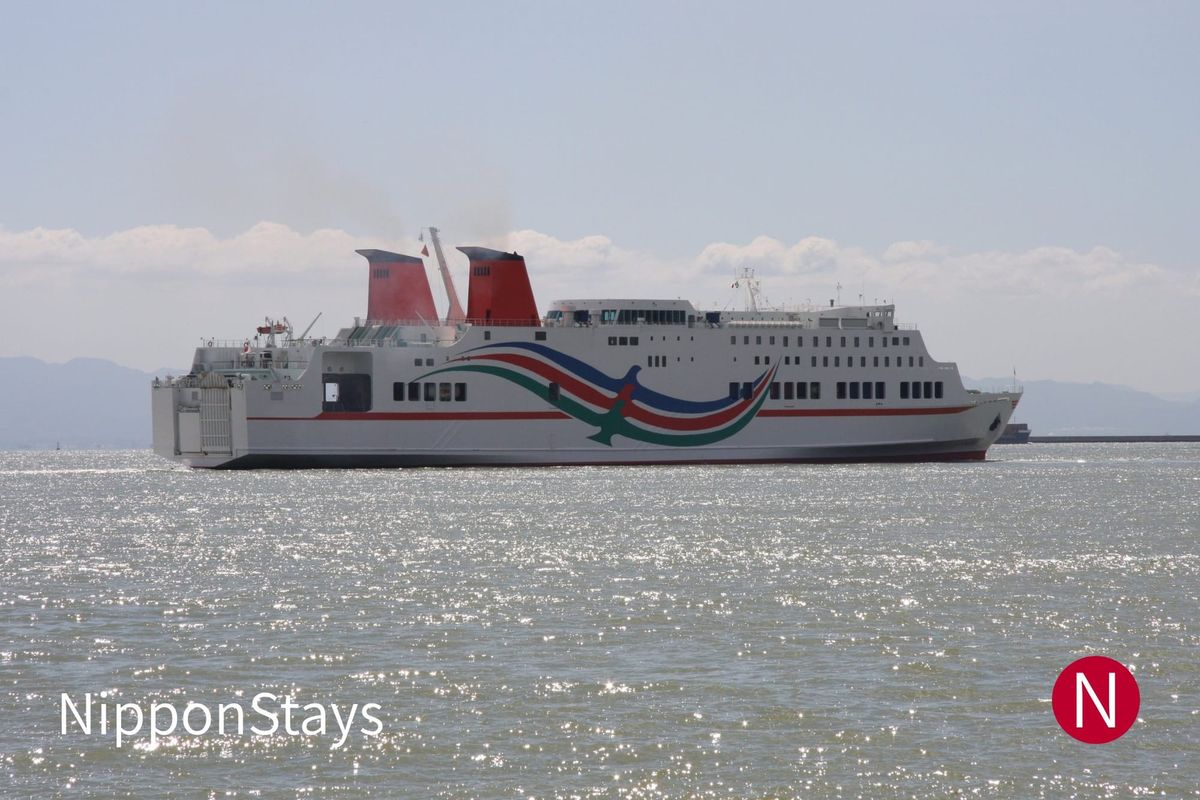
The second option is the cruise ferry SEA PASEO, a car-carrying ship that takes about 2 hours 40 minutes for the same crossing. It's slower but it's the only way to bring a car across, and the one-way passenger fare (¥6,000) is a third cheaper than the jet's ¥9,000 — both current since Setonaikai Kisen's September 1, 2026 fare revision. Neither company publishes a joint round-the-clock schedule; each runs its own set of daily departures on the same two routes.
Jet vs. cruise ferry, side by side
| Service | Hiroshima–Matsuyama time | Via Kure? | Car? | First sailing (Hiroshima) | Last sailing (Hiroshima) |
|---|---|---|---|---|---|
| Jet (Linear Jet / Super Jet) | From 70 min | Yes, calls at Kure | No — passengers only | 7:30am | 8:00pm |
| Cruise ferry (SEA PASEO) | About 2h 40min | Yes, calls at Kure | Yes, vehicles up to 12m+ | Around 6:00am | Around 10:00pm |
Of the two Hiroshima–Matsuyama boat services, only the cruise ferry carries vehicles; the faster jet — 8 sailings a day, spread between 7:30am and 8:00pm — is passengers only (Setonaikai Kisen and Ishizaki Kisen timetables, checked September 2026). Neither company publishes a separate reduced timetable for winter; the schedule that was in effect from November 2025 carries through the 2026–27 season, so there's no "winter dial" to plan around here — the two things that actually change in winter are how early it gets dark and how likely a sailing is to be cancelled for weather.
Sleep on the Hiroshima side or the Matsuyama side?
Which city you spend the night in should follow the boat you need, not the other way around. If you're heading to Dogo Onsen or elsewhere in Matsuyama and want the whole day there, take the 7:30am jet — which means sleeping in Hiroshima the night before, ideally somewhere you can reach Hiroshima Port (Ujina) without a long transfer at that hour. If instead you're arriving into Hiroshima by air, our guide to hotels near Hiroshima Airport covers getting from the airport into the city before you make this crossing at all.
Once you're in Hiroshima proper, the choice of area matters more than usual because of how the tram to the port runs (next section) — a hotel by the station beats one near the Peace Memorial Park or downtown Kamiyacho if you're catching that first boat, even though both of those areas are covered well by our Hiroshima where-to-stay guide and our guide to hotels near the Peace Memorial Park for a stay that isn't built around an early departure.
Getting to Hiroshima Port (Ujina) before the first boat
Hiroshima Electric Railway's Line 5 runs directly from Hiroshima Station to Hiroshima Port, and it is the only tram line that does this without a transfer. The first car of the day leaves Hiroshima Station at 5:56am, and the ride to the port takes about an hour — call it 6:58am on arrival (Hiroden's official first/last train page, checked September 2026). Against a 7:30am jet departure, that leaves roughly 30 minutes to buy your ticket and board, which is workable but not generous if the tram runs even a few minutes late or you're moving slowly with luggage. If that margin feels too tight, a taxi from the station is faster than the tram and removes the risk, though neither company publishes a fixed taxi fare for the route.
This is the practical reason to book a hotel connected to or immediately beside Hiroshima Station rather than one nearer downtown: every extra transfer before 6am eats into that half-hour buffer.
When the boat does not run: the land route
Both companies suspend sailings for what their own notices describe only as adverse weather and sea conditions ("気象海象"); neither Setonaikai Kisen nor Ishizaki Kisen publishes a specific wind-speed or wave-height figure that triggers a cancellation, and decisions are announced on the day rather than in advance. That means you can't forecast a cancellation from a weather app — check the operator's own site or call ahead on the morning you're due to travel, not the night before.
If the crossing is off, the practical land route runs by Shinkansen and bus rather than by the boat's own replacement service, because there isn't one. Take the Shinkansen from Hiroshima to Fukuyama or Shin-Onomichi, then change to the "Kirara Express" highway bus, which runs directly on to Matsuyama (Fukuyama–Matsuyama in about 2 hours 40 minutes, Shin-Onomichi–Matsuyama in about 2 hours 10 minutes) — allow roughly 3 to 3.5 hours door to door, and note that the bus itself runs only twice a day each way, so check its timetable before you commit to a Shinkansen departure (Honshi Bus Kaihatsu and Iyotetsu Bus route pages, checked September 2026). It's slower than the boat and needs one more change, but it isn't weather-dependent.
Arriving in Matsuyama: the port bus to Dogo
Matsuyama Kanko Ko (the tourist port both services use) sits well outside the city center, and every arrival is met by an Iyotetsu limousine bus. The route to Dogo Onsen Station takes about 50 minutes; the first departure of the day is at 5:15am, which is early enough to meet even the earliest ferry crossing (Iyotetsu Bus limousine timetable, checked September 2026). If your plans in Matsuyama don't involve Dogo, the same bus also calls at JR Matsuyama Station and Okaido/Matsuyama-shi Station in around 25 minutes, which is the faster stop for most other hotels in the city.
| Your plan | Night before | Boat | Arrive | Next step |
|---|---|---|---|---|
| First boat, full day in Matsuyama | Hotel by Hiroshima Station | 7:30am jet | Around 8:40am | Limousine bus to Dogo, about 50 min |
| Bringing a car or heavy luggage | Hiroshima or Kure | Cruise ferry, SEA PASEO | Mid-morning to evening, by departure | Drive off, or the same limousine bus on foot |
| Boat is cancelled for weather | — | None — check the operator's site that morning | — | Shinkansen to Fukuyama/Shin-Onomichi, then the Kirara Express bus |
Trip Essentials for Hiroshima
Things worth booking before you land, all in English:
- eSIM — Airalo's Japan eSIM: install it at home and data works as soon as you switch off airplane mode at Hiroshima Airport.
- Airport transfer — Klook covers bus, train, and private transfers from Hiroshima Airport.
- Luggage storage — arriving before check-in? Radical Storage takes bags at shops near Hiroshima Station for a flat daily rate.
- Tickets and day trips — Klook covers Miyajima day trips and Peace Memorial tours; booking ahead skips the ticket-window line.
FAQ: Hiroshima–Matsuyama ferry
How long does the Hiroshima to Matsuyama ferry take?
The jet service (Linear Jet on Setonaikai Kisen's boats, Super Jet on Ishizaki Kisen's — the same route and timetable under two names) takes from 70 minutes. The car-carrying cruise ferry SEA PASEO takes about 2 hours 40 minutes for the same Hiroshima–Kure–Matsuyama crossing.
How much does the Hiroshima–Matsuyama ferry cost?
As of Setonaikai Kisen's September 1, 2026 fare revision, the jet service is ¥9,000 one way for an adult. The cruise ferry is ¥6,000 one way for a passenger on foot; taking a car costs considerably more and is priced by vehicle length.
Is the Hiroshima–Matsuyama ferry schedule different in winter?
No — neither company publishes a separate winter timetable, and the schedule in effect from November 2025 runs through the 2026–27 winter. What does change in winter is daylight and the odds of a weather cancellation, not the timetable itself.
What happens if the Hiroshima–Matsuyama ferry is cancelled?
Both operators suspend sailings for weather or sea conditions without a published numeric threshold, and they announce this the morning of, not the day before. The land alternative is the Shinkansen to Fukuyama or Shin-Onomichi followed by the twice-daily Kirara Express highway bus on to Matsuyama, roughly 3 to 3.5 hours in total.