Former Kishi Residence and Toraya Kobo: Two Architects, One Bus Stop
A prime minister's house by Yoshida Isoya and a sweet workshop by Hiroshi Naito, on one site 19 minutes from Gotemba Premium Outlets. Photography allowed.
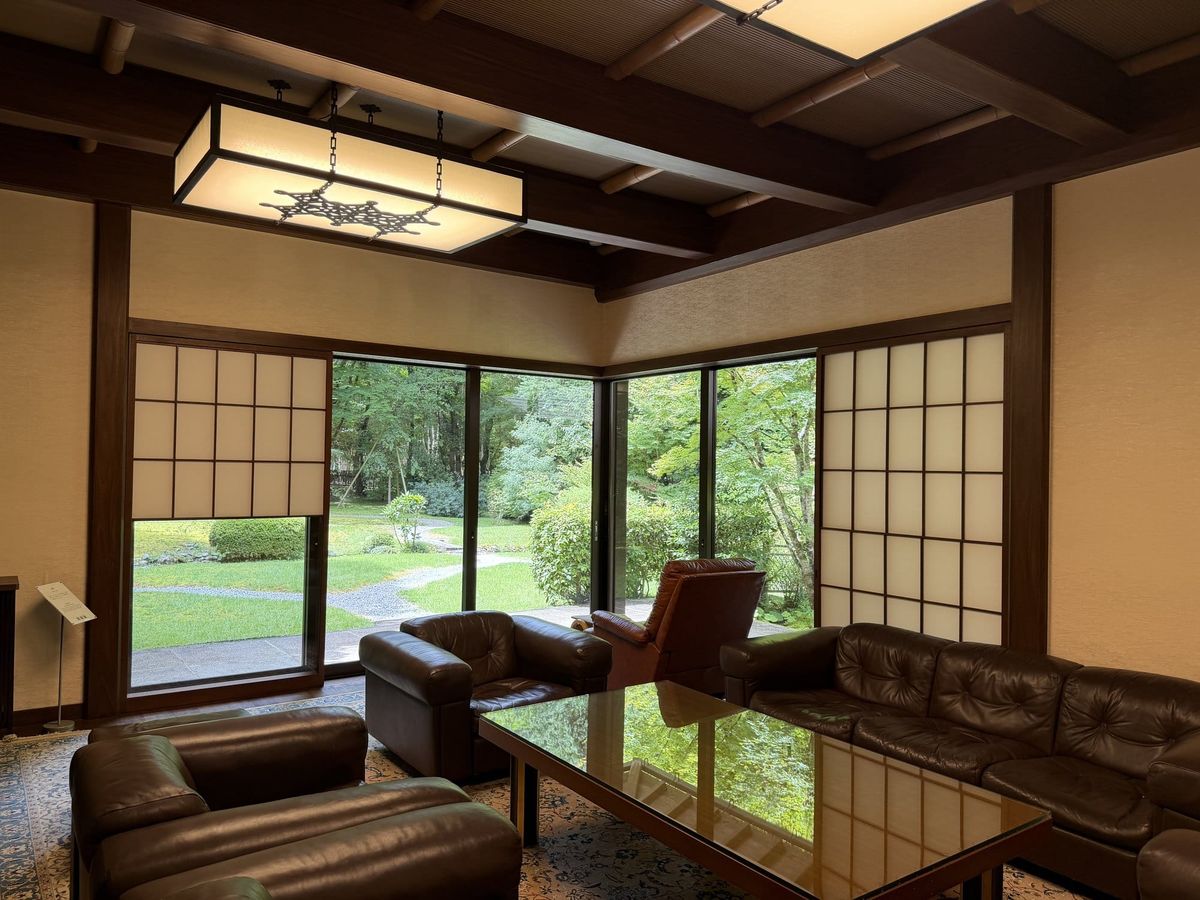
The Former Kishi Residence sits one bus stop off the road between Gotemba Premium Outlets and Hakone, and it costs ¥300 to enter. It was the retirement home of a Japanese prime minister, designed in 1969 by Yoshida Isoya, and the quickest way to understand why it matters is to stand in the drawing room and look up: leather sofas, a Persian rug, a glass coffee table — and a ceiling made of bamboo. Sharing the same wooded site is Toraya Kobo, a sweet workshop finished in 2007 by Hiroshi Naito, where you can watch dorayaki being griddled. Two architects, two generations, one gravel path between them.
The drawing room explains the whole building
Yoshida Isoya is credited with creating modern sukiya architecture, and that phrase does no work at all for a visitor who has never heard it. The drawing room does the work instead.
It is furnished like a Western reception room of its era: three brown leather sofas, a low glass table, a patterned rug. Then you notice the ceiling is a grid of bamboo poles, the light fitting overhead is a paper box, and the walls on either side of the garden window are shoji. The room is not Japanese decor with Western furniture in it, and it is not a Western room with a Japanese ornament hung on the wall. It is one room built two ways at once.
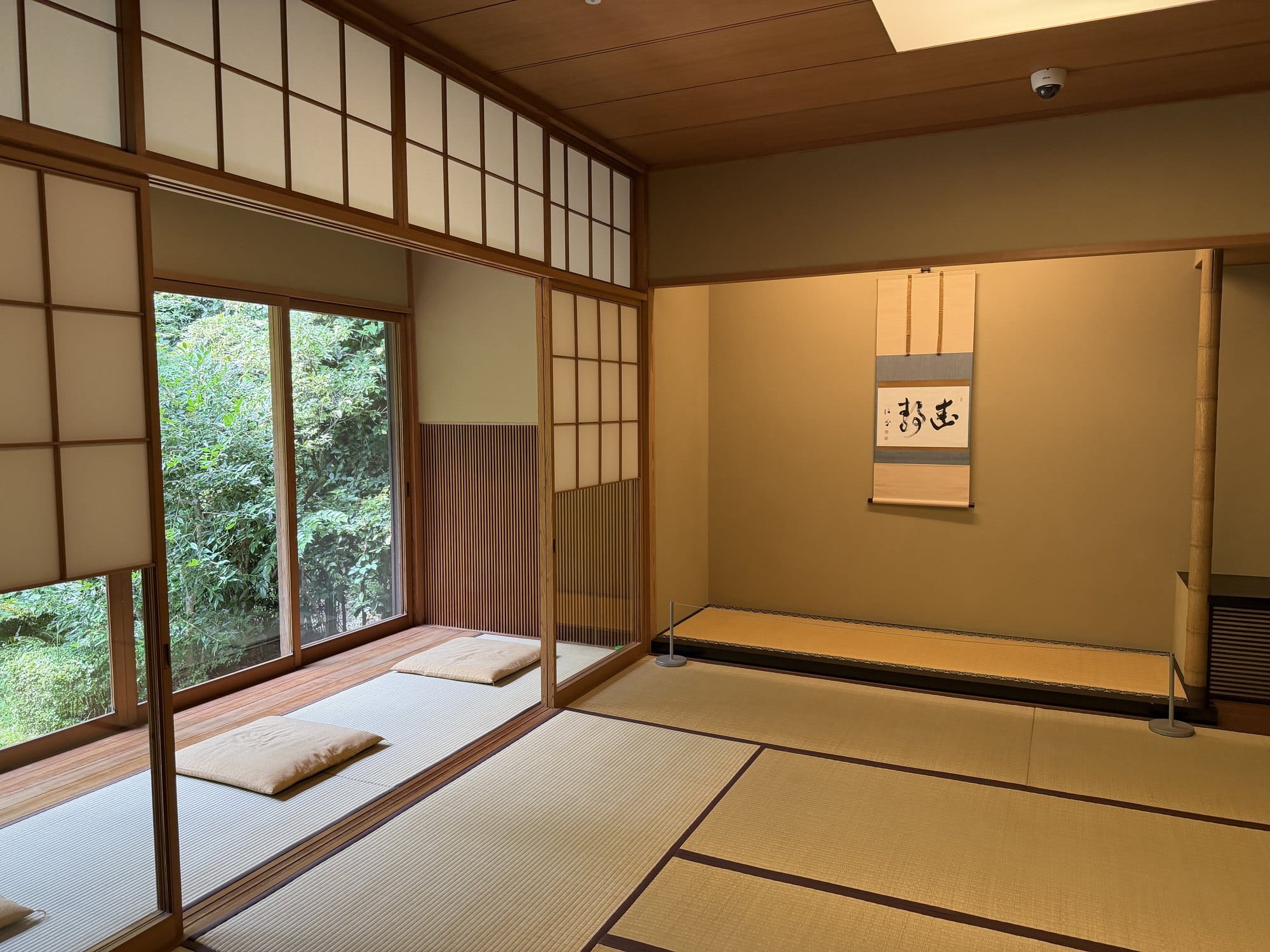
Next door is a straightforward tatami room — a hanging scroll in the alcove, an tokobashira post that is a length of bamboo rather than polished timber, and two floor cushions set on the veranda so you can sit and look at the garden. Walking from one room to the other in about ten seconds is the entire argument of Yoshida's career, delivered without a caption.
The house was finished in 1969. Kishi Nobusuke, the 56th and 57th prime minister, lived here from January 1970 until 1986, the year before he died. In October 2021 the main building was added to the national register of tangible cultural properties.
You can photograph almost all of it
This surprised us, and it changes what the visit is worth. The notice inside asks you to refrain from photography in exactly two places: the video monitor in the entrance hall, and the exhibition room with the Kishi family material. Everywhere else — the tatami room, the drawing room, the veranda, the garden — is open.
The other requests are the ones you would expect in a listed building, and they are worth taking seriously: do not touch the shoji, the posts or the fittings; phones on silent and no calls; no eating or drinking inside.
The second building was designed to disappear
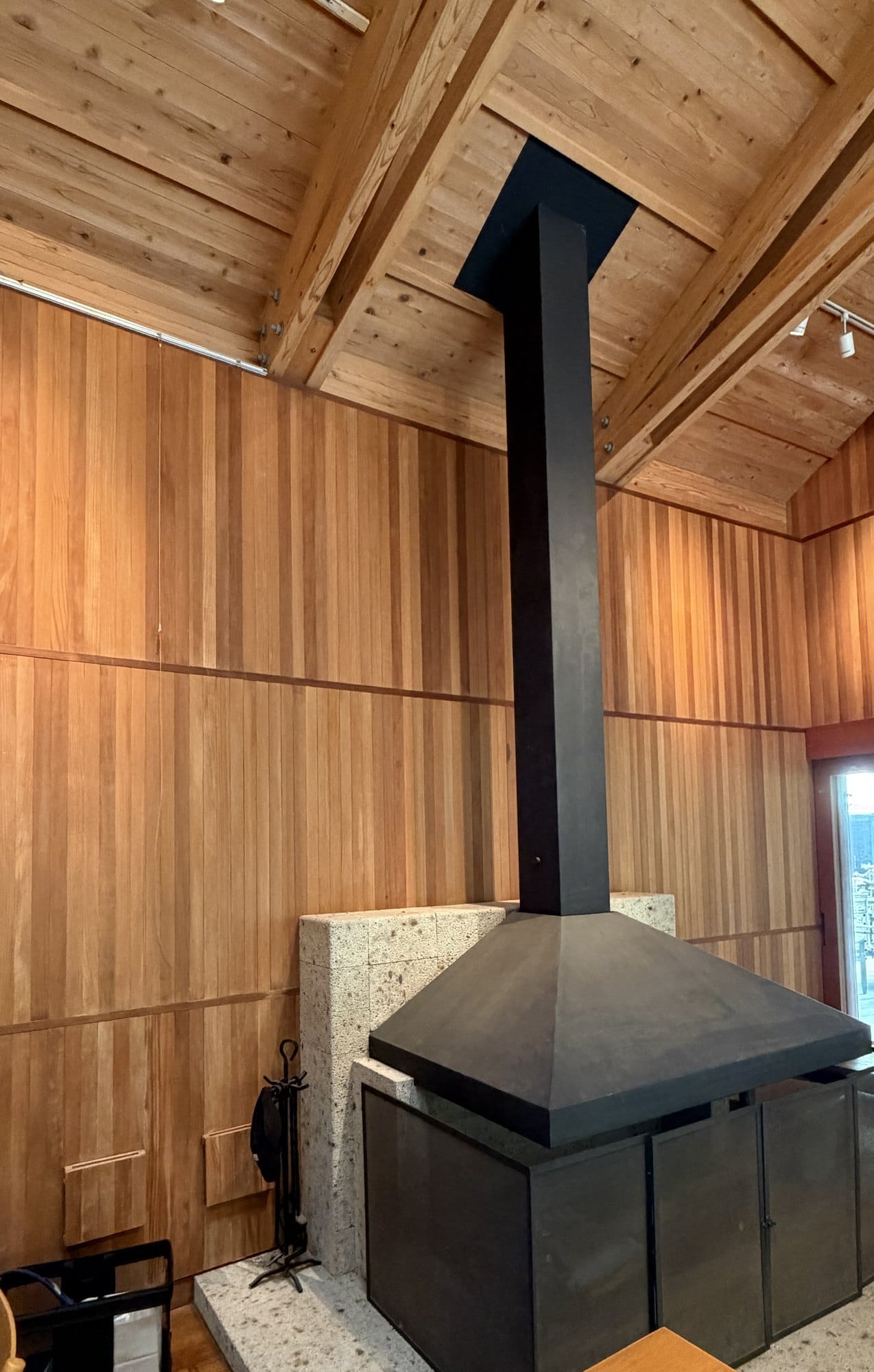
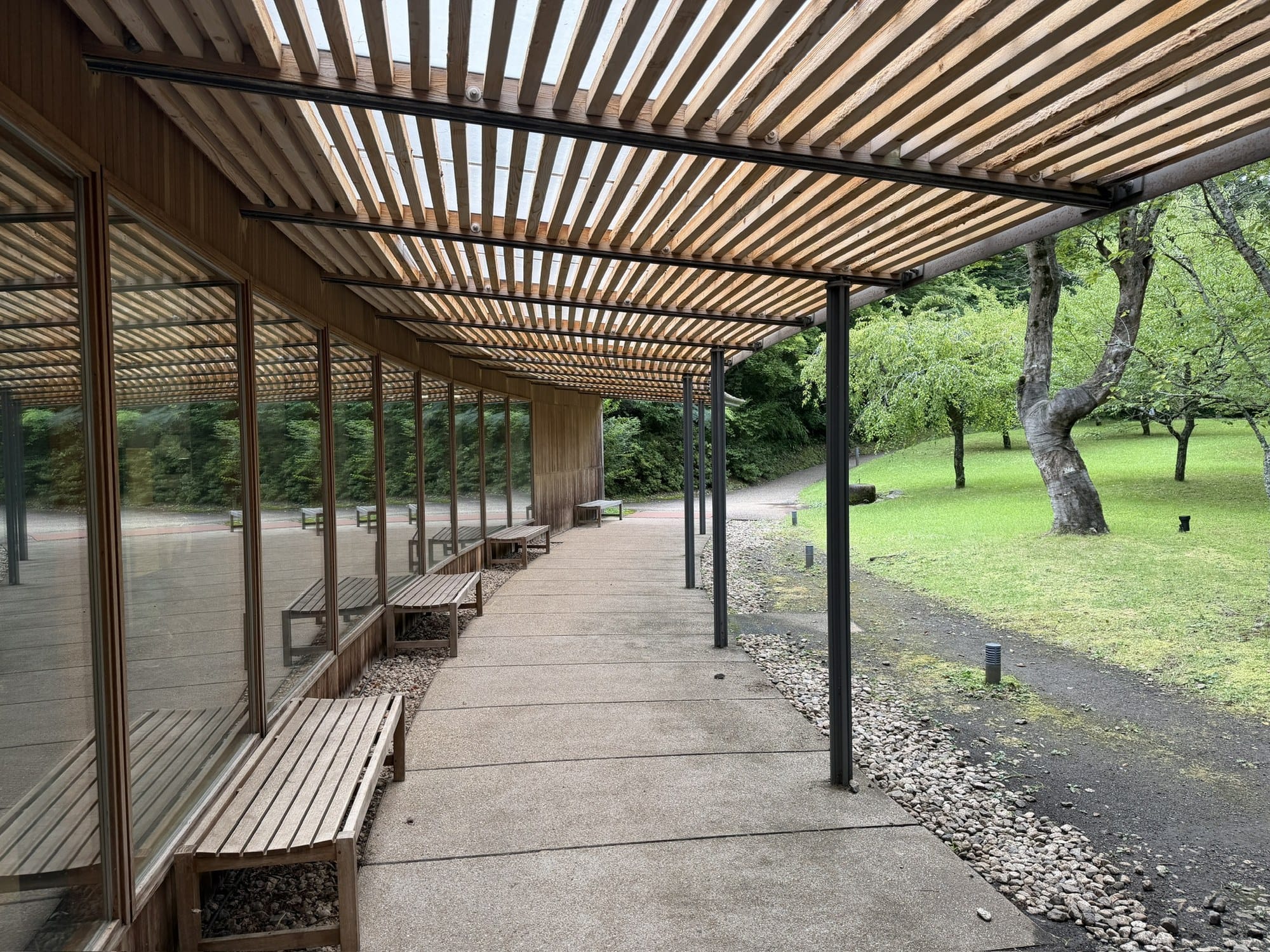
Toraya Kobo, on the same site, opened in 2007 to a design by Hiroshi Naito — a single-storey building curved in a shallow arc through the trees, with the café, the shop and the kitchen strung along it. Naito has written that on this project he spent more care on making the garden than on the building, that the building should be plain, something like a part of the garden, and that the message is the richness of the whole setting.
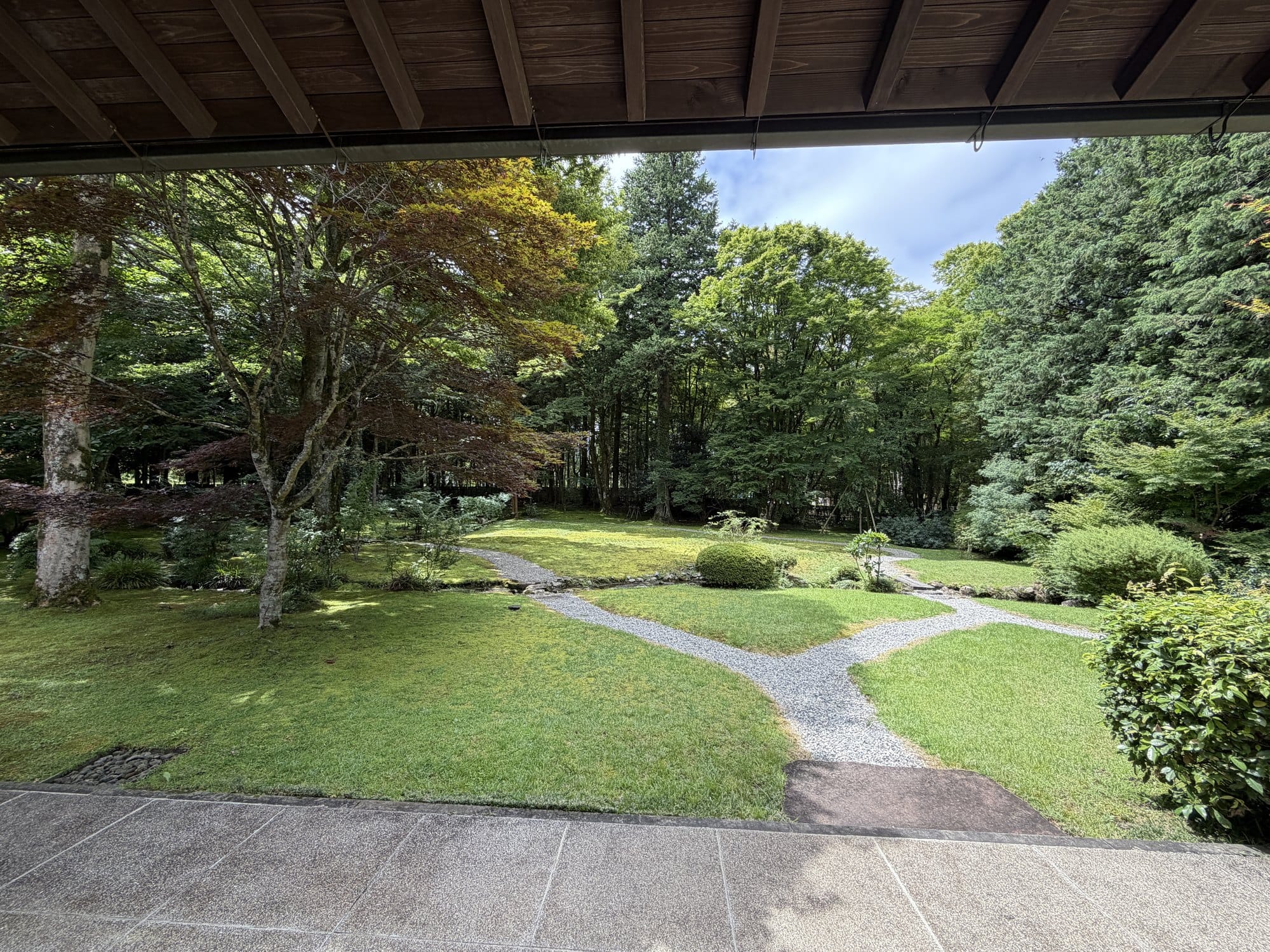
You can see him meaning it. From under the deep eaves the view is trees, moss, and a gravel path that forks in a Y across the lawn. The interior is exposed timber framing and cedar boards, glazed along its whole lower edge. It is a good building that declines to be the point.
| Former Kishi Residence | Toraya Kobo | |
|---|---|---|
| Architect | Yoshida Isoya | Hiroshi Naito |
| Completed | 1969 | 2007 |
| Entry | ¥300 adults, ¥150 school children | Free; you pay for what you order |
| What to look at | Bamboo ceiling over leather sofas; bamboo alcove post next door | Timber frame, deep eaves, the garden it defers to |
| Closed | Tuesdays (the next day if Tuesday is a public holiday), and 29 Dec – 3 Jan | Tuesdays |
| Photography | Yes, except two marked spots | We were not stopped; no notice seen |
The two buildings were finished 38 years apart, and the older of them has been a registered cultural property since October 2021 (checked August 2026). Seeing both takes about two hours including a stop for sweets.
What to eat, and what it costs
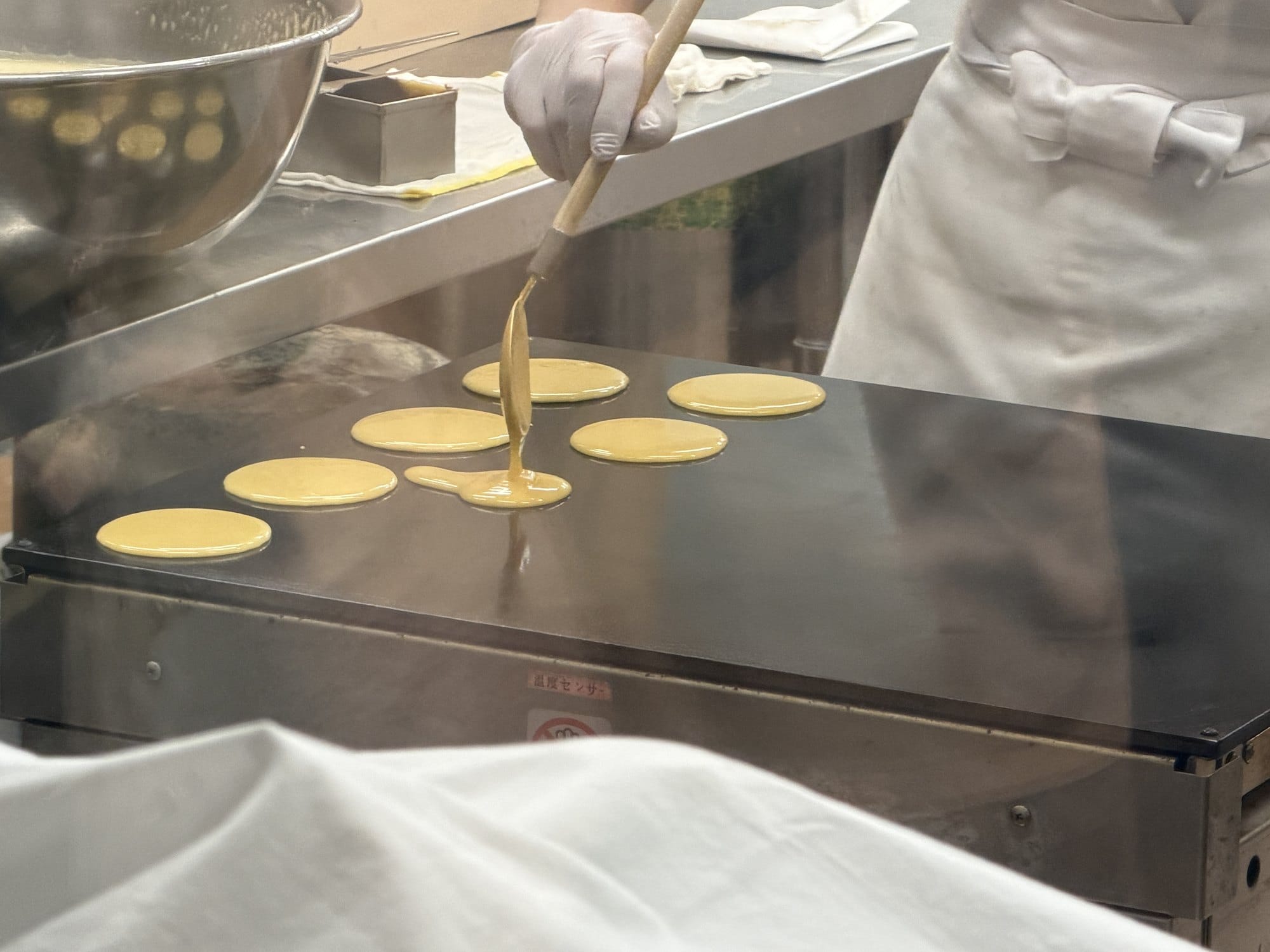
Toraya Kobo griddles its dorayaki where you can see it: batter poured from a wooden ladle onto a wide hot plate, six rounds at a time. Toraya has shops across Japan — and one in Paris, on rue Saint-Florentin, open since 1980. This is where you watch it being made. If you want a sit-down meal in Gotemba rather than a sweet, the Shizuoka hamburg chain Sawayaka has a branch at Gotemba Premium Outlets, and our guide to getting a table at Sawayaka explains the numbered-ticket system and how long the wait ran there in August 2026.
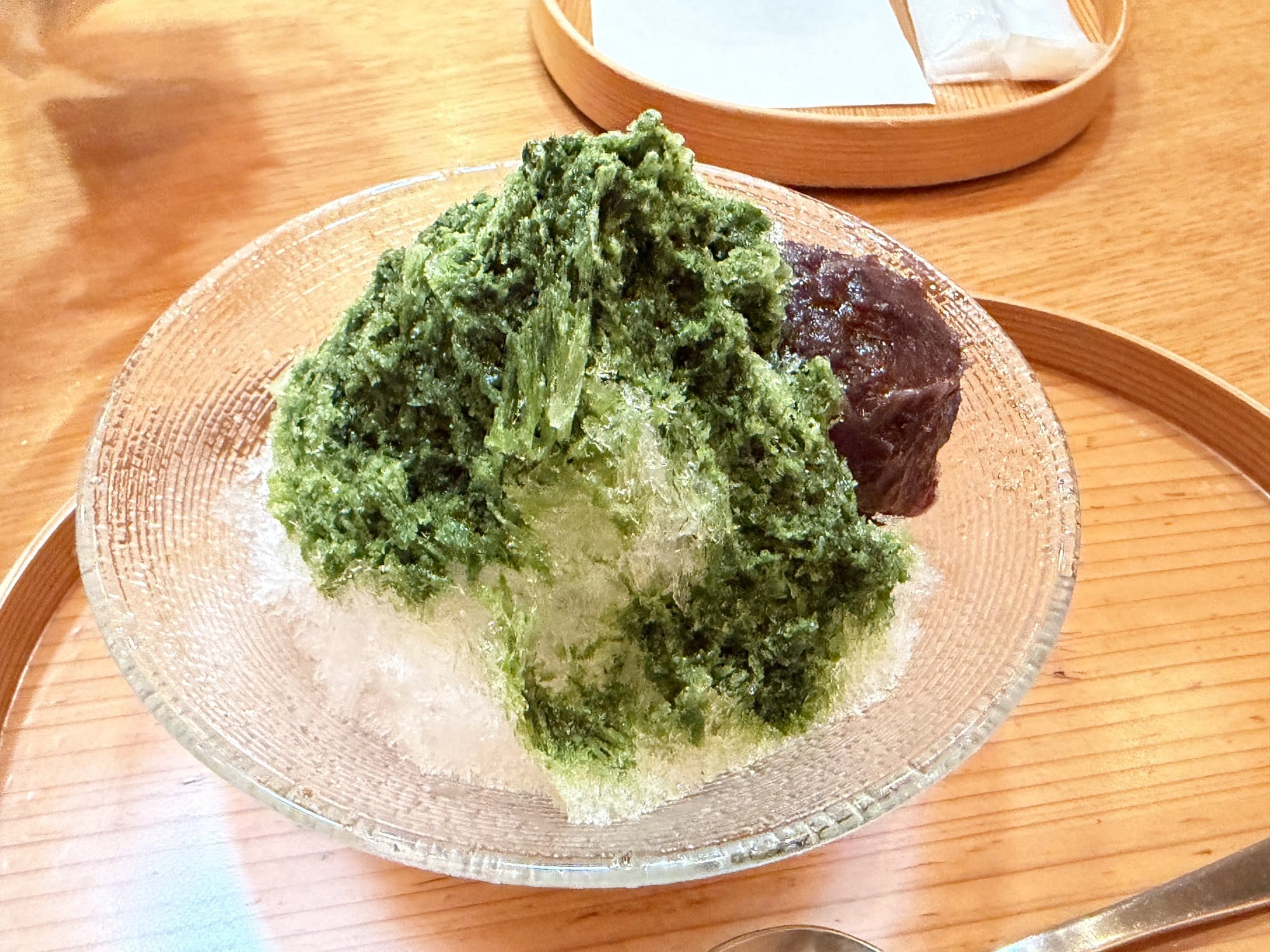
Prices in August 2026, tax included: dorayaki ¥680, monaka ¥680, shaved ice ¥1,400, tokoroten ¥950, somen ¥1,300, Mt Fuji cider ¥400. Sweets ordered in the café come with sencha, and the tea is refilled as often as you want — the board says so explicitly, which is not something you see often.
The seasonal sweets change every month, so treat any list as an example rather than a menu. In August they were an ume mochi and a kuzu manju at ¥710 with tea, and a fig mizu-yokan at ¥950 made with figs picked that morning in Fuji City, served in limited numbers. A salt yokan for ¥1,500, takeaway only, was made with salt from Heda in Numazu. Both are Shizuoka ingredients, which is the sort of detail the workshop format allows and a branch store does not.
On the shaved ice: at ¥1,400 it is not cheap, and it is worth it. The matcha syrup is fragrant rather than sweet and the white syrup is restrained. Both arrive with the bean paste set beside the ice rather than buried in it, though the white one is heaped high enough that you have to dig a little to find it. What you are paying for is Toraya's bean paste, the fact that you watched the sweets being made, and a seat in this garden. The dorayaki is the same story in a smaller package.
Go at eleven, not at ten
We arrived at opening on a Sunday in August and queued about twenty minutes; a sign at the entrance apologised that the workshop was still getting ready. By eleven the queue had gone entirely.
This is the opposite of the usual advice, and it lines up with the buses. Towards the outlets there are 14 departures on Saturdays, Sundays and holidays but only 11 on weekdays, and the weekday timetable has a hole in it: after 13:47 the next bus is 15:17. Arrive around eleven and you walk straight in, and you are still inside the part of the day when buses come roughly every half hour.
Getting there
The bus stop is called Higashiyama Kyu-Kishi-tei mae, which removes the usual problem of not knowing when to press the button. It is a 3-min walk from the stop to the site. Everything here is Hakone Tozan Bus, and two of its routes call at the stop: the L line between Hakone-Yumoto Station and the outlets, and the M sightseeing loop that runs via Miyagino. That is why this works as a stop on the way rather than only as a detour.
| From | How | Time / fare |
|---|---|---|
| Gotemba Premium Outlets | Hakone Tozan Bus, L or M route | 19–22 min, ¥200 |
| Hakone-Yumoto Station | Hakone Tozan Bus, L route towards the outlets | Same stop; a through service, not a detour |
| JR Gotemba Station | Fujisan exit, bay 0, bus for Gotemba Premium Outlets | Alight at Higashiyama Kyu-Kishi-tei mae |
| JR Gotemba Station | Taxi | About 15 min |
| By car | Gotemba IC, Tomei Expressway | About 5 min; free parking on site |
Buses towards the outlets: 11 departures on weekdays, 14 on Saturdays, Sundays and holidays, roughly 9:40 to 18:20, with a gap between 13:47 and 15:17 on weekdays (checked August 2026). Opening hours: 10:00–18:00 April to September, 10:00–17:00 October to March, last entry 30 minutes before closing. Closed Tuesdays (the following day if Tuesday is a public holiday) and 29 December to 3 January. Toraya Kobo closes on Tuesdays as well, so the whole site is shut that day — there is no version of this visit where you see one but not the other. Admission ¥300 for adults and ¥150 for school children; free for visitors with a disability certificate and one companion. Verified against the official site, August 2026.
One thing worth knowing before you plan around it: the same bus line continues to Hakone, so this is not only a detour from the outlets. It is a stop you can make on the way between them.
Is it worth the detour?
If you have an afternoon between the outlets and Hakone, yes. You are getting a listed building you can photograph, by an architect almost unknown outside Japan, for the price of a coffee — and a second building by a living architect who deliberately made it quieter than its own garden. Add a bowl of shaved ice and you have used two hours well.
If you are choosing between this and another hour of shopping, be honest about what you like. This is a house and a garden and a plate of sweets. Nothing here is spectacular. It is careful, which is a different pleasure, and the reason to come is that both buildings reward looking up.
For more on Japanese craft bought at the source, see our guide to buying a folding fan in Kyoto and to Japan Traditional Crafts Aoyama Square in Tokyo. If Mt Fuji is the reason you are in the area at all, Kawaguchiko villas with a Fuji view covers the other side of the mountain.
FAQ: visiting the Former Kishi Residence
Can you take photos inside the Former Kishi Residence?
Yes, apart from two places: the video monitor in the entrance hall and the exhibition room of Kishi family material. The tatami rooms, the drawing room and the garden are all open to photography. You are asked not to touch the shoji, posts or fittings.
How do you get there from Gotemba Premium Outlets?
Take a Hakone Tozan Bus on the L or M route and get off at Higashiyama Kyu-Kishi-tei mae, about 19 to 22 minutes for ¥200, then a 3-min walk. Buses run roughly hourly; there are 14 a day towards the outlets at weekends and 11 on weekdays, with a gap between 13:47 and 15:17 on weekdays. The same stop is served from JR Gotemba Station, bay 0 at the Fujisan exit.
What time should I arrive to avoid the queue at Toraya Kobo?
Later than you would expect. We queued about twenty minutes at the 10:00 opening on an August Sunday, and by 11:00 there was no queue at all. Weekday and peak-season patterns may differ.
Do I need to book?
No. You buy your ticket for the house at the reception in the exhibition and training building, and the workshop café takes walk-ins.
Is there anything to eat on site?
Toraya Kobo serves sweets with sencha, shaved ice in summer, somen and takeaway yokan. Eating and drinking inside the Former Kishi Residence itself is not allowed, so do the house first or the sweets first, not both at once.
Information audit: Last fact-checked August 2026 · Hours, admission and station access verified against the official Higashiyama Kyu-Kishi-tei site · Prices, bus times, queue length and the photography rules were recorded on site on 16 August 2026 · How this guide was researched: we visited both buildings on the same morning. Seasonal sweets change monthly and bus timetables change; treat specific items and departure times as examples.