Echizen Crab: When to Go, What to Order, Where to Stay
Echizen crab season runs 6 Nov-20 Mar, but seiko-gani lasts just 56 days. What changes if you eat it in Fukui, not Tokyo.

Echizen crab season is set to run from 6 November 2026 to 20 March 2027, matching Fukui's standing season pattern of recent years, but that single window covers three different animals with three different calendars. The male crab (the one most people mean by "Echizen crab") is available the whole stretch. Seiko-gani, the smaller egg-bearing female, is legal for only 56 days, 6 November to 31 December — if you want her, you have to go before New Year. Mizugani, a soft-shelled male taken right after molting, only opens on 19 February and runs to the same 20 March close. And here is the honest part: a tagged Echizen crab course is already on the menu at restaurants in Tokyo that buy from the same boats, which is exactly what I ate. So this guide is built around the real question — if you can eat the crab without leaving Tokyo, what does going to Fukui actually change?
You Can Already Eat Echizen Crab in Tokyo. So What Does Fukui Change?
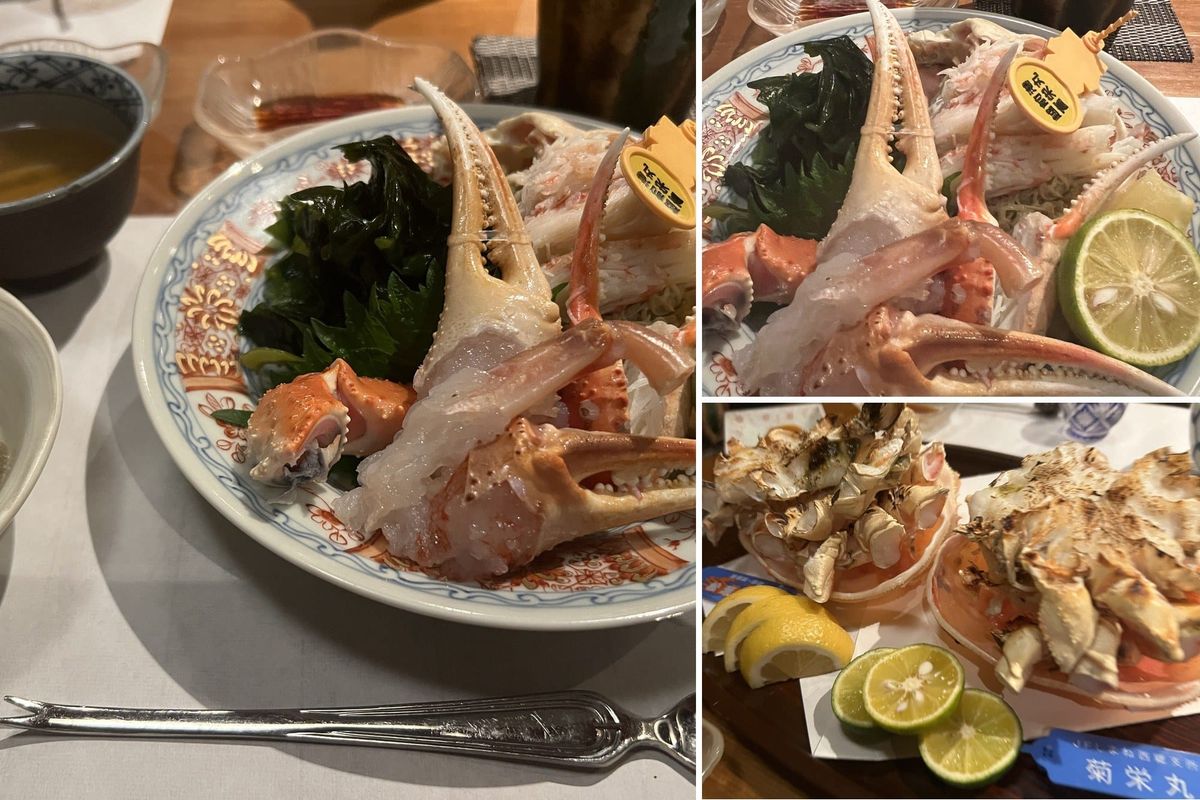
On the evening of 13 February 2025, in Tokyo, I ate a tagged Echizen crab course: crab sashimi first, then the same crab grilled in its shell, with sudachi and wakame on the plate and a dedicated narrow fork for picking the legs clean. The course took about an hour. The box the crab arrived in was printed with "JF Echizen" and the name of the boat, Kikueimaru — meaning the specific fishing cooperative and the specific vessel that landed it were both traceable from where I sat, several hundred kilometers away.
That traceability is the whole point of the tag, and it works the same whether you eat the crab in Fukui or in a Tokyo restaurant with the right supplier. So the honest answer to "why go to Fukui" is not that the crab tastes different at the source — it is the same crab, the same boats, the same tags. What changes is availability and timing. In practice, seiko-gani and mizugani are caught in smaller volumes and sold mostly through local markets and ryokan, while the male crab — with the longest season and the highest volume — is what typically travels furthest intact. Go to Fukui and the female crab, the soft-shell crab, and same-day landings are all on the table in a way they usually are not back in Tokyo, nearly three hours away by train.
My own answer, four years earlier, was neither of those. In November 2021 I flew to Komatsu Airport, drove to Fukui, and stayed at the Toyoko Inn by Fukui Station on the night of 12 November — six days after that season's 6 November opening. I was not there to eat crab in a restaurant. I was there to buy it and carry it home. That is a reason to go to the source that has nothing to do with a menu, and it is not something the English-language coverage of Echizen crab season explains.
The Echizen Crab Calendar: Three Crabs, Three Windows
The single phrase "Echizen crab season" hides three separate legal fishing windows, each for a different form of the same animal, and each confirmed on Fukui Prefecture's own fisheries page and enforced by the local fishing cooperatives (JF Echizen and related ports).
| Crab | 2026-27 window | Length | Best for |
|---|---|---|---|
| Male crab (echizen-gani) | 6 Nov 2026 – 20 Mar 2027 | About 4.5 months | The full season — widest choice of size and price |
| Seiko-gani (female) | 6 Nov – 31 Dec 2026 | 56 days | Egg roe (uchiko and sotoko), a local favorite eaten before New Year |
| Mizugani (soft-shell male) | 19 Feb – 20 Mar 2027 | 30 days | Sweeter, cheaper, a spring-only alternative |
Fukui Prefecture publishes 6 November to 20 March as the standing season, and the same dates have recurred for years, but each season's specific opening is confirmed by a prefectural notice normally issued in late October or early November — check that notice before booking non-refundable travel (checked September 2026).
Of the three windows, the seiko-gani season is the one first-time visitors most often miss, because it closes on 31 December while the headline "Echizen crab season" keeps running for another eleven weeks. Fukui Prefecture's own fisheries page confirms the female-only window is exactly 56 days, 6 November to 31 December, against roughly four and a half months for the male crab (checked September 2026). If seiko-gani is the reason for the trip, the trip has to happen in November or December — not "sometime this winter."
What the Yellow Tag Actually Proves
Echizen crab has carried a yellow identification tag since 1997, when Echizen Town's fishing cooperative introduced it as one of the first crab-branding schemes in Japan; the same cooperative first attached a tag to female seiko-gani landed at Echizen port in 2004, and the practice spread to the rest of the prefecture's ports from 2007. Since 27 September 2018 the tag has also carried Japan's official Geographical Indication (GI) mark. The tag is attached at the base of a claw and printed with the brand name and the landing port; on my Tokyo course, the box carried the same information — JF Echizen and the boat name Kikueimaru — which is how I could trace the crab back to a specific cooperative and a specific vessel without having been anywhere near the port myself.
What the tag proves is where and how the crab was landed, not that it beats every other crab on the plate. The same species of snow crab is landed and tagged under different regional brand names all along the Sea of Japan coast — Kano crab in Ishikawa, Matsuba crab across the San-in coast, Taiza crab from Kyoto's Taiza port in Kyotango. Our guide to Japan's brand snow crab tags breaks down how those names and tags differ; the color of Echizen's tag is confirmed yellow, but tag colors for the other regional brands vary by port and are not something to assume.
Getting to Fukui From Tokyo
Since the Hokuriku Shinkansen extended from Kanazawa to Tsuruga on 16 March 2024, Tokyo to Fukui has been a direct ride with no transfer, at a fastest scheduled time of 2 hours 49 minutes since the March 2026 timetable revision. Before that extension, reaching Fukui from Tokyo meant changing trains at Kanazawa or Maibara. Travelers coming from Kansai now do the opposite trade: the Thunderbird limited express from Osaka or Kyoto now terminates at Tsuruga, which means a same-station transfer to the Shinkansen where there used to be a one-seat ride through to Fukui. Our full breakdown of routes into Fukui covers timings from Tokyo, Kanazawa, and the Kansai airports in more detail, including which trains actually require that Tsuruga change.
Where to Eat It and Where to Sleep
Crab-course pricing at both restaurants and ryokan is set by the day's catch, the size grade of the crab, and the season window it falls in, so it is not something to quote as a fixed rate here — check the current course price directly with the restaurant or ryokan before you book, and treat any number you see online as a starting point rather than a promise.
Where you sleep in Fukui also depends on how you want to eat. An Awara Onsen ryokan built around a crab-course dinner turns the meal into part of the room rate, on a plan that is billed with the stay rather than ordered separately — the kind of meals-included structure we cover generally in ryokan with meals vs. room-only. Basing yourself at Fukui Station instead keeps the crab course a separate, a la carte decision, and puts you closer to the trains covered above.
| Name | Area | Price range | Best for |
|---|---|---|---|
| Toyoko Inn Fukui Ekimae | Fukui Station, West Exit (1-min walk) | Set nightly — check current rates | A station-side base for eating crab out and catching early trains |
| Hotel Prime Inn Fukui Awara | In front of Awara Onsen Station | Set nightly — check current rates | Staying near Awara's onsen ryokan district without booking a full kaiseki plan |
For a fuller comparison, including the station-front FUKUMACHI BLOCK towers and how the crab-plan math against a ryokan actually works out, see where to stay in Fukui. If you are routing through Kanazawa anyway, Fukui works better as a two-night add-on than a separate trip — our where to stay in Kanazawa guide covers the alternative base for travelers who would rather anchor in Ishikawa and day-trip south.
Trip Essentials for Fukui
Things worth booking before you land, all in English:
- eSIM — Airalo's Japan eSIM: install it at home and data works as soon as you switch off airplane mode at Komatsu Airport.
- Tickets and day trips — Klook covers the Fukui Dinosaur Museum and day trips to Eiheiji and Tojinbo; booking ahead skips the ticket-window line.
FAQ: Echizen Crab Season
Can I really eat tagged Echizen crab without going to Fukui?
Yes — Tokyo restaurants that buy directly from Echizen suppliers serve tagged crab with the same traceable boat and cooperative information printed on the box. I ate one such course in Tokyo on 13 February 2025 and could trace it back to the boat Kikueimaru through the JF Echizen tag alone. Going to Fukui changes what is available (seiko-gani, mizugani, same-day landings), not whether the crab is authentic.
When does seiko-gani season end?
Seiko-gani, the female crab, can only be caught from 6 November to 31 December — a 56-day window confirmed on Fukui Prefecture's own fisheries page (checked September 2026), against roughly four and a half months for the male crab. The dates recur every year, but Fukui issues each season's formal notice in late October or early November, so confirm it before booking non-refundable travel. Once the calendar turns to January, seiko-gani is off the market until the following November, even though the male-crab season keeps running until 20 March.
What does the yellow tag on an Echizen crab actually guarantee?
It identifies the landing port and, on many crabs, the specific boat, tracing back to a system Echizen Town's fishing cooperative started in 1997 and extended to Geographical Indication status in 2018. It is a chain-of-custody mark, not a taste ranking against other regional brand crabs like Kano or Matsuba.
How long does it take to get from Tokyo to Fukui?
Since the Hokuriku Shinkansen extension opened on 16 March 2024, the fastest scheduled Tokyo-to-Fukui service takes 2 hours 49 minutes (since the March 2026 timetable revision) with no transfer. Before that date, the trip required changing trains partway, so the direct connection is the single biggest change for anyone planning a crab-season trip.