Koyasan Overnight or Day Trip: What the Night Buys You
Two things at Koyasan need an overnight stay: the early-morning service and the 19:00 Okunoin night tour. Everything else works as a day trip from Osaka.
Koyasan overnight or day trip is a question about two hours of the day, not about how long you can stay. A day trip from Osaka gives you a long visit — the trains run from before six in the morning until the evening, and the mountain is roughly two hours from Namba — so you are not short of time. What you cannot reach on a day trip is the early morning service inside a temple and the guided walk through Okunoin cemetery after dark, because both sit outside the hours the railway runs. If neither of those is why you are going, the day trip is the right answer and there is nothing second-rate about it. Our pick for the day-trip base is Swissotel Nankai Osaka, from ¥21,000 for two, because it sits directly above the station the Koya line leaves from. If you do stay on the mountain, a temple room with the evening shojin ryori and breakfast starts from ¥17,000 per person at Ekoin (checked September 2026).
Koyasan is a town, not a viewpoint
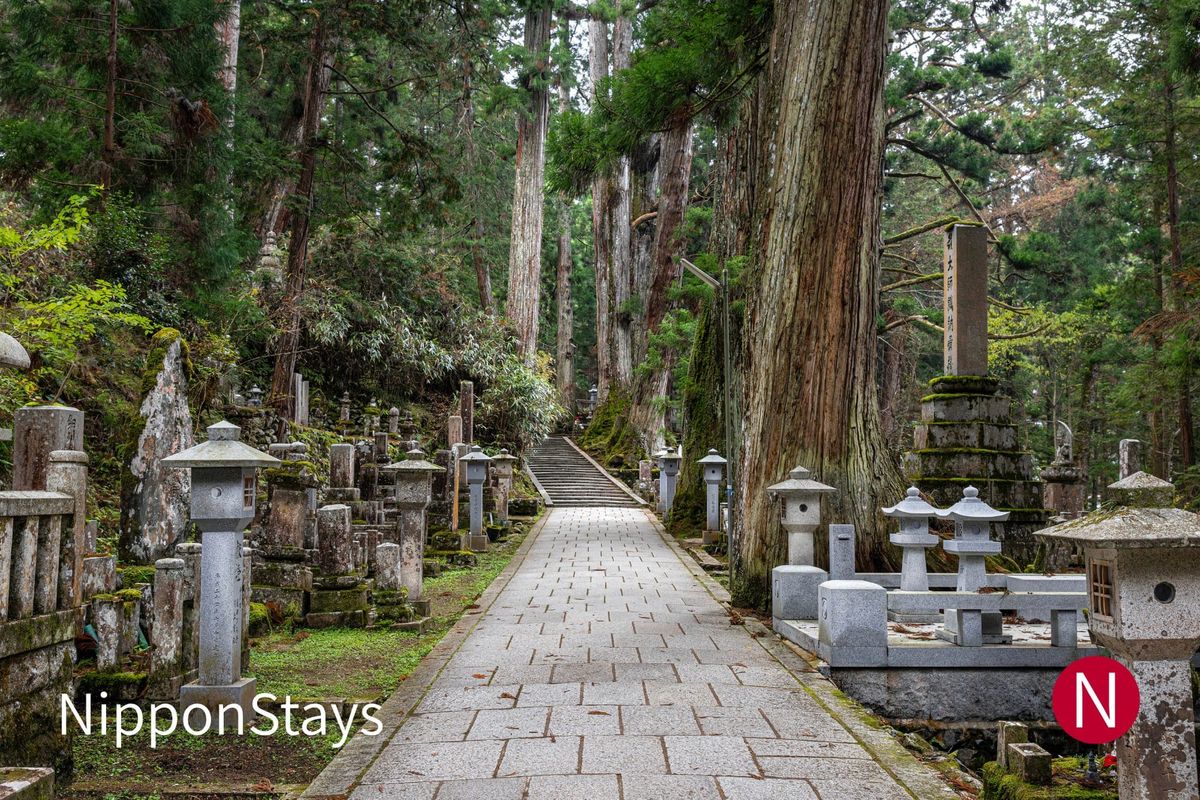
The first thing to fix is scale. Koyasan is not a temple you visit; it is a monastic town of more than a hundred temples on a plateau at around 800 m, with a bus network, shops, a tourist office and a cemetery that runs for two kilometres under cedar trees. People routinely underestimate it and allow three hours.
The way up tells you what you are dealing with. The Nankai line runs to Gokurakubashi at the foot of the mountain, and from there a funicular covers 0.8 km with a height difference of 328 m in about five minutes, for ¥500 (¥250 for children, checked August 2026, per Nankai's own Koyasan pages). That gradient is the reason Koyasan feels sealed off from the rest of Kansai — and the reason the last departure of the evening matters so much.
| What you want | Day trip | Overnight in a temple |
|---|---|---|
| Kongobu-ji, Danjo Garan, the pagoda | Yes — easily | Yes |
| Okunoin cemetery in daylight | Yes | Yes |
| Shojin ryori dinner | Lunch versions exist | Yes, as the evening meal |
| Morning service inside the temple | No | Yes |
| Okunoin after dark | No | Yes |
The two things a day trip cannot reach
This is the whole decision, so it is worth being precise about what these two things are.
The morning service. Temples that take overnight guests hold a service early — the hour varies by temple, so ask when you book rather than assuming. Guests are welcome to attend, and at some temples you can follow the procession that carries the morning meal to Kobo Daishi at the far end of Okunoin, a rite that has been performed daily for centuries. This is not a performance arranged for visitors; you are present at something the temple does whether you are there or not, which is exactly why it cannot be scheduled into a day trip.
Okunoin after dark. A guided night tour of the cemetery starts at 19:00, runs about an hour, and costs ¥2,500 (¥2,300 booked online), with a free shuttle back afterwards (checked August 2026, per the tour operator's own site). It is led by monks or former temple staff, and an English-language tour is offered. Booking is at the Awesome Tours counter inside the Tairyu shop, with reception windows of 13:00–17:00 and 18:30–18:55.
Nineteen hundred is the number that decides your trip. On the timetable in force from 28 March 2026, the last cable car that still connects to Osaka leaves Koyasan at 20:45 on weekdays and 20:44 on Sundays and holidays, reaching Namba at 22:37 and 22:47 after changes at Gokurakubashi and Hashimoto. The tour ends around 20:00 at the far end of the cemetery, and the station is a bus ride away. The later cables, 21:40 on weekdays and 21:20 at weekends, only take you down the hill: the next train toward Osaka from Gokurakubashi leaves at 05:41 (checked September 2026 against Nankai's station timetables). You cannot attend a 19:00 tour and then travel back to Osaka the same night without running for a connection that leaves no margin.
Check the current timetable yourself before you plan around any of this. Services change, the last departure is earlier than city visitors expect, and there is no late option to fall back on.
What the temple stay actually costs
Temple lodging is not budget accommodation, but the three-to-four-times premium it is usually described with belongs to the upper rooms rather than to the standard ones. Checked September 2026 on the temples’ own booking pages: Ekoin lists a 6-mat room from ¥17,000 per person and an 8-to-12-mat room from ¥19,000 per person, both with the evening shojin ryori and breakfast, and Sojiin was listed the same day at ¥33,464 for two with both meals — ¥16,732 a head. Against a station-side four-star in Osaka at around ¥21,000 for two, room only, which is ¥10,500 each, a standard temple room runs about 1.6 to 1.8 times as much per person.
Where the premium does reach three or four times is the grade above that. Ekoin’s better Japanese rooms start from ¥29,000 per person and its 40 m² Japanese-Western room from ¥39,000, which is 2.8 to 3.7 times the Osaka night, and its largest room is ¥51,000. Fukuchiin, the one temple on the mountain with its own hot spring, sits in that upper band as well. Many temples have shared bathing as standard, so a private bath is the single thing that moves the price most.
Confirm rates and room types on the temple's own booking page for your dates. Prices vary by room grade, whether the bathroom is private, and the season, and the range between the cheapest and most expensive room in a single temple can be wide.
That is the trade in plain terms: you are paying a large premium for the morning and the evening. If you want them, it is worth it and nothing else delivers them. If you are going to look at the buildings and walk the cemetery, you are paying the premium for hours you will spend asleep.
Two practical things that catch people out
Temples often have a curfew. If the night tour is part of why you are staying, check the temple's policy before you book both. The shuttle back from the tour drops at Senjuinbashi for several temples including Rengejo-in and Nan-in, which tells you the operators expect guests to be coming back late — but the temple sets the rule, not the tour.
Shukubo is not a hotel with a theme. These are working temples that accept guests, and the etiquette follows from that. It is a reason to stay, not a caveat.
If you day-trip, base yourself at the right end of Osaka
The Koya line runs from Namba, so where you sleep in Osaka decides how early you can start. Being at the departure station rather than twenty minutes away is worth more here than it usually is, because the first part of the journey is long and the useful hours are at the front of the day.
| Where you sleep | Area | From price (2 guests) | Best for |
|---|---|---|---|
| Swissotel Nankai Osaka | Namba — above the station | from ¥21,000 | Walking downstairs to the Koya line platform |
| Citadines Namba Osaka | Namba | from ¥14,000 | A kitchen, for an early breakfast before the first train |
| Mimaru Osaka Namba Station | Namba | from ¥18,000 | Families who need one room and real beds |
These are normal-season from-rates at two guests; treat them as a way of ranking the options rather than as prices for your dates. For the wider question of whether a single night at a traditional inn earns its place in an itinerary, our guide to whether a ryokan is worth it for one night works through the same trade in a different setting, and our onsen ryokan guide covers where those stays are worth building a trip around. If Koyasan is one stop on a wider Kansai run, where to stay in Nara deals with the other place people try to compress into an afternoon.
The number that decides it
Two experiences at Koyasan are available only to overnight guests — the early-morning service and the 19:00 Okunoin night tour — and everything else on the mountain is reachable on a day trip from Osaka (checked August 2026). Put against a temple night that runs about 1.6 to 1.8 times an Osaka hotel night per person in a standard room, and three to four times it only in the rooms with a private bath, the decision is not about time or money in general. It is about whether those two hours are the reason you are going.
Trip Essentials for Osaka
Things worth booking before you land, all in English:
- eSIM — Airalo's Japan eSIM: install it at home and data works as soon as you switch off airplane mode at Kansai Airport.
- Airport transfer — Welcome Pickups runs fixed-price door-to-door pickups from Kansai Airport; Klook sells the airport bus and train tickets if you'd rather ride.
- Luggage storage — arriving before check-in? Radical Storage takes bags at shops near Osaka or Namba Station for a flat daily rate.
- Tickets and day trips — Klook covers Universal Studios Japan tickets and Osaka attraction passes; booking ahead skips the ticket-window line.
FAQ: Koyasan overnight or day trip
Is Koyasan worth staying overnight?
If you want the early-morning service or the night tour of Okunoin, yes — they are not available any other way, and no amount of daytime hours substitutes for them. If your interest is the temples, the Danjo Garan and the cemetery itself, a day trip covers all of it and saves a substantial amount.
Can you do Koyasan as a day trip from Osaka?
Yes, comfortably. The mountain is roughly two hours from Namba and the trains start early, so a day trip gives you most of the daylight on the plateau. The constraint is not the total hours but the two ends of the day, which the timetable puts out of reach.
How much does a temple stay at Koyasan cost?
Standard rooms with dinner and breakfast started from ¥17,000 per person at Ekoin and at ¥16,732 per person at Sojiin when both were checked in September 2026, which is about 1.6 to 1.8 times an Osaka hotel night at ¥21,000 for two, room only. The three-to-four-times figure applies to the rooms with a private bath: Ekoin’s upper rooms start from ¥29,000 per person. Check the temple’s own booking page for your dates.
Do you have to be Buddhist to stay in a temple at Koyasan?
No. Temples that take lodgers accept guests regardless of religion, and attending the morning service is welcomed rather than required. What is expected is that you treat it as a working temple — quiet hours, and a curfew at many of them.