Is Kawasaki a Good Place to Stay? Honest 2026 Guide
Is Kawasaki a good place to stay? Honest breakdown: transit times to Tokyo, Yokohama and Haneda, price tiers, and who should base here in 2026.
Is Kawasaki a good place to stay? Yes if you are optimising for Haneda access and price; no if you want central Tokyo on your doorstep in the evening. Book Keikyu EX Inn Keikyu Kawasaki-Station (from ¥6,500), which is inside the station building and is the whole point for a pre-dawn flight, or Dormy Inn Kawasaki Natural Hot Spring (from ¥9,000) if you would rather have an onsen bath than the shortest walk. The condition that changes the answer: if your days are in Shibuya and Shinjuku rather than at the airport, the nightly saving does not cover the commuting.
Of the 4 hotels covered in this guide, 3 are within a 5-min walk of a station, and all 4 have a convenience store within a 5-min walk — the logistical floor that makes pre-dawn departures manageable (checked July 2026).
Some links in this guide are affiliate links. If you book through them, we may earn a commission at no extra cost to you.
Kawasaki in 60 seconds: who should base here (and who shouldn't)
Kawasaki is a city of about 1.5 million people in Kanagawa Prefecture, positioned on the JR Tokaido and Keihin-Tohoku lines between Tokyo and Yokohama. That geography is almost the entire argument for staying here. The city is not a destination in the way that Kyoto or Nikko are; you come to Kawasaki to sleep cheaply and move efficiently.
A practical fit if you:
- Have an early or late Haneda flight (about 15–20 min by Keikyu Airport Line from Keikyu Kawasaki Station)
- Plan day trips to both Tokyo and Yokohama and want to split the geographic and price difference
- Have an accommodation budget under ¥10,000 a night and will trade atmosphere for access
- Are booked on a Kawasaki factory night-view tour—departure points are steps from the station
Better to base elsewhere if you:
- Want to step out of your hotel into Tokyo's sightseeing core (stay in Shinjuku, Ueno, or Akihabara)
- Have an itinerary centered on Yokohama sightseeing—stay in Yokohama instead
- Want a hotel with local character; most options here are standard chain business hotels
At-a-glance: representative stays by price band ($40–120 a night)
The four properties below represent the main price tiers available in Kawasaki. Rates vary by season and day of week—the figures are approximate starting points, not fixed prices.
| Name | Area | Price range | Best for |
|---|---|---|---|
| Keikyu EX Inn Keikyu Kawasaki-Station — check rates | Keikyu Kawasaki (Central Exit, inside station building) | from ¥6,500 | Haneda access, budget travelers |
| Sotetsu Fresa Inn Kawasaki-Higashiguchi — check rates | JR Kawasaki (Central-East Exit, 5-min walk) | from ¥6,000 | Value business stays, East side |
| Dormy Inn Kawasaki Natural Hot Spring — check rates | 10-min walk from JR Kawasaki | from ¥9,000 | Mid-range comfort, onsen bath |
| Hotel Metropolitan Kawasaki — check rates | JR Kawasaki (Central-West Exit, 2-min walk) | from ¥12,000 for two | Spacious rooms, upper mid-range |
All rates vary by season. For a full exit-sorted list, see hotels closest to Kawasaki Station.
The honest case: a transport bargain, not a sightseeing hub
Kawasaki's accommodation market runs on business-hotel logic: compact but functional rooms, reliable Wi-Fi, coin laundry, and front desks that process check-in quickly. These are the conditions that make overnight stays efficient when you are spending most of your waking hours on the train network anyway.
What you give up is walkable sightseeing. From Kawasaki you are one train stop from Yokohama and about 18 min from Tokyo Station—close enough that a late start does not ruin the day, but not the same as exiting your hotel into Shinjuku's restaurant grid.
The rate differential is the payoff. On a mid-week night, a comparable JR chain business hotel in Kawasaki typically runs ¥3,000–¥5,000 less than a similar property in Shinjuku or Yokohama's Nishi-ku. On weekends, business hotels often drop further while leisure-area hotels hold their price. Over a three-night stay, that gap covers two or three round-trip train fares to central Tokyo with money to spare. For the full corridor-value argument, see cheap corridor stays.
One useful practical detail: every hotel on this list has a convenience store within a 5-min walk—critical for a pre-dawn departure snack or late-night meal when restaurants are closed.
Access by the numbers: Yokohama in 10 min, Shinagawa in 10, Haneda in 15–20
Travel times below are train only, measured from the station platform. Add your hotel's walk time to the total.
- Yokohama Station: about 10 min by JR Tokaido Line, ¥260
- Shinagawa (Shinkansen interchange, south-Tokyo gateway): about 10 min by JR, ¥260
- Tokyo Station: about 18 min by JR Tokaido Line, ¥350
- Shibuya / Shinjuku: about 25–30 min with one transfer at Shinagawa or Osaki
- Haneda Airport: about 15–20 min by Keikyu Airport Line from Keikyu Kawasaki Station, ¥410
The Keikyu Airport Line runs roughly every 10–15 min during the day. First departures from Keikyu Kawasaki run before 5:30 am. Confirm exact timetables on the Keikyu website before any very early departure. For hotels specifically chosen around Haneda timing, see bases for a Haneda flight.
Where to stay: JR Kawasaki exits vs the Keikyu Kawasaki side
JR Kawasaki Station and Keikyu Kawasaki Station are a 5-min walk apart and connected by an underground pedestrian concourse. Hotels cluster around each, serving slightly different priorities.
JR Kawasaki Station: three exits, three situations
- Central-East Exit: The main restaurant and shopping street runs east from here. Sotetsu Fresa Inn Kawasaki-Higashiguchi (278 rooms, check-in 15:00, check-out 11:00) is a 5-min walk. Factory night-view tour meeting points are a 1-min walk from this exit.
- Central-West Exit: Opens directly onto Lazona Kawasaki shopping mall and a supermarket—useful for a grocery run before check-in. Hotel Metropolitan Kawasaki (304 rooms, check-in 15:00, check-out 12:00) is a 2-min walk from this side, the shortest station-to-hotel walk for a full-service property in the area.
- North Exit: Primarily office buildings. No hotels of note immediately adjacent; not relevant for leisure or transit stays.
Keikyu Kawasaki Station: Central Exit
Keikyu EX Inn Keikyu Kawasaki-Station (175 rooms, check-in 15:00, check-out 10:00) sits inside the Keikyu station building, accessible from the Central Exit. You can reach the Keikyu Airport Line platform in under 2-min walk from the front desk—the most airport-efficient hotel position in Kawasaki.
Dormy Inn Kawasaki Natural Hot Spring is about a 10-min walk from either station. The extra walk is the trade-off for a rooftop natural hot spring bath and sauna—a meaningful upgrade after a long travel day if you are spending ¥9,000+ anyway.
Luggage storage: JR Kawasaki Station has coin lockers in the Central-East concourse in multiple sizes. Keikyu Kawasaki also has lockers near the ticket gates. Hotels in the area generally accept luggage drop after check-out; confirm at check-in.
The niche reason to stay: factory night-view tours
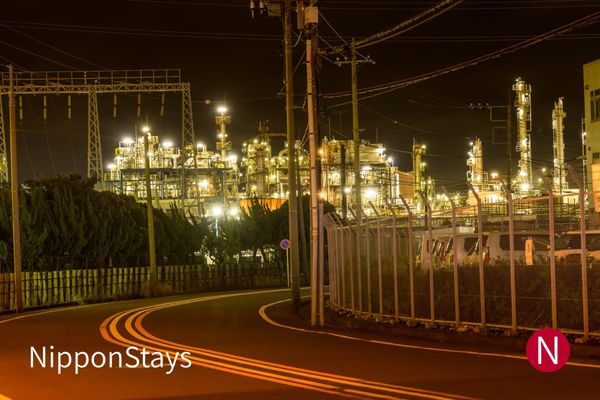
The Keihin Industrial Zone on Kawasaki's waterfront is a surprisingly popular draw. At night, lit-up petrochemical plants and factory complexes line the canals and create an industrial landscape that is genuinely photogenic. Tours run by boat (yakatabune) and by bus are the standard way to see it—much of the waterfront is off-limits to individuals, and there is no public viewpoint that matches what the boat routes cover.
Key facts for planning:
- Boat tours typically run on weekends; advance booking is required and popular dates sell out weeks ahead.
- The meeting point for many boat tour operators is Kawasaki Nikko Hotel, a 1-min walk from JR Kawasaki Station's Central-East Exit. A transfer bus takes participants to the embarkation dock.
- Bus tours depart from various meeting points; check individual operators for current schedules as these change seasonally.
- Tours often end late in the evening. A hotel near the Central-East Exit means a short walk back after.
For a full hotel list oriented around tour logistics, see factory night-view tour bases.
Kawasaki vs Yokohama vs central Tokyo as a base
If you are comparing these three options side by side:
| Name | Area | Price range | Best for |
|---|---|---|---|
| Kawasaki | Between Tokyo and Yokohama | from ¥6,000 (rates vary by season) | Lowest rates, Haneda access, factory tours |
| Yokohama | Yokohama Station / Kannai / Minato Mirai | from ¥9,000 (rates vary by season) | Sightseeing in Yokohama, harbor atmosphere |
| Central Tokyo | Shinjuku / Akihabara / Ueno | from ¥12,000 (rates vary by season) | Maximum proximity to Tokyo sights |
Yokohama is worth the extra cost if your trip gives real time to Chinatown, Minato Mirai, or Yamashita Park—the city earns its room rate. See our Yokohama area guide for neighborhood breakdowns. For a direct comparison of both, Kawasaki vs Yokohama maps the trade-offs by trip type.
Central Tokyo makes everything easier if your budget can absorb ¥12,000+ a night. Kawasaki's case rests on low rates plus workable access—it makes that case consistently, but it makes no other case.
Is Kawasaki right for your trip? Quick decision checklist
Base in Kawasaki if you tick at least two of these:
- You have a Haneda flight before 9 am or after 10 pm
- You are splitting several nights between Tokyo and Yokohama sightseeing and want the geographic midpoint
- Your nightly hotel budget is under ¥10,000 and a chain business hotel suits your needs
- You are on a factory night-view tour and want to walk back to the hotel afterward
Look elsewhere if:
- You want the hotel to be part of the Japan experience—character-led options here are limited
- Your schedule is anchored to Yokohama (Minato Mirai, Chinatown)—base in Yokohama
- One fewer train stop in the morning would meaningfully change your day—pay for central Tokyo
Next steps: hotels closest to Kawasaki Station by exit and walk time; budget hotels in Kawasaki under the ¥8,000 ceiling; and bases for a Haneda flight ranked by proximity to the Keikyu platform.
Trip Essentials for Kawasaki
Things worth booking before you land, all in English:
- eSIM — Airalo's Japan eSIM: install it at home and data works as soon as you switch off airplane mode at Haneda.
- Airport transfer — Welcome Pickups runs fixed-price door-to-door pickups from Haneda; Klook sells the airport bus and train tickets if you'd rather ride.
- Tickets and day trips — Klook covers Tokyo and Yokohama attraction tickets; booking ahead skips the ticket-window line.
FAQ: Is Kawasaki a good place to stay?
How far is Kawasaki from central Tokyo?
JR Kawasaki Station to Tokyo Station is about 18 minutes by JR Tokaido Line for ¥350. Shinagawa — a major interchange and Shinkansen stop — is about 10 minutes for ¥260. Shibuya and Shinjuku add a transfer at Shinagawa or Osaki, making the total journey about 25–30 minutes. The connection is workable for a Tokyo-based itinerary, though you spend a few extra minutes each way compared to staying in central Tokyo.
Is Kawasaki convenient for Haneda Airport?
Kawasaki is one of the most Haneda-convenient bases in the corridor. From Keikyu Kawasaki Station, the Keikyu Airport Line runs to Haneda Airport Terminal 1 and 2 in about 15–20 minutes for ¥410, with departures roughly every 10–15 minutes during the day. The Keikyu EX Inn sits inside the Keikyu station building, making it the closest hotel to the airport platform in Kawasaki — under 2 minutes from the front desk to the platform.
Are Kawasaki hotels cheaper than Tokyo or Yokohama?
On a mid-week night, comparable JR chain business hotels in Kawasaki typically run ¥3,000–¥5,000 less than similar properties in Shinjuku or Yokohama's Nishi-ku. Budget options start from ¥6,000 at Sotetsu Fresa Inn and Keikyu EX Inn. Mid-range options with extras like a natural hot-spring bath (Dormy Inn) start from ¥9,000. The saving is real but depends on your dates — on weekends, business hotels in Kawasaki may drop further while leisure-area hotels hold their price.
What is there to do in Kawasaki?
Kawasaki itself is not a major sightseeing destination, but it has one genuinely unusual draw: factory night-view tours of the Keihin Industrial Zone. Boat tours run by yakatabune and bus tours visit the lit-up petrochemical plants along the waterfront canals — a surprisingly photogenic industrial landscape. Advance booking is required and popular weekend dates sell out weeks ahead. The meeting point for many boat tours is Kawasaki Nikko Hotel, a 1-min walk from JR Kawasaki Station's Central-East Exit.
Information audit: Last fact-checked July 2026 · Prices checked July 2026 (all rates are “from” floors that vary by season) · How this guide was researched: hotel facilities, prices and access details are verified against official and primary sources; we have not personally stayed at every property listed. The author commuted to work in Yokohama, next door, for many years · How this site verifies information: About NipponStays.